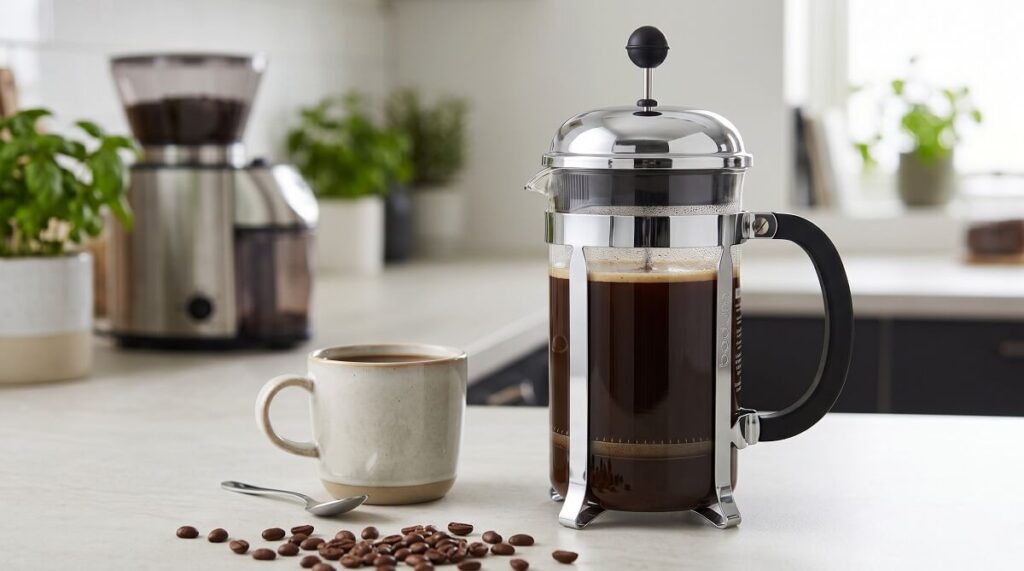
French press coffee makers have flooded the market over the past decade, and Bodum’s Chambord stands as one of the most recognized names. Here’s the thing though: Not all French presses deliver the same results. After analyzing hundreds of real owner reviews across multiple platforms, the Bodum Chambord consistently earns praise for rich, full-bodied coffee and surprisingly durable construction—but it’s not perfect for everyone.
Why Coffee Lovers Choose the Bodum Chambord
The Bodum Chambord delivers superior coffee quality compared to drip machines, according to verified purchasers. W. Warshauer, a verified Amazon buyer, explains the advantage: “Coffee has a lot of natural oils in it that carry a lot of flavor. Using a paper filter traps those oils, so they never get expressed in the cup. The french press method produces a coffee that is much richer and fuller in body than any drip coffee I have ever had.”
Multiple reviewers mention abandoning their automatic drip coffee makers permanently after trying the Chambord. ChristineMM, who purchased the 32-ounce model in 2011, was “shocked at the superior taste of the coffee made with the same pre-ground beans from this coffee press. There was no bitterness!” She notes that her favorite coffees, which she’d been drinking for over two years in a drip machine, tasted dramatically better through the French press.
The simplicity of the brewing process appeals to both beginners and experienced coffee enthusiasts. According to Bodum’s official product page, the Chambord uses heat-resistant borosilicate glass that won’t alter or impair coffee’s natural flavor, paired with a stainless steel filter system that allows essential oils to pass through while keeping grounds out of the cup.
What Real Owners Say About Coffee Quality
Verified purchasers consistently describe the Chambord’s coffee as richer, smoother, and more complex than drip-brewed alternatives. Bryan, who reviewed the 12-ounce chrome model in August 2025, notes that French press coffee is “usually consistent and end up being less frustrating in the long run compared to pour-overs.” He recommends sticking with darker or medium roasts “since you’re aiming for full-bodied cups which contain more oils and fines.”
The lack of paper filters emerges as a recurring theme in positive reviews. Edgar g, reviewing the 34-ounce polished model, appreciates that “paper filters are also not necessary, which makes one less thing to worry about. The cups are great to drink with its high temperature and full-bodied flavor.”
Temperature retention receives mixed feedback. Several reviewers note the coffee stays hot enough during the 4-minute brewing process, but some wish for better insulation. Amazon Customer, who owns the 12-ounce chrome version, solves this by preheating the press with hot tap water before brewing. W. Warshauer mentions that “the coffee is still hot when I’m ready to pour into the cup, but it would still be nice” to have thermal insulation, adding that Bodum does make thermal French presses at higher price points.
Regarding coffee grounds in the finished cup, opinions vary based on grinder quality. W. Warshauer emphasizes: “Don’t skimp on the grinder. Toss your whirly-blade away and get yourself a burr grinder.” He explains that blade grinders produce “a lot of dust and coffee boulders; neither are very good for coffee brewing,” while burr grinders deliver consistent particle size. With a quality grinder, “the amount of grinds in the cup will be exceptionally minimal.”
Build Quality and Durability: The Truth
The Chambord’s construction earns consistent praise for longevity, with many owners using the same unit for years or even decades. Tim, who purchased the 8-cup model in 2004, notes: “The way the plunger assembly goes together is simple and can be assembled easily by hand.” He describes the metal-banded handle assembly as “sturdy and polished,” with a “very hard plastic” handle that’s “comfortable to grip and hold.”
Anonomous, who received multiple Bodum French presses as gifts in 2005, still uses the glass Chambord model despite owning stainless steel alternatives. The reviewer chose the glass version as a favorite because “you can see how the coffee is brewing (color) during the 4 minute brew process” and appreciates its “clarity and delicacy.”
The glass beaker represents the primary vulnerability. ChristineMM purchased the Chambord specifically because “the glass beaker is a separate piece” unlike Bodum’s Brazil model, which has plastic fused to the glass. This modular design means “replacement glass pieces are sold separately in case mine breaks.” According to Bodum’s website, replacement beakers are readily available and affordable.
Mitchell B., who has used the 34-ounce model since 2016, highlights the dishwasher-friendly design: “Did I mention its dishwasher friendly?” The reviewer also mentions parents who have owned their Bodum for “nearly 15 years,” demonstrating the product’s potential lifespan.
Several reviewers address concerns about metal quality. Tim clarifies: “One complaint was that the metal was flimsy and bends easily. I’m not sure what that person was doing with their coffee press. Mine doesn’t bend at all with NORMAL use.” The stainless steel frame undergoes chrome-plating processes to create what Tim describes as “a durable, shiny surface capable of withstanding many years of use.”
Size Options: Finding Your Perfect Fit
The Chambord comes in multiple sizes, and choosing correctly matters. According to Coffeeness’s 2026 Bodum French Press guide, the Chambord is available in 4-cup (17 oz), 8-cup (34 oz), and 12-cup (51 oz) models, with prices ranging from $36.99 to $49.99.
W. Warshauer explains that the 3-cup (12 oz) model “will make about 8-10 oz of brewed coffee. You can’t quite get all 12oz of water in with the grounds, and some of the water gets soaked up in to the grounds.” This size proves “perfect for me, since I only drink one cup-a-day, but if you drink more, go for a bigger model.”
Cpn Rick, who reviewed in 2014, went through a sizing journey: “I bought the 12 cupper was too big for one. Then I bought the 12 oz 3 cupper….too small. Filled to capacity, didn’t fill a 10 oz cup, no less the 14 oz mug I prefer.” He settled on the 4-cup (17 oz) model: “Quality brew and I get the 14 oz cupful I like.”
Kathryn, who received the 8-cup chrome model as a Christmas gift, notes it’s “labeled as an 8 cup carafe, but whenever we fill it to the top, we end up with two large mugs.” She clarifies that Bodum uses the standard coffee measurement of 4 oz per cup, not the 8-12 oz servings many people now drink.
For households with multiple coffee drinkers or entertaining guests, the larger 12-cup model makes sense. David Enochs, reviewing the 34-ounce polished model in December 2025, confirms: “Plenty of coffee for both my husband and I to have our morning cup.”
Common Complaints and Limitations
The glass beaker’s fragility tops the list of concerns. JRM, who bought the 12-ounce chrome version in 2023, notes the glass “to be a bit thinner than the larger version” and found the box “a bit messed up as if it was used” with an Amazon sticker indicating the product “got a second life.” However, the French press itself arrived “in perfect condition.”
ChristineMM points out a practical issue: “The manufacturer has legal warnings in two languages which fill over two inches of space on it so it is clear that Bodum wasn’t leaving markings off to have a clean design look.” The lack of volume markings on the glass means users must measure water separately if they want precise ratios.
Cleaning requires more effort than disposable paper filters. Mountain Miss, who switched from drip coffee in 2012, acknowledges: “The press is harder to clean than rinsing a filter, but not by much. I wash it by hand after every brew, and it only takes a minute.” She specifically avoids the dishwasher “because the glass isn’t all that thick.”
YngwieDonut, reviewing in 2014, warns against common mistakes: “Stir your coffee before the 4 min brew/steep with a wooden chopstick. I watched Alton Brown use a metal spoon and I actually yelled at my television. You will break the glass.” The reviewer also advises: “Do not quickly mash the press down like all my waiters do. Slow, easy, and consistent to filter the grinds and to forgo the hot coffee volcano.”
Some owners wish for better heat retention. Crazy in Mississippi, who purchased in 2010, notes: “It is, in fact, true that your coffee press IS GOVERNED BY THE LAWS OF PHYSICS. Your coffee will DEFINTELY cool after you make it.” The reviewer makes coffee in advance, refrigerates it, and reheats it by the glass—a practice that “coffee snobs shudder” at but works for their preferences.
Who Should Buy the Bodum Chambord
The Bodum Chambord suits single coffee drinkers and couples who prioritize coffee quality over convenience. Tim’s assessment from 2004 still rings true: “Great investment in better coffee drinking and piece of mind. I also like the ability to get spare parts if I should ever need them.”
First-time French press buyers benefit from the Chambord’s reputation and parts availability. Mitchell B. emphasizes this advantage: “Unlike comparable French presses, Bodum uses high quality glass, steel and hard plastics for their product. This means that you’ll be enjoying your press for years to come long after others would have broken.”
Coffee enthusiasts ready to invest in proper equipment will get the most from the Chambord. W. Warshauer recommends pairing it with a burr grinder (minimum $60, though entry-level models like the Bodum Antiqua work) and fresh-roasted beans. The reviewer notes: “You’ll probably want to spend no less than 60. I’ve heard good things about the antiqua from bodum, the infinity from capresso and pretty much anything in the baratza line-up.”
Budget-conscious buyers appreciate the value proposition. ChristineMM, who paid significantly less than typical drip coffee makers, writes: “This cost me less than half what a drip coffeemaker costs and much less than those one-cup coffee makers. I’m happy with the low cost. As I said earlier if the glass beaker breaks I can buy a replacement for a low price.”
The Chambord works particularly well for travelers and campers. ChristineMM notes: “Since this uses no electricity and is small I am taking it with me when camping. I am thrilled to be able to have great tasting coffee while camping or staying in cabins without electricity but with access to open fire or portable camping stoves which can be used to boil the water.”
However, those who need maximum convenience or heat retention might prefer thermal models. Am T, who purchased in 2010, summarizes the trade-off: “A few extra steps to get delicious coffee and a little more cleanup: I love fresh ground coffee so I don’t mind the extra steps.” The reviewer lists the process: “1. boil water 2. grind coffee (coarse ground) 3. brew, and be gentle when pressing 4. cleanup is taking apart the mesh/strainer and washing it 5. enjoy your coffee!”
Leguminator, who returned to Bodum after nine years with an off-brand stainless press, captures the ownership experience: “I forgot what it’s like to not have grounds in my coffee, how easy it is to plunge and it looks fantastic on my table. In my opinion, Bodum is the way to go.”