It’s mid-January in Dearborn. The furnace is running 24/7, outdoor temps are hovering around 15°F, and the indoor humidity in my 1950s brick house has dropped to 20%. My sinuses feel like sandpaper, the wood floors are creaking more than usual, and I just got a static shock touching the doorknob that could’ve lit a match. This is the problem every Michigander faces in winter: bone-dry air that makes everything miserable.
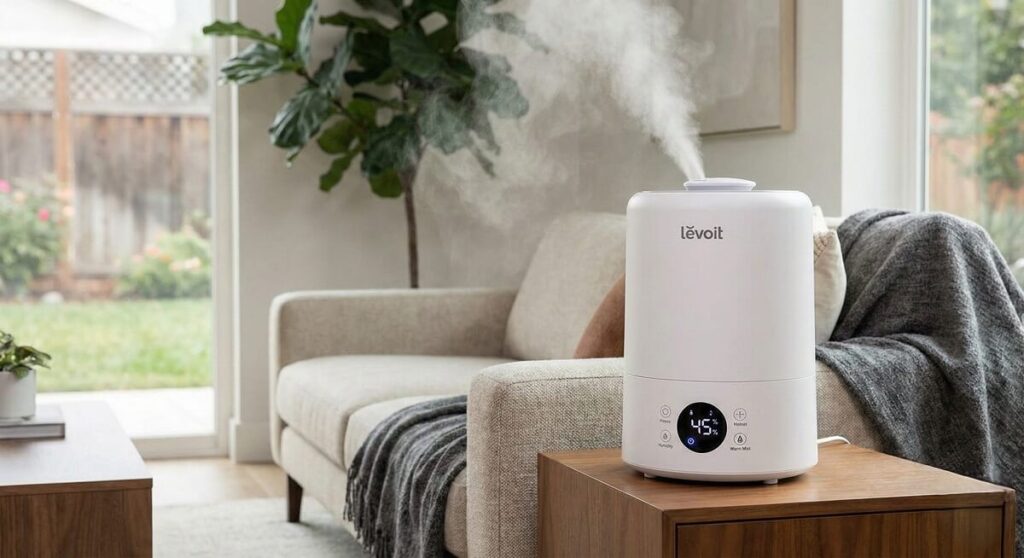
Enter the Levoit LV600HH Hybrid Ultrasonic Humidifier—a unit that promises to humidify up to 753 square feet with both warm and cool mist options. But does it actually work, or is it just another appliance that sprays water into the air while creating more problems than it solves?
Spoiler: It works exceptionally well. But there are some real gotchas around the humidity sensor, cleaning requirements, and the hidden cost of distilled water that we need to talk about.
The Bottom Line
The Levoit LV600HH is one of the best-performing humidifiers you can buy for medium to large rooms, delivering powerful humidification, genuinely quiet operation, and thoughtful design features. According to TechGearLab’s testing, this unit brought a test room to ideal 45% humidity in just half an hour and reached peak humidity levels of 68%—that’s serious humidification power.
Here’s what you’re getting for around $90-100: a 1.6-gallon (6-liter) dual mist humidifier rated for up to 753 square feet, up to 36 hours of runtime on low settings, warm and cool mist options, a remote control, and operating noise levels under 40 dB in sleep mode. The humidification output reaches 500mL per hour, which is strong enough to combat even Michigan’s brutal dry winters.
The catches? The built-in humidistat reads 10-17% higher than actual room humidity, making auto mode frustrating to use. Cleaning is significantly more involved than simpler humidifiers due to multiple components. And if you use tap water instead of distilled, you’ll deal with white mineral dust coating everything and frequent deep cleaning to prevent mineral buildup and mold.
But if you’re dealing with dry winter air, nosebleeds, cracked skin, static electricity nightmares, or hardwood floors that are shrinking from low humidity, this thing will make a dramatic, noticeable difference. Users consistently report transformative results—better sleep, fewer sinus infections, relief from dry skin, and humidity levels that actually protect wood furniture and musical instruments.
What I Like: Real-World Performance
Let’s start with what matters most: does it actually add moisture to the air effectively? Absolutely yes.
User John Pappas runs this unit in his condo apartment and reports it keeps the space at a comfortable 40-45% humidity range consistently. He notes the unit works “extremely well,” though he had to use the VeSync app to fine-tune the target to 43% since the device controls only allow 5% increments. Multiple users report similar experiences—the LV600HH genuinely raises humidity levels and maintains them, unlike cheaper units that seem to just blow mist without measurable impact.
Julie’s family has been using theirs for three full winter seasons with excellent results. They purchased a second unit for their son’s room and a smaller Levoit for their daughter’s room after seeing how well the first one performed. This is the kind of repeat purchase behavior that signals genuine satisfaction.
The quiet operation is no joke. According to Baby Gear Lab’s testing, the LV600HH operates at under 40 dB in sleep mode and earned a 9.0/10 noise score. User SundayAtDusk describes it as making barely any noise, and John Pappas specifically notes the Levoit is quieter than his Dreo humidifier and “would not disturb anyone even if it’s at your bedside.” When you’re trying to sleep with dry sinuses, that silent operation while humidifying the air is invaluable.
The dual mist option—warm and cool—is genuinely useful. The warm mist doesn’t significantly raise room temperature, but according to Nerd Techy’s analysis, warm mist humidifies a room up to 25% faster than cool mist. User SundayAtDusk tested warm mist on the second heat setting during one cold night but found cool mist worked better overall, which matches what most users report—cool mist for daily use, warm mist when you need faster results or prefer the comfort of warm vapor.
The 1.6-gallon tank capacity is substantial. On the lowest mist level, John Pappas reports filling it at least once daily, which aligns with the advertised 36-hour runtime on low settings. Steve in STL notes that in his oversized 1,700 square foot open space with 17-foot ceilings (far exceeding the 753 square foot rating), the unit runs constantly but still does “a great job raising the humidity level from approximately 20% to 50%+/-.” That’s impressive performance even when significantly outmatched.
The remote control is a small but meaningful convenience. You can adjust mist levels, humidity targets, and timers from across the room without getting out of bed. It’s one of those features you don’t think you need until you have it, then you miss it on every other humidifier.
Ease of filling gets consistent praise. The tank lifts off easily with a built-in handle, and the 3.25-inch wide opening (verified by TechGearLab) lets you get your hand inside to clean. SundayAtDusk notes it’s “easy to fill,” though cautions it’s “very heavy when filled,” which is expected with 1.6 gallons of water weighing about 13 pounds.
Where It Falls Short
Here’s the thing though—the built-in humidity sensor is problematic. Multiple users report it reads significantly higher than actual room humidity. John Pappas notes his standalone humidity monitors read 45% while the Levoit thinks it’s satisfied at much lower actual humidity, requiring him to set the target to 43% via the app to achieve real-world 40% humidity. David J. Morgan provides detailed analysis: to get 45% actual humidity in his room, he runs the unit at a 55% setting. When the air gets really dry and the unit hasn’t run in a while, the sensor can read “ridiculously high—like it’ll say it’s 65% in the room when it’s really 30%.”
The problem stems from sensor placement and how it interacts with the unit’s own mist output. Pamela Whitney’s photo comparison shows the Levoit reading 30 percentage points higher than a separate portable hygrometer just 5 feet away. The sensor is at the back of the unit near the air intake, and it gets fooled by the mist coming from the unit itself until that moisture dissipates into the broader room. This causes the unit to cycle on and off frequently, thinking it’s achieved the target humidity when the rest of the room is still dry.
The solution? Either use a separate hygrometer and adjust your target humidity upward by 10-15%, or elevate the unit to table height (as the manual recommends but most people ignore) so the sensor isn’t sitting in a pocket of its own mist. Jim specifically notes placing his unit on a table solved the auto-shutoff problems he was experiencing with it on the floor.
Cleaning is significantly more involved than simpler evaporative humidifiers. The unit disassembles into roughly a dozen pieces—tank, base, mist nozzles, water channel, heating element chamber, and various gaskets. James S includes a photo showing all the components spread out, and he describes cleaning as “a nightmare” with “bends, slits, and crevices that you can’t get a cloth or a sponge into.” He recommends watching an online video before attempting to disassemble it the first time.
Shelley Boberg offers a counterpoint, noting that while cleaning requires effort, the unit is designed to be fully accessible: “I was able to clean every single nook and cranny of this machine!!” She can get her hand into the reservoir and break down all components, which she prefers over units with sealed sections that accumulate hidden gunk. Using humidifier drops (6 drops per gallon of tap water) and purchasing Levoit’s mineral absorption pads significantly reduced her cleaning frequency.
The white dust issue is real and unavoidable if you use tap water. This is true of all ultrasonic humidifiers, not unique to Levoit, but it bears emphasizing. Terry S reports white powder collecting on nearby surfaces that requires wiping down, and an air purifier next to the unit coats with white dust. Buyer of Products ran two units with well water (rated 6/10 for calcium—just above “perfect”) and reports furniture and walls needed cleaning of white powder residue about once a month. After fighting calcium buildup that became “harder and harder to get out” over time, they stopped recommending the unit for anyone with any calcium in their water.
The warm mist feature uses more power and generates a slight bubbling sound. SundayAtDusk notes warm mist is “slightly louder and less energy-efficient” than cool mist. The heating element also requires additional cleaning attention to prevent mineral scale buildup.
Auto-off when the tank empties works reliably, but there’s a quirk: when it’s out of water and the display is off, you can’t interact with the controls at all until you refill and replace the tank. Seems obvious in retrospect, but it’s mildly annoying if you’re troubleshooting and don’t realize the tank just ran dry.
Performance & Ease of Use
Humidification Power
According to TechGearLab’s testing, the LV600HH earned the top humidifying performance score (9.0/10), bringing a room to ideal 45% humidity in just 30 minutes and reaching peak levels of 68%. Nerd Techy confirms the unit reaches 45% humidity in under 30 minutes with accuracy within 1-2 percentage points (though this conflicts with user reports of sensor inaccuracy—likely tested with the unit properly elevated).
Real-world user data backs this up. Steve in STL runs his unit in a challenging 1,700 square foot open space—more than double the rated 753 square feet—and still achieves 50% humidity starting from 20%. That’s the kind of output that handles Michigan basements, old houses with poor insulation, and oversized rooms.
The 500mL per hour mist output is among the higher rates in this category. For context, that’s enough to add over a gallon of moisture to your air every 8 hours on maximum settings.
Noise Levels
Baby Gear Lab measured under 40 dB in sleep mode, earning a 9.0/10 noise score. For reference, 40 dB is quieter than a library, roughly equivalent to a whisper. John Pappas specifically bought this over other options because his Dreo humidifier at 43% was “annoying loud” while the Levoit wouldn’t disturb bedside sleep.
At higher mist settings, there’s a gentle bubbling sound from the ultrasonic mechanism, but users consistently describe it as pleasant white noise rather than disruptive mechanical grinding.
Controls & Usability
The front menu screen is “very useful and easy,” according to SundayAtDusk, with clear indicators for humidity level, mist output, timer settings, and water level. The three mist speeds plus warm/cool selection plus auto mode give you plenty of control without overwhelming complexity.
The remote works well and includes all the main functions—mist level, humidity target, timer, warm/cool selection. Several users mention this as a standout feature compared to competitors that require you to walk over and manually adjust settings.
One minor annoyance: the unit cycles a fair amount when using auto mode due to the humidity sensor issues discussed earlier. David J. Morgan notes “it’s mildly annoying but not fatal” since it still maintains humidity in the target range, just with more on/off cycling than ideal.
The Tap Water vs Distilled Water Reality
This is the hidden cost nobody talks about enough, and it dramatically affects the total cost of ownership.
Levoit officially recommends distilled water. So does every ultrasonic humidifier manufacturer. But let’s do the math on what that actually means:
At half a gallon per day usage (John Pappas’ moderate usage pattern), you’re going through 3.5 gallons per week, or roughly 182 gallons over a typical Michigan winter heating season (mid-November through March). At $1.24 per gallon (Walmart pricing), that’s **$226 annually just for water**. That’s more than double the cost of the humidifier itself.
Julie’s family uses distilled water exclusively across three Levoit units and reports the units “stay super clean throughout the winter” with minimal cleaning needed. When they switched to RO (reverse osmosis) water from their home filtration system, performance remained excellent with “very little need for cleaning during winter months.”
The alternative? Tap water works, but it comes with tradeoffs:
Buyer of Products tried tap water with well water rated 6/10 for calcium. Result: white powder on furniture and walls requiring monthly cleaning, calcium buildup in the unit that became progressively harder to remove, and they ultimately stopped recommending the unit to anyone without mineral-free water. After two winter seasons, they gave up and note “if you have any calcium in your water, we DO NOT recommend this unit.”
Terry S uses tap water and reports white dust collecting on an air purifier next to the humidifier and on the floor, requiring regular wiping. The pink bacterial film formed even when using distilled water during the first week, suggesting you can’t completely avoid cleaning regardless of water choice.
David J. Morgan initially tried tap water (fairly soft, high mineral content) and saw no obvious deposits or performance issues in three months of steady winter usage. However, his update one year later is stark: “DON’T DO IT. At the end of a season, I had a film on walls, windows, everywhere. And the unit needed a heck of a cleaning.” He solved the problem by purchasing a Vevor water distiller for under $100, which he notes is “paying for itself as we speak.”
**Ryan’s take:** If you’re a regular user, either budget $200-250 annually for distilled water, invest $100-150 in a countertop water distiller, or accept that you’ll spend significant time cleaning both the unit and your living space. There’s no free lunch with ultrasonic humidifiers.
Who Should Buy This
Dry climate and winter sufferers: If you’re in Michigan, Colorado, Arizona, or anywhere humidity regularly drops below 30% in winter, this delivers the moisture output you need. Steve in STL raised his space from 20% to 50% humidity. Users report relief from sinus infections, nosebleeds, dry skin, and static electricity.
People protecting wood investments: Hardwood floors, wood furniture, and musical instruments need 40-50% humidity to avoid cracking and warping. David J. Morgan bought this specifically to protect his solid wood acoustic guitar, and it does the job. The unit can maintain stable humidity critical for preserving wood.
Quiet sleepers: The under-40 dB sleep mode is genuinely bedroom-friendly. If you’ve avoided humidifiers because of noise, this changes that calculation.
Medium to large room coverage: The 753 square foot rating is realistic. Users report good performance in primary bedrooms, living rooms, and even oversized spaces when run continuously.
People willing to maintain equipment: If you don’t mind weekly cleaning routines and either buying distilled water or dealing with mineral buildup, the performance justifies the maintenance. Julie has run hers for three winter seasons successfully with proper care.
Those who want control options: Warm/cool mist, multiple speed settings, auto mode, sleep mode, timer, remote control—this has more adjustability than most competitors. If you like fine-tuning your environment, you’ll appreciate the options.
Who Should Skip This
If you want true set-and-forget automation: The humidity sensor inaccuracy means you’ll need to monitor actual room humidity with a separate meter and adjust targets manually. Auto mode doesn’t work well enough to trust blindly.
If you hate cleaning appliances: This requires regular, somewhat involved cleaning. Buyer of Products describes it as having “no way to really clean except by unscrewing things and taking them all apart.” If you want a low-maintenance humidifier, look at evaporative wick models instead.
If you have very hard tap water and refuse to buy distilled: The white dust and mineral buildup will drive you crazy. Buyer of Products explicitly recommends against this unit for anyone with calcium in their water unless you’re committed to distilled water.
If you need smart home integration: This is the LV600HH (remote control model). If you want WiFi, app control, and voice assistant integration, you want the LV600S instead. They’re similarly priced but the S model adds smart features.
If you need top-fill convenience: The LV600HH requires removing the tank and flipping it upside down to fill. The newer LV600S offers top-fill, which is significantly more convenient. If mobility or strength is a concern (that 13-pound filled tank is heavy), the top-fill model is worth considering.
Very small spaces under 200 square feet: This is overkill for tiny bedrooms or offices. You’ll be refilling constantly on low settings or dealing with over-humidification. Look at the Levoit Classic 200 or similar smaller units instead.
FAQ
- How often do I really need to clean this thing?
- It depends on your water source. With distilled or RO water, users report cleaning every 1-2 weeks with deep cleans monthly. With tap water, you’ll see pink bacterial film and mineral deposits within a week, requiring more frequent attention. Shelley Boberg’s routine: rinse weekly, wipe all surfaces with water and vinegar solution weekly, deep clean monthly. Plan for 15-20 minutes of cleaning time per session, not including vinegar soak time for mineral removal.
- Is the warm mist actually useful or just a gimmick?
- According to Nerd Techy, warm mist humidifies up to 25% faster than cool mist, which is meaningful when you need to raise humidity quickly. However, most users find cool mist sufficient for daily use and prefer it due to lower energy consumption and quieter operation. SundayAtDusk notes warm mist “didn’t seem to make any difference to room temperature” and worked less well than cool mist in their experience. Use warm mist when you want faster results or prefer the comfort of warm vapor; stick with cool mist for overnight operation.
- Why does everyone say the humidity reading is wrong?
- The humidity sensor is located at the rear air intake of the unit, and it gets fooled by the mist output from the unit itself before that moisture disperses throughout the room. Pamela Whitney’s testing shows the Levoit reading 30% higher than a separate hygrometer 5 feet away. David J. Morgan confirms needing to set the target 10-15% higher than desired actual humidity. The solution: use a separate hygrometer to monitor real room humidity and adjust your target settings accordingly, or elevate the unit to table height as the manual recommends.
- How much does it actually cost to run per month?
- TechGearLab estimates operating cost around $159 over the unit’s lifetime. Power consumption is minimal (under 40W even on high settings). The real cost is water—if using distilled water at moderate usage (half gallon daily), expect $15-20 monthly during winter. That’s $90-120 per heating season just for water, far exceeding electricity costs. This is why several users invest in countertop water distillers.
- Can I use essential oils in this?
- Yes, there’s a dedicated aroma box for essential oils. However, several users caution against it. Essential oils can degrade plastic components over time and complicate cleaning. If you want both humidification and aromatherapy, many users recommend running a separate essential oil diffuser rather than using the aroma function.
- What’s the difference between the LV600HH and LV600S?
- The LV600S is the smart model with WiFi connectivity, VeSync app control, voice assistant integration, and top-fill design. The LV600HH (this model) has a remote control but no smart features and requires removing/flipping the tank to fill. Tank capacity is similar (1.6 gallons for HH, 1.5 gallons for S). The S also includes a water filter sponge while the HH is filterless. Coverage area is higher on the S model (up to 753 sq ft vs 430 sq ft for the HH according to some sources, though this conflicts with other specifications listing both at 753 sq ft). If you don’t need smart home integration and prefer a remote, the HH saves money. If you want app control and top-fill convenience, get the S.
- How long does a full tank actually last?
- Highly variable based on mist level and room conditions. Levoit claims up to 36 hours on the lowest setting. Real-world reports: John Pappas fills once daily on low settings. In very dry conditions (20% starting humidity) running on high, expect 12-15 hours. In moderate conditions on medium settings, 20-24 hours is typical. The 1.6-gallon capacity is substantial, but when you’re humidifying 500+ square feet of dry winter air, you’ll go through it faster than you expect.
- Does it automatically shut off when empty?
- Yes, it has reliable auto-shutoff when the water level gets too low. Multiple users confirm this works consistently. SundayAtDusk notes “there is very little water left in the tank” when it shuts off, meaning it uses nearly all the water before stopping.
- Is this good for a baby’s room?
- Baby Gear Lab tested it specifically for nursery use and gave it a 75/100 overall score, ranking it #1 of 9 tested humidifiers. The quiet operation (9.0/10 noise score) makes it excellent for sleep environments. However, the ease of cleaning score was only 6.0/10, and you need to stay on top of maintenance to prevent mold and bacteria growth. If you choose this for a nursery, commit to weekly cleaning with distilled water for safety.