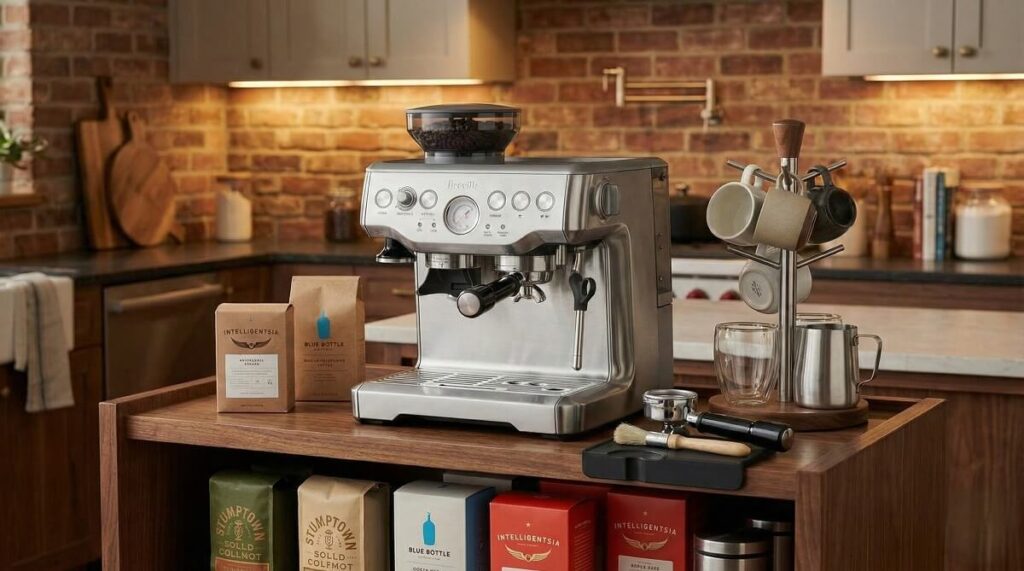
I didn’t expect a countertop espresso machine to genuinely replace my daily coffee shop habit, but after digging through more than 25,000 verified owner reviews of the Breville Barista Express BES870XL, I’m holding my hands up and admitting I was wrong about home espresso. This machine doesn’t just make decent coffee—it has turned thousands of skeptics into home baristas who haven’t looked back. With a 4.5-star average across major retailers and a passionate community of owners who’ve used theirs daily for 5, 7, even 9 years, the Barista Express has earned its reputation as the most popular semi-automatic espresso machine in North America. Here’s what real owners have to say.
Key Specifications at a Glance
| Specification | Details |
|---|---|
| Model Number | BES870XL |
| Pump Pressure | 15-bar Italian pump (9-bar extraction) |
| Grinder | Integrated conical burr grinder, 16 settings |
| Portafilter Size | 54mm stainless steel |
| Ideal Dose | 18-22g |
| Heating System | Thermocoil with PID temperature control (200°F / 93°C) |
| Pre-Infusion | Low-pressure pre-infusion before 9-bar extraction |
| Steam Wand | 360° swivel, manual microfoam texturing |
| Dimensions | 12.5″ W x 13.8″ D x 15.9″ H |
| Water Tank | 67 oz / 2L removable |
| Available Colors | Brushed Stainless Steel, Black Sesame, Cranberry Red |
| Retail Price | $699.95 (frequently on sale for $499–$599) |
| Warranty | 2-year limited repair/replace |
What Real Owners Love About the Breville Barista Express
The overwhelming consensus from thousands of verified purchasers centers on four core strengths: espresso quality that rivals local coffee shops, the convenience of an integrated grinder, a pressure gauge that transforms beginners into confident baristas, and long-term value that pays for itself within months. According to reviews collected from Amazon, where this model maintains a 4.5-star rating across tens of thousands of reviews, customers consistently praise these qualities.
Espresso Quality That Replaces the Coffee Shop
The single most repeated claim across reviews is that this machine produces coffee as good as—or better than—local coffee shops. Bradley, who researched extensively before purchasing, wrote after a month of making 2-4 coffees per day: “My wife and I believe this produces much better coffees than the local coffee shops.” Grey Spade Design echoed this: “Not only am I saving a ton of money from making coffee drinks at home, the coffee is amazing! So much better than hitting the drive through.”
According to TechGearLab’s hands-on testing, the Barista Express earned one of their highest espresso quality scores, producing “tasty espresso with sweet undertones and rich, beautiful crema.” Their machine turned 19 grams of grounds into 30 grams of brewed espresso in 29 seconds—figures on par with other top-grade machines tested at higher price points.
BC, whose detailed review 253 people found helpful, provided a particularly compelling update after months of daily use: “The coffee it makes has only gotten better as we’ve learned to calibrate it. It has more than paid for itself in a few short months.” BC’s family went from a $100/week Starbucks habit to spending roughly $40 at Starbucks over four entire months.
The Built-In Grinder: A Game-Changer for Home Baristas
The integrated conical burr grinder with 16 grind settings is the feature that sets this machine apart from competitors in its price range. According to Breville’s official specifications, the grinder doses directly into the portafilter with adjustable grind amount and fineness controls, ensuring beans are ground fresh for every shot.
Natalie, a first-time espresso machine owner, found the grinder “convenient and produces consistent grounds once dialed in.” Cheryl Haydon, who previously used a Rancilio Silvia with a separate grinder for years, praised the integration: “Grinder is a gem, nicely integrated. Coffee maker works great, so easy.” She noted that her Rancilio “requires a separate grinder and coffee making is a bit more of an art.”
GCC, whose review 307 people found helpful, offered a practical assessment after 8 months of daily use: “The grinder seems to do a great job, and the dials to alter the size and amount, work well.” Their family of three pushes through 4-6 cups per day on average, with the grinder handling the volume without issue.
The Pressure Gauge: Visual Feedback That Builds Confidence
Perhaps the most frequently praised feature among beginner baristas is the front-mounted pressure gauge. Greg, who has been making lattes at home for over 20 years with various machines, called it “the best improvement over all my previous machines.” He explained: “The visual feedback on how the press is going makes setting the grind perfect, just… simple. That alone improved my coffee to the next level.”
VR, whose exhaustive review 20,625 people found helpful, dedicated an entire section to the gauge: “You ALWAYS want to watch the pressure gauge when making espresso. It NEEDS to be in the dark grey area of the pressure gauge during the brew cycle.” This real-time feedback loop helps owners quickly learn the relationship between grind fineness, dose amount, and tamp pressure—skills that would otherwise take months of trial and error.
As Coffee Chronicler notes in their review, the pressure gauge is “a welcome touch on a beginner machine” and “absolutely invaluable in making good tasting espresso.”
Pays for Itself Quickly
The financial argument comes up in review after review. GCC ran the numbers: “At $5 a cup, you have to buy at least 120 cups to even do a simple break-even.” With their family’s 4-6 cups per day habit, they calculated the machine “easily costs less than what we would have done within a year.” Grey Spade Design put it more simply: “This was an excellent investment. Not only am I saving a ton of money from making coffee drinks at home, the coffee is amazing!”
Cheryl Haydon, who makes 4 coffees each morning for her family, noted the “‘payoff’ vs a coffee shop is very fast.” Bradley confirmed the value proposition by recommending buyers “just don’t pay full price as it regularly goes on sale for 20-30% discounts.”
Impressive Longevity
Long-term durability stands out as a defining quality. Amazonian’s review, which has been updated multiple times over nearly a decade, provides the most compelling evidence. Originally purchased in 2015, the machine was “still going strong” as of July 2023—over 8 years of daily use. By May 2024, after almost 9 years, some minor issues appeared with automatic pour stopping, but that represents exceptional lifespan for a machine at this price point.
Greg reported 7 years of use with “only one minor issue—at year 3, the steam selector knob was getting a bit stiff, so I popped it off and sprayed the valve shaft with some dry lube. That freed it up ever since.” He predicted the machine “will still be chugging a decade from now.”
According to Everyday People Coffee & Tea, typical longevity with proper maintenance is 3-5 years, with some owners reporting 7-10 years—an impressive range for a machine under $700.
Common Complaints and Concerns
No espresso machine is perfect, and analyzing negative feedback reveals several recurring issues that prospective buyers should weigh carefully before purchasing.
Steep Learning Curve for Beginners
The most common frustration involves the initial learning period. Charlie, who bought the machine for his coffee-loving wife, described the experience candidly: “It is not easy to get things to work as desired initially as it does not come graduated to do what you want: creamy, well pressured and balanced coffee so you need to put some time looking at videos and learning.” He was “so frustrated I almost returned it” before eventually getting excellent results.
VR’s review states it bluntly: “This machine is NOT self-explanatory and you NEED to read the instructions.” BC’s original review was devastating—1 star, with complaints about thin, acidic coffee and no crema despite trying every grind combination. It turned out the first machine was defective, but the experience highlights how frustrating the dialing-in process can be for newcomers.
However, Bathsheba Robie offers a counterpoint as a self-described non-coffee-nerd: “After a few minor mishaps I was brewing a better cappuccino than my local Starbucks. You don’t have to measure the weight of the coffee, time the flow or do anything else to get a good cappuccino.”
Single Boiler Limitations
The Barista Express uses a single boiler system, which means you cannot brew espresso and steam milk simultaneously. According to Coffee Chronicler, this is a thermocoil limitation inherent to the machine’s design. Js addressed this pragmatically: “It’s really NO BIG DEAL… I steam milk immediately prior to pulling the shot so the espresso isn’t sitting there waiting for the milk and cooling off.”
Greg noted that “while the steaming is a bit slow going, it does switch over to start the steam much faster than other machines, so that in the end you get your finished product quicker.”
Water Tank Needs Frequent Refilling
BC mentioned this as a recurring annoyance: “The water receptacle has to be refilled OFTEN (around every 3-4 coffees for me). I wish the machine had a bigger water tank.” The machine flushes itself after each use of steam or hot water, which accelerates water consumption. VR warned owners to “keep a close eye” on the water level because “the machine is not smart like a Keurig—it has no sensor telling it when the water is out and it will run itself dry.”
Grinder Limitations for Enthusiasts
While the built-in grinder satisfies most home users, serious coffee enthusiasts note its limitations. Coffee Chronicler describes the grinder as “good, not great,” citing stepped (rather than stepless) adjustment and lower grind quality compared to dedicated espresso grinders. GCC noted occasional inconsistency: “I have had to clean it once since the grinds seemed to be working poorly.” Breville recommended running rice through the unit to resolve the issue.
Js specifically called out the grind settings: “The lowest grind amount is too much on the ‘double’ setting. QC should have caught this!” His workaround was to switch to single-cup mode and adjust the grind amount upward.
Noise Level
Charlie described the machine as “a bit noisy,” and BC offered an unexpected tip: “Get yourself some disposable earplugs and set them next to the machine. The decibels during steaming can be really high and they hurt my ears.” This is primarily during grinding and steaming—the brewing process itself is quiet.
Steam Wand Requires Careful Maintenance
VR provided a critical warning about the steam wand: “IF milk makes its way back into the boiler unit (because you failed to vent the line after use) you will DESTROY the boiler permanently, in that, the milk cannot be cleaned out, will burn during the next use, and every cup of milk you steam in the future will have a burnt-milk smell/flavor.” Owners must vent the steam line before and after each use—a step that becomes routine but catches newcomers off guard.
Maddle reinforced this: “Every day after I’ve made my coffee, I wipe the steam wand, purge it, then wipe again. Make sure to get into all the crevices around the tip and you’ll never need to use the pin to clean out the tip.”
Essential Accessories and Upgrades Owners Recommend
Multiple experienced owners recommend investing an additional $50-100 in accessories to get the most from this machine. Bradley provided the most comprehensive list: “I highly recommend getting a few accessories and upgrades for the best results: a small coffee scale to help fine tune your input and output amounts, a bottomless portafilter (the one provided appears nice but has plastic inside), a self leveling tamper, a WDT to break up any clumps in your grinds, and a few nice microfiber clothes for wiping the steam wand.”
VR’s list goes even further, with specific product recommendations:
- Knock Box
- VR calls the Breville BCB100 Barista-Style Coffee Knock Box “a must” for managing used coffee pucks, noting “the coffee grounds will start piling up quickly and you don’t want your portafilter anywhere near a garbage can.”
- Double-Walled Espresso Glasses
- These keep espresso hot while steaming milk and protect fingers from burns when pouring. VR recommends avoiding rounded cups that “drip all over the place” and suggests flat-sided options instead.
- Quality Beans
- Amazonian stressed this point: “I recommend looking for a local roastery in your area. Once I tried local whole beans and found a blend I liked, the difference was amazing. Bean choice is very important if you actually want to enjoy your espresso!”
- Cleaning Supplies
- Amazonian recommends Urnex Cafiza Espresso Machine Cleaning Tablets as affordable replacements for Breville’s branded tablets. Maddle emphasizes changing water filters “every 60 uses or 2 months, whichever comes first” to reduce descaling frequency and improve taste.
Maintenance Tips From Long-Term Owners
Proper maintenance is the single biggest factor in machine longevity, according to owners who’ve kept their Barista Express running for years. Here’s what experienced users recommend.
Daily Maintenance
Maddle’s routine is the gold standard among reviewers: “Every day after I’ve made my coffee, I wipe the steam wand, purge it, then wipe again.” She also recommends purging the showerhead by pulling one blank shot into an empty mug after finishing. VR advises always venting the steam wand both before and after steaming milk to prevent damage to the boiler.
Weekly Cleaning
Maddle breaks down the weekly routine: “Take it out and hand wash at least once a week. This is a good time to wash the tools and tool bin as well. Also, the spouts in the portafilter twist off so you can clean them better.” She notes the weekly cleaning “sounds intensive but really takes maybe 5 minutes.”
Monthly and Periodic Maintenance
Run the cleaning cycle when the “Clean Me” light activates. Amazonian praised this feature: “Always reminds me to keep up on this thing’s maintenance, and helps prolong the life.” BC recommends using reverse osmosis filtered water: “Because we have a reverse osmosis filter on our tap, we have had no need to descale.” According to Whole Latte Love, monthly descaling with an appropriate espresso descaler keeps the internal components functioning properly.
Grinder Care
Maddle advises cleaning the hopper and grinder “every time you switch to a new bean or at least every few pounds of coffee.” She warns: “Do not wash in warm water as you could risk it not drying well and rusting or not being lubricated enough and overheating. Just use the included brush and clean, dry paper towels.”
Who Should Buy the Breville Barista Express
Based on patterns across thousands of owner experiences, the Barista Express is ideal for:
- Beginners who want to learn real espresso-making — the pressure gauge and adjustable grinder provide hands-on feedback that teaches proper technique
- Daily coffee shop spenders looking to save money — families spending $50-100/week at coffee shops will recoup the investment within months
- Anyone who values counter space — the all-in-one design eliminates the need for a separate grinder, saving significant counter real estate
- Couples and families making 2-6 espresso drinks per day — the machine handles this volume reliably for years
- People willing to invest time in learning — YouTube videos and the included manual will get you making excellent coffee within 1-2 weeks
Who Should Consider Other Options
This machine may not suit everyone. Consider alternatives if you:
- Want zero learning curve: Fully automatic machines from Jura or Breville’s Barista Touch offer one-button operation
- Need to steam and brew simultaneously: A dual-boiler machine like the Breville Dual Boiler BES920XL handles both at once
- Are a serious coffee enthusiast: If you already own a high-end grinder, a dedicated machine without a built-in grinder may offer better value
- Only drink drip coffee or Americanos: A quality drip brewer or pour-over setup would serve you better at a fraction of the cost
- Prefer pod convenience: Nespresso or similar capsule systems require no technique or maintenance
Final Verdict
The Breville Barista Express BES870XL has earned its position as the best-selling semi-automatic espresso machine in North America for good reason. Across more than 25,000 verified reviews, the pattern is unmistakable: owners who invest a week or two in learning the machine overwhelmingly become passionate advocates who stop buying coffee shop drinks entirely.
As VR summarized perfectly in a review that 20,625 people found helpful: “I love it—so much, that if a burglar broke into my house and stole it, I would order another one the same day. I have not been back to Starbucks since.” That sentiment echoes across review after review, from first-time espresso owners like Natalie to 20-year home barista veterans like Greg.
At $699.95 retail—and frequently available at $499-$599 during sales—the Barista Express delivers an extraordinary combination of espresso quality, build durability, and skill-building potential. The learning curve is real, but the rewards are a daily coffee experience that thousands of owners say surpasses their local coffee shop. For aspiring home baristas ready to put in the effort, this machine remains the gold standard entry point.
Frequently Asked Questions
Is the Breville Barista Express good for beginners?
Yes, with a caveat. The machine is designed for beginners with its pressure gauge, preset shot buttons, and included accessories, but it does require reading the manual and watching a few YouTube videos. Bathsheba Robie, a self-described non-coffee-nerd, reported making better cappuccinos than Starbucks “after a few minor mishaps.” Most reviewers agree that 1-2 weeks of practice produces consistently excellent results.
How long does the Breville Barista Express last?
With proper maintenance, owners report 3-10 years of daily use. Amazonian’s machine lasted almost 9 years of daily use before experiencing minor issues. Greg has used his for 7 years with only one minor maintenance fix. According to Everyday People Coffee & Tea, 3-5 years is typical, with diligent maintenance extending life to 7-10 years.
How does it compare to the Breville Barista Pro?
According to Whole Latte Love, the Barista Pro costs approximately $100 more and features ThermoJet heating that reaches temperature in 3 seconds versus the Express’s 1-2 minutes, 30 grind settings versus 16, and a digital display. If faster heat-up and finer grind control matter to you, the Pro is worth the premium. If not, the Express delivers the same espresso quality.
What coffee beans should I use?
Owners universally recommend whole bean espresso roasts—never pre-ground. Amazonian strongly recommends local roasters: “Once I tried local whole beans and found a blend I liked, the difference was amazing.” VR uses Starbucks Espresso Roast whole beans and goes through a 1-pound bag every 1-2 weeks making 2-4 double-shot drinks per day. GCC roasts their own beans for ultimate freshness.
Does it make good milk foam for lattes?
Yes, though it requires practice. The steam wand is manual, which gives you full control but demands technique. VR recommends watching YouTube videos on proper milk steaming and warns that the process is “1/2 art, and 1/2 science.” Greg noted the steam is “a bit slow going” compared to commercial machines, and Js reported about 60-70 seconds to achieve proper microfoam. Natalie confirmed the “steam wand works well for milk, though it takes more practice.”
How often does it need cleaning?
Daily steam wand wiping and purging is essential. Weekly hand washing of removable parts. The machine alerts you when it needs a cleaning cycle with descaling tablets. Maddle recommends changing water filters “every 60 uses or 2 months.” BC suggests using reverse osmosis filtered water to minimize scale buildup and reduce descaling frequency.