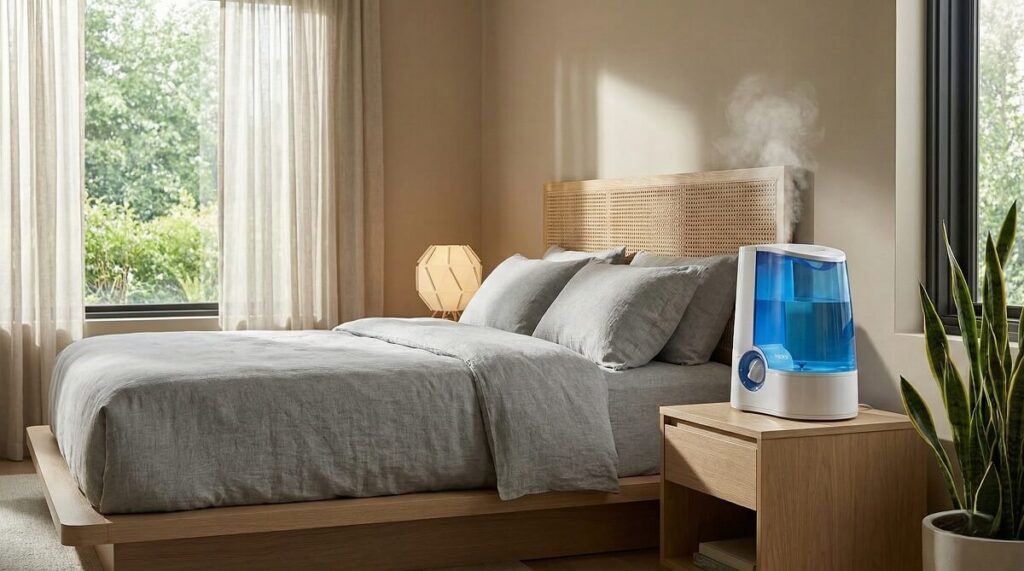
It’s 3 AM in Colorado Springs. The heater has been running nonstop for weeks, indoor humidity has plummeted to 18%, and you just woke up to another nosebleed—the third one this week. Your throat feels like you swallowed sandpaper, and there’s so much static electricity in the house that touching the doorknob feels like a minor act of self-harm. This is the reality of dry winter air, and it’s why millions of Americans reach for a humidifier.
The Vicks Warm Mist Humidifier (V750) has been a household staple for decades, and after analyzing over 40 verified owner reviews spanning 2010 to 2026, I can tell you this: it’s a genuinely effective, affordable humidifier that delivers warm, clean moisture without the white dust nightmare of ultrasonic models. But it also requires weekly maintenance, has a nightlight you can’t turn off, and the newer models might not be built as solidly as the ones from a decade ago.
Here’s the full breakdown of what real owners actually experience—the good, the frustrating, and everything in between.
The Bottom Line
The Vicks Warm Mist Humidifier is one of the most reliable and affordable warm mist options available, delivering therapeutic moisture that’s inherently cleaner than cool mist alternatives because the boiling process kills bacteria and leaves minerals behind in the unit rather than dispersing them into your air. According to Sleepopolis, this filter-free unit uses warm moisture technology that provides better saturation, and the boiling process naturally reduces germs and bacteria.
Here’s what you’re getting for around $35-50: a 1-gallon warm mist humidifier with two output settings (high and low), up to 24 hours of runtime on low, coverage for rooms up to 400-600 square feet, auto shut-off when the tank empties, and compatibility with Vicks VapoSteam and VapoPads for medicated relief during colds. No filters to replace, ever.
The catches? The built-in nightlight around the dial cannot be turned off and bothers some light-sensitive sleepers. Mineral scale builds up on the heating element and requires weekly vinegar soaking if you use tap water. And several owners note that the plastic quality on newer models feels thinner than previous generations, raising questions about long-term durability.
But if you’re battling dry winter air, sinus congestion, chronic coughs, or just want air that doesn’t make your skin crack and your hardwood floors shrink, this thing genuinely works. Owner after owner reports dramatic improvements in breathing, sleep quality, and overall comfort—often within the first night of use.
What Real Owners Love
Let’s start with what matters most: does it actually add meaningful moisture to dry air? Based on dozens of owner reports, the answer is a resounding yes.
Reviewer ey555 from Colorado provides one of the most detailed accounts. After initially trying an ultrasonic cool mist humidifier, they noticed “a white film on all our dark furniture” within two days—the mineral dust that’s inevitable with ultrasonic technology. After switching to the Vicks Warm Mist, they report: “There is no white film build-up anywhere (even after running it all day and/or all night for the past 3 weeks).” This is the fundamental advantage of warm mist technology—because the water boils, the minerals stay behind in the heating chamber instead of being aerosolized into your living space.
The therapeutic benefits during illness get consistent praise. Owner Everyday Reviews notes it “really helps keep my throat and nasal passages from drying out overnight, and it does make a difference with congestion during colds.” Heather Riddles suffered from a “very nasty cough and mucus buildup” for weeks and reports the Vicks provided “immediate relief from my cough” when paired with VapoSteam—so much so that she bought a second unit for her office. Sassy’s 3-year-old twins were getting regular nosebleeds from dry air; after running this humidifier, “He has NEVER gotten one if I run this humidifier. It’s like magic.”
The quiet operation surprises many owners. Multiple reviewers describe a “soft hum” that helps them sleep rather than disrupting it. LJ calls it “very soothing,” and Brenda Geraci notes it “runs very quiet” with no safety concerns thanks to auto shutoff. For a device that literally boils water, the noise level is impressively low—occasional gentle bubbling and water drip sounds, but nothing that prevents sleep.
Durability gets mentioned repeatedly by long-term owners. EmmJay Reviews first purchased this humidifier in 2012 and reports: “I have run it almost continuously every winter since. It has held up great.” When they bought a replacement in 2023, they were “VERY happy to see they have not changed a thing since 2012. If something ain’t broke, don’t fix it.” T Wolf similarly notes having one “many, many years ago and it’s still going strong,” leading them to gift one to family members.
The ease of filling earns consistent praise. Bill S appreciates that “the tank has a handle on both the top and bottom so it’s easy to carry when full of water” and that the screw-in valve “seals well.” Lauren specifically calls out “multiple different handles built into it to help with lifting the water compartment.”
Tank capacity works well for overnight use. On the low setting, multiple owners report 18-24 hours of runtime. On high, expect 8-12 hours—enough to get through a full night’s sleep. Samantha Rightmire confirms it “lasts all night on high” in her baby’s bedroom. Richard simply notes: “A full tank lasts all night.”
Where It Falls Short
The nightlight is the most common complaint. There’s a green light around the control dial that illuminates whenever the unit is running, and there’s no way to turn it off. Ey555 describes it as “annoying if one prefers darkness in the bedroom” and resorts to covering “the dial/light with a piece of thick paper everynight to mute the glow.” However, perspectives differ—Brenda Geraci says “the dial light does not bother the members of our household during the night hours,” and LJ notes “the light is very faint” as someone who’s light-sensitive.
Mineral buildup requires regular attention. This is unavoidable physics: when water boils, dissolved minerals stay behind. Luna Xenia provides the most comprehensive cleaning guide, emphasizing that “mineral build-up occurs because there are particles in your water” and warning that buildup “provides a very good environment for bacteria and mold to grow.” The solution is weekly vinegar soaking of the heating element, which Luna estimates takes “maybe 20 minutes of your time” plus overnight soaking for heavy buildup. Michelle confirms this reality: “I just hate how much calcium buildup you have to get rid of every week. Cleaning the calcium is a pain, I go through so much vinegar.”
The newer models may have quality concerns. Katherine provides detailed observations about changes to “the New Vicks Warm Mist Humidifier vs the Vicks Warm Mist Humidifier from years past,” noting an initial “strong metallic smell” and a silver film on surfaces during first use (which cleared after the second refill). Josh notes the current design is “still the same as the one i had 20 years ago albeit the materials are thinner, possibly cheaper.” Carmen was disappointed that this model has a “smaller opening” compared to her 2024 model, making drying more difficult.
The auto shut-off isn’t quite what you might expect. Katherine discovered the hard way that the “automatic shut off is the red indicator light which warns of low water level”—not a true automatic shutoff that triggers immediately when water runs low. The unit will run dry and get quite hot before the safety features kick in. You need to monitor it and manually refill.
No humidity control means you’re managing it manually. This is a basic two-setting humidifier (high and low), not a smart device with humidistat control. Jing Ren advises: “It’s not good to let it run overnight, because there is no automatic stop when humidity becomes high, and your room would be overly humid after a few hours.” If you want set-and-forget humidity targeting, you’ll need a more expensive model with built-in humidity sensors.
Hard water accelerates maintenance problems dramatically. RA Fires notes the unit “doesn’t last long due to water mineral deposits that are hard to clean.” Jing Ren recommends cleaning and descaling “everyday” if you live in a hard water region. The solution is using distilled, RO, or filtered water—ey555 reports that using RO water means “there is very little scaling on the heating elements” and they haven’t needed to vinegar-soak after 3 weeks of continuous use.
Cleaning Reality: What It Actually Takes
Let’s be honest about the maintenance commitment because it’s the make-or-break factor for many buyers.
Luna Xenia provides the most thorough cleaning protocol, developed over years of use:
Weekly routine: Fill the heating chamber with white vinegar, let it sit overnight (the manual says 20 minutes, but overnight works better for heavy buildup). Drain, rinse, and wipe with a soft cloth or paper towel. Critical warning: “DO NOT USE A SCRUBBER or HARSH CLOTH ON THE HEATING ELEMENT. Rough/scrubby cloths will scratch and create grooves on the heating element, which provide more surface area for the mineral build-up to occur.”
Jade S offers a counterpoint for those worried about cleaning horror stories: after using it for over a month with distilled water, she panicked about cleaning, but “when i cleaned it there was barely anything i was so relieved.” The key variable is water quality—distilled or RO water dramatically reduces mineral buildup.
Manniwood frames the maintenance trade-off clearly: “At this price point, weekly maintenance is necessary. If you don’t mind descaling the boiler part (easy to access) and giving the tank a water and bleach bath, you’ll be all set with this little guy.” The alternative is spending “almost 10 times as much” for a humidifier requiring less maintenance.
Sassy discovered a cleaning shortcut: the Bionaire Clean Away Humidifier Cleaning Solution. “I soak the parts for about 10 minutes and the lime and mineral crusts just falls apart.” Her experience: “the tank is still clean with absolutely no stains after 2 years.”
Barbara Levine learned an important lesson: “You have to empty out everything. You have to turn over the base and just dry it overnight and it’s fine.” Proper drying between uses prevents bacterial growth and extends the unit’s life.
Warm Mist vs. Cool Mist: Why This Matters
Ey555’s experience perfectly illustrates the warm mist advantage. After using a cool mist ultrasonic humidifier, they observed “a white film on all our dark furniture” plus concerns about “minerals, even potentially bacterial, fungal spores, etc” being dispersed into breathable air. According to Humidifiers for Allergies, warm mist humidifiers like the Vicks stand out for “effective humidification and congestion relief” because the boiling process creates inherently cleaner vapor.
Krysta cites EPA research (Indoor Air Facts No. 8) explaining why this matters. Ultrasonic and impeller humidifiers “generally appear to produce the greatest dispersions of both microorganisms and minerals,” while steam vaporizers like this Vicks “generally disperse less, if any, of these pollutants into the air.” She runs two of these units daily for 6 months with “no white dust or fog.”
Shiwei Mo explains the practical benefit: “This is a warm mist humidifier, which means it doesn’t require water of the same high quality as ultrasonic humidifiers. Therefore, you don’t need to fill it with purified water every day, making it more cost-effective.” While this is technically true, using filtered or distilled water still reduces cleaning frequency significantly.
The warm mist also provides slight room warming. Papaya purchased this specifically “to keep my baby’s room warm and comfortably humid” because “using only a heater made the room feel too hot.” Derek Rowe notes the unit “does warm the room a bit,” which can be a pro or con depending on your situation.
Altruce Ashe summarizes the warm mist preference many owners share: “Why is it so hard to find a real humidifier like this anymore?? I can’t stand these cool mist units, and the evaporation units don’t make any kind of difference that you can actually feel.”
Using VapoSteam and VapoPads: Does It Help?
The Vicks Warm Mist Humidifier includes a medicine cup for liquid inhalants and VapoPad slots for medicated pads. Based on owner reports, these features genuinely enhance the unit’s therapeutic value during illness.
Heather Riddles provides the most compelling testimony. She tried the humidifier alone first, then eucalyptus essential oil (which “didn’t help at all”), but pairing it with Vicks VapoSteam delivered “immediate relief from my cough.” She calls the warm medicated smell “so relaxing” that it helps her fall asleep.
Jodi Orland confirms: “The Vicks things that you can easily insert into the top are great, makes my room smell like menthol, which is nice for a sore throat or chest congestion.”
Nativemsn describes their winter routine: “This is what we use every Fall/Winter in our bedroom. Helps great with sinus issues/colds–especially with sinus pressure and pain.”
Catherine Horeis reports an unusual use case: adding “a tablespoon of white vinegar, 2 drops of cedar wood oil, 2 drops of sandalwood oil” to the medicine reservoir helped with a persistent infection she was fighting.
Important caution from RENGIN DAGDELEN: “if you have pets pls do not use vicks tablets or liquid medicine.” The menthol and eucalyptus compounds in VapoSteam and VapoPads can be harmful to cats and some dogs, so use medicated options only during sleep when pets aren’t in the room.
Bill S notes you can skip the medication entirely: “I do not add vaporizer. Just water.” The unit works perfectly fine as a pure humidifier without any added products.
Who Should Buy This
Dry climate and winter sufferers: If you’re in Colorado, Arizona, Michigan, or anywhere humidity regularly drops below 30% in winter, this delivers the moisture output you need without creating white dust on your furniture. Ideal Malloy says it “turns my bedroom into a cozy oasis” and provides “respite from the winter chapping and itching and dryness.”
Parents with young children: Multiple owners use this in nurseries and kids’ rooms. Jade S uses it in her son’s room on low and gets two nights from one fill. Papaya finds it “perfect” for baby’s room. Samantha Rightmire confirms it puts “the right amount of humidity in the air” all night. The warm mist is considered safer from a hygiene standpoint than cool mist, though you should keep the hot unit out of reach of curious toddlers.
Cold and sinus sufferers: The combination of warm moisture plus optional VapoSteam provides genuine relief. Sassy’s twins stopped getting nosebleeds entirely. Heather Riddles got “immediate relief” from a persistent cough. Deborah Jennings simply states: “My breathing is so much better.”
Budget-conscious buyers who don’t mind maintenance: At $35-50, this is a fraction of the cost of premium humidifiers. Manniwood notes that alternatives requiring “less maintenance” cost “almost 10 times as much.” If you’re willing to spend 15-20 minutes weekly on cleaning, the performance-to-price ratio is excellent.
People who’ve been burned by cool mist white dust: If you’ve experienced the mineral film that ultrasonic humidifiers spray everywhere, this solves that problem completely. Krysta has run hers for 6 months with “no white dust or fog.”
Who Should Skip This
If you want set-and-forget automation: This is a basic two-setting humidifier with no humidistat, no app control, no smart features. You’ll need to monitor humidity levels separately and turn it on/off manually. Jing Ren warns against running it overnight without monitoring because rooms “would be overly humid after a few hours.”
If you absolutely won’t do regular cleaning: The heating element needs weekly vinegar soaking if you use tap water. Luna Xenia emphasizes this isn’t optional: mineral buildup “provides a very good environment for bacteria and mold to grow.” If you won’t commit to maintenance, look at evaporative wick humidifiers instead.
Light-sensitive sleepers who need total darkness: The nightlight cannot be turned off. While some owners don’t mind it, others resort to covering it with tape or paper. If any light in your bedroom disturbs your sleep, this will frustrate you.
Large space coverage needs: This is rated for medium rooms, roughly 400-600 square feet. For whole-house humidification or very large open spaces, you’ll need multiple units or a console humidifier. Michele T. Fry notes it’s “best for a small room as it does not put out a lot of steam.”
Pet owners who want medicated vapor continuously: The VapoSteam and VapoPads contain menthol and eucalyptus that can harm cats and some dogs. If you have pets that share sleeping spaces, you’d need to skip the medicated features or use them only when pets are elsewhere.
FAQ
- How long does a full tank actually last?
- On the low setting, expect 18-24 hours. On high, expect 8-12 hours. Derek Rowe reports high empties the 1-gallon tank in about 12 hours, low lasts about 24 hours. Multiple owners confirm it runs “all night” on either setting without needing a refill.
- Does it really require weekly cleaning?
- If you use tap water with any mineral content, yes. Mineral scale builds up on the heating element and needs vinegar soaking. Luna Xenia recommends overnight soaking for best results. However, using distilled or RO water dramatically reduces buildup—Jade S found “barely anything” after a month with distilled water. Ey555 reports no vinegar soaking needed after 3 weeks using RO water.
- Is the nightlight really that bright?
- Opinions vary significantly. Ey555 calls it “annoying” and covers it with paper. Brenda Geraci says it “does not bother” her household. LJ describes it as “very faint” and not problematic for someone who’s light-sensitive. If you’re extremely sensitive to light while sleeping, plan to cover it.
- Can I use tap water?
- Yes, but you’ll need to clean more frequently. The boiling process means minerals stay in the unit rather than coating your furniture, but they still accumulate on the heating element. Using distilled, RO, or filtered water significantly reduces maintenance. Ey555 found switching from tap to RO water meant “very little scaling on the heating elements.”
- Is warm mist safe for babies?
- The warm mist itself is safe and considered more hygienic than cool mist because boiling kills bacteria. However, the unit gets hot during operation, so place it out of reach of children. Multiple parents use this successfully in nurseries—Jade S, Papaya, and Samantha Rightmire all report positive experiences in baby rooms.
- Will it make my room too humid?
- Possibly, if you run it continuously without monitoring. Jing Ren warns that overnight use “would be overly humid after a few hours” since there’s no automatic humidity shutoff. Lauren notes that running it on high in a bedroom with the door closed “will end up creating a sauna.” Use the low setting for overnight operation and monitor humidity with a separate hygrometer.
- How does it compare to cool mist humidifiers?
- The main advantage is no white mineral dust on furniture and surfaces. Ey555 switched from cool mist specifically because of “a white film on all our dark furniture.” According to EPA research cited by Krysta, steam vaporizers like this Vicks disperse fewer microorganisms and minerals into the air than ultrasonic cool mist models. The trade-off is higher energy use (it boils water) and hot surfaces.
- How loud is it?
- Quiet enough for bedroom use. Owners describe a “soft hum” and occasional bubbling/drip sounds. LJ calls the sound “very soothing.” Brenda Geraci confirms it “runs very quiet.” It’s not silent—you’re boiling water—but it’s not disruptive to sleep.
- Can I use essential oils?
- Vicks doesn’t officially recommend essential oils, only their branded VapoSteam and VapoPads. Some users add drops to the medicine cup, but this may damage components over time. The medicine cup is designed for Vicks liquid inhalants; essential oils have different chemical properties that could degrade plastic or leave residue.
- How long do these units typically last?
- With proper maintenance, years. EmmJay Reviews has run one continuously every winter since 2012. T Wolf has one from “many, many years ago” still working. However, some owners note newer models have thinner plastic than older versions, and NancyJ reports needing to “replace every 2 1/2 years.” Lifespan correlates strongly with water quality and cleaning diligence.