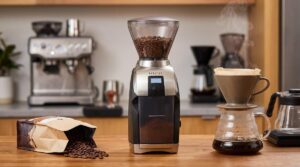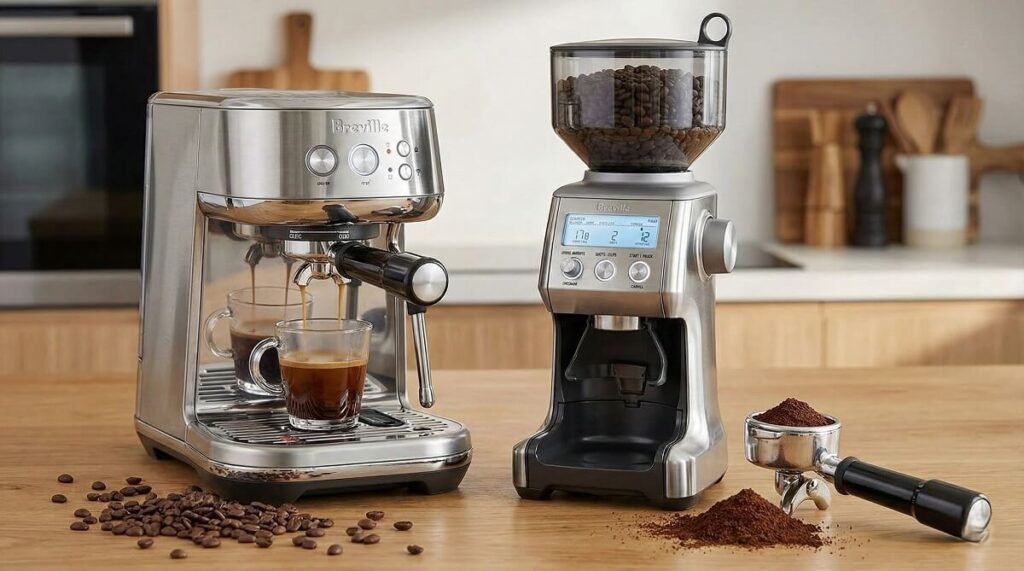
Over 1,000 verified owners have tested the Breville Smart Grinder Pro in real kitchens. If aggregating customer experiences wasn’t my job, the Breville BCG820 is probably the grinder I’d recommend to anyone serious about coffee but not ready to drop $500+ on a professional model.
With 76% of owners giving it 5 stars and consistent praise for grind quality, this $200 grinder punches well above its weight class. But it’s not perfect—some owners report motor issues after extended use, and the static cling problem is real. Here’s what actual owners discovered after daily use.
What Real Owners Say About Build Quality
The Breville Smart Grinder Pro feels substantially more premium than its price suggests. Multiple owners specifically called out the solid construction after upgrading from cheaper models. One verified purchaser noted, “After opening the box I was impressed with the build quality and attractive appearance,” adding that photos made it “look kind of like cheap plastic, but that’s not at all how it feels.”
The metal burrs—the same 40mm conical steel burrs found in Breville’s Barista Express espresso machine—are driven by a 165-watt motor at 450 RPM. According to testing from TechGearLab, this setup delivers field-leading performance across nearly all grind sizes.
However, not everything is metal. One long-term owner cautioned that “a lot of the ‘metal’ is just plating,” though they emphasized this “doesn’t hurt the functionality (or bargain) of the machine.” The grind adjustment knob drew particular criticism for feeling “a bit ‘plasticy’ and ‘cheap,'” with one reviewer questioning “how well this will hold up to years of use.”
The hopper design earned universal praise. It’s airtight, holds a full pound of beans with room to spare, and features a twist-lock mechanism that closes the feed ports when removed—no bean spillage. One owner appreciated being able to “pull the hopper off of the grinder and change out or refrigerate the beans.”
Grind Consistency: The Most Important Factor
This is where the Breville BCG820 truly distinguishes itself from budget competition. One experienced owner who researched extensively before purchasing concluded: “Where it counts, this grinder is the king, unless you want to spend far far more for a true professional model.”
The consistency claim isn’t marketing hype. According to independent testing, the Smart Grinder Pro produces “more than twice as much ‘optimal’ size grounds as compared to the next best make and model” in its price range. You can spend two or three times as much and still not achieve more consistent grinds.
Real-world testing confirms this. A chef and competitive BBQ pitmaster who tested multiple burr grinders before settling on the Breville wrote: “I went through a few other models they don’t stand up to this Model.” After dialing in his preferred setting at 56, he achieved “Pure Perfection for coffee to my tastes.”
The 60 grind settings—plus additional micro-adjustments via the upper burr—provide genuine flexibility. One owner initially worried there were “almost too many to chose from,” but ultimately appreciated having “plenty of options to find your perfect grind.” For espresso specifically, owners consistently report excellent results, with one noting they dial in at “15.8 seconds at size 14 grind” for perfectly extracted double shots.
The grinder handles both ends of the spectrum. For French press users, the coarsest settings produce uniform large grinds. For espresso, it goes fine enough for non-pressurized portafilters—a capability that costs significantly more in competing models. As one owner pointed out, the similar-priced Baratza Virtuoso requires “instructions from the internet on how to adjust the shims on the burrs to get very fine,” while the Breville handles it out of the box.
Smart Features That Actually Work
The LCD panel initially strikes many buyers as unnecessary—possibly even “cheesy”—but owners quickly change their minds. One skeptical purchaser admitted: “Well it works great and is very useful.” The backlit display shows your grind setting clearly, which matters when you’re half-awake at 6 AM.
The programmable timer is the feature that separates casual users from obsessive coffee nerds. You can program grind time in 0.2-second increments for cups (1-12) or shots (1-60). One methodical owner explained their process: “I still find it easier to weigh my beans first (a cheap 500g scale is highly recommend), then place them in the hopper,” grinding until empty to establish baseline times for different settings.
Here’s the critical discovery: once dialed in, the timer eliminates waste. An owner using a pressurized portafilter at setting 15 found their medium roast beans grind at exactly 1 gram per second. Set the timer to 14 seconds, and they consistently get 14 grams—no scale needed. They concluded: “The timer is a perfectly adequate substitute for a built-in scale.”
The portafilter adapters (54mm and 58mm) surprised owners who assumed they’d be gimmicky and messy. Reality: “It puts 99.9% of the grinds in a neat mound in the middle of the filter, much better than I can do by hand.” The included cradle activates grinding when you push the portafilter up—a genuinely useful touch for espresso workflows.
One design quirk: the included catch cup doesn’t align perfectly with the grinder port when fully inserted. The metal lid sticks to the portafilter magnet if pushed too far back, and vibration causes it to slide during grinding. Most owners solve this by grinding directly into their portafilter or removing the lid entirely.
Is It Loud? Noise Level Reality Check
Grinder noise exists on a spectrum from “annoyingly loud” to “acceptable for early morning use.” The Breville lands on the quieter end. According to HomeGrounds testing, it registered 80dB at medium grind settings—a full 15dB quieter than many competitors.
Real-world confirmation comes from a new parent: “My newborn infant gives it zero thumbs up… because he’s somehow still asleep while in the same room 20ft. away.” That’s about as practical a noise test as you’ll find.
Multiple owners specifically note it’s “much quieter” than blade grinders they previously used. One owner switching from a Baratza Encore (itself not particularly loud) found the Breville “quieter than my blade grinder” and “definitely quieter than some of the others I’ve seen.”
Realistic expectations matter here. As one owner pragmatically noted: “Do not expect whisper quiet, I do not think that’s ever going to be a thing for electric grinders.” But for burr grinder standards, the Breville BCG820 won’t wake the house.
The Mess Factor: Static and Cleanup
This is the grinder’s most consistent criticism. Coffee grounds escape—not dramatically, but enough to require a quick countertop wipe after each use. One owner keeps “a towel under the grinder to catch the larger grounds that try to ‘escape,'” finding this “makes cleanup a bit easier.”
The static cling issue is real but solvable. Grounds stick to the plastic catch container due to static charge, and some fall behind the container where the lid doesn’t mate perfectly with the chute. The magnetic removable tray catches most escapees and makes cleanup straightforward, but you’re not getting a mess-free experience out of the box.
The solution that experienced owners recommend: buy an AIEVE silicone bellows (about $10-15). It fits between the hopper and lid perfectly. “Give it a couple pumps after each use,” one owner explains. “The extra grinds are almost completely removed from the chute and are added to your dose where they belong! No waste. No mess.”
Internal retention (grounds left in the chute after grinding) measures about 0.2-0.3 grams according to owners who weigh their doses. One noted this is “a bit more ‘loss’ with the stand alone grinder than with the built-in one” on Breville’s Barista Express, though grinding coarser may increase retention slightly.
An owner updating their review after years of use emphasized: “Simple solution, get a dosing funnel. Keeps all grinds going into the portafilter.” Combined with a bellows for purging the chute, the mess becomes manageable rather than frustrating.
Reliability: Will It Last?
This is where owner experiences diverge most dramatically. Long-term reliability sits at the heart of the biggest concern about this grinder.
First, the positive data: Multiple owners report 4-6+ years of daily use without issues. One owner’s 6-year update stated: “Still working great, no reliability issues. I have adjusted the burrs once to account for wear. I see no reason not to expect another 6 years of trouble free use.” Another at the 2-year mark reported “no reliability issues” with daily use.
The grinder’s solid construction suggests longevity. As one owner noted when comparing failure rates: “¾’s give it a 5 or 4 and only 12% are 1’s. I see this as a testament to it’s build quality and reliability.” That’s notably better than most grinders in this category, where 15-20% typically report problems.
However, there’s a known failure mode. The motor, while adequate for most use cases, is “a bit underpowered” according to experienced users. It can occasionally bind up during grinding, particularly with harder or oilier beans. When this happens, the grinder slows or stops mid-cycle.
The critical advice from a long-term owner: “If the grinder slows down or stops grinding before it has run its cycle, PAUSE THE GRINDER.” Then follow the simple procedure: remove the hopper, remove the upper burr, dump out remaining beans, brush the lower burr area, reassemble, and restart. “It will complete the remainder of the cycle that was paused.”
This binding issue is rare—one owner experienced it once in months of daily use—but ignoring it when it happens can damage the motor. Some 1-star reviews mention “burning smell” and motors dying, which likely stems from forcing the grinder to run when jammed rather than clearing it.
The replacement parts situation is favorable. Breville offers good parts availability, and the upper burr (the main wear item) can be purchased when needed, though availability fluctuates.
Value Analysis: Is $200 Worth It?
At $199.95 (frequently on sale for $180-190), the Breville Smart Grinder Pro occupies a strategic price point. It costs about $60 more than the entry-level Baratza Encore and roughly the same as the Baratza Virtuoso.
According to CoffeeGeek, it “represents extremely good value for the money” considering its grind consistency performance. The testing data supports this—it delivers grind uniformity comparable to grinders costing $400-500.
Owners consistently frame it as the best value in its category. One who extensively researched alternatives concluded: “This grinder has gotten very good reviews by established ‘coffee folk’ for good grinder for people starting out their coffee journey.” They acknowledged it’s not “the G.O.A.T. grinder” or “even the most consistent one,” but for someone starting out or not wanting to spend $300+, “this one makes a lot of sense.”
The value calculation changes based on your needs. For French press-only users, spending $200 doesn’t make sense when a $40 Cuisinart DBM-8 delivers adequate coarse grinds. But for anyone wanting espresso capability plus versatility for other brew methods, the Breville delivers features and performance that would cost significantly more elsewhere.
What you’re getting for $200: metal conical burrs, 60+ grind settings, programmable timer, two portafilter adapters, large airtight hopper, and grind consistency that rivals much pricier models. An experienced owner who tested multiple grinders summarized: “I have no idea why anyone would want to spend more money on a grinder when they can buy this one.”
The counterargument: spending $50-80 more on a flat burr grinder with upgraded burr set would deliver marginally better consistency for espresso purists. But for most home users, that difference won’t be noticeable in the cup.
The Verdict: Who Should Buy This Grinder
After analyzing over 1,000 owner experiences, the Breville Smart Grinder Pro excels for specific users while disappointing others.
Buy this grinder if you:
- Want espresso capability without spending $300+ on a dedicated espresso grinder
- Brew multiple methods (espresso, pour-over, drip, French press) and need versatility
- Value programmable features and digital controls
- Own or plan to buy a Breville espresso machine (the portafilter cradles are perfectly sized)
- Want grind consistency that rivals much pricier models
- Don’t mind spending 5-10 minutes monthly on basic cleaning and maintenance
Skip this grinder if you:
- Only make French press and don’t need fine grind capability—save $160 and buy the Cuisinart DBM-8
- Want absolute zero-maintenance operation with no learning curve
- Expect a completely mess-free grinding experience without accessories
- Need the absolute finest espresso grinds for extremely light roasts (requires burr adjustment or stepping up to a $400+ flat burr model)
- Want a built-in scale instead of timer-based dosing
The reliability picture is mostly positive—75% of long-term owners report years of trouble-free operation. The documented failure mode (motor binding) is manageable if you know how to clear it. Just don’t ignore warning signs if the grinder starts struggling.
One owner who upgraded from 15 years with a blade grinder summed up the transformation: “I’ve noticed less silt in my French press, and the uniform grind makes brewing the coffee better because beans should brew for the optimum amount of time.” That’s the core benefit: consistent extraction that makes good beans taste like good coffee.
At $200, it’s not an impulse purchase. But if you’re serious enough about coffee to read detailed reviews, you’re exactly the user this grinder was designed for. Just budget an extra $15 for a silicone bellows and dosing funnel, and you’ll have a setup that competes with grinders twice the price.
A two-year owner who remains “very pleased” with their purchase offered this perspective: “Definitely feels sturdy. Do not expect whisper quiet, but it was definitely quieter than some of the others I’ve seen… For me that’s a decent sound level.” That pragmatic satisfaction—great where it matters, acceptable everywhere else—defines the Breville Smart Grinder Pro ownership experience.