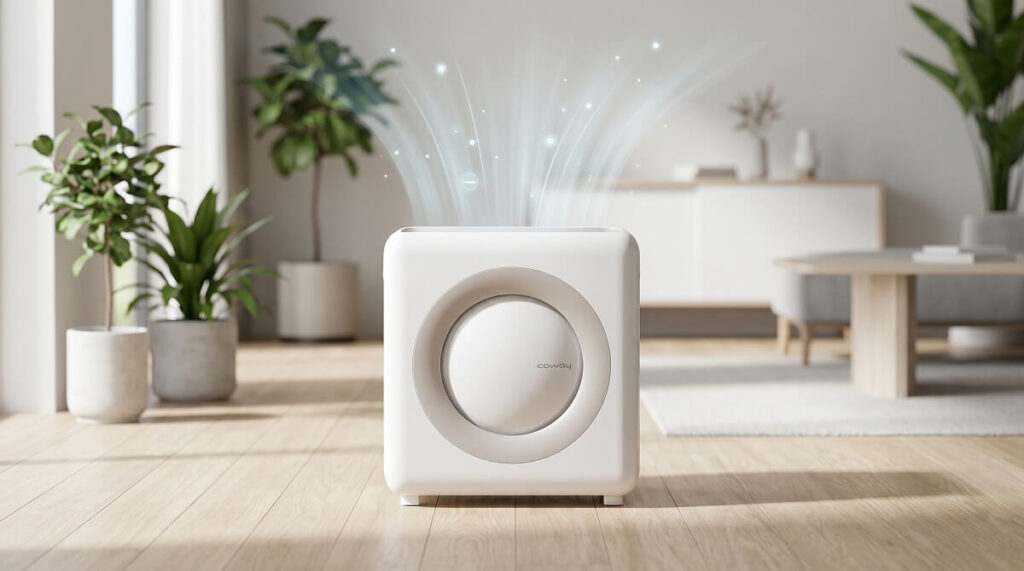
When the Canadian wildfire smoke descended upon NYC in summer 2023, one user found themselves coughing, eyes watering, forced to wear an N-95 mask inside their own apartment just to breathe. Their $90 tower purifier was on loan to a neighbor with elderly family members. Desperate, they ordered the Coway Airmega AP-1512HH based on recommendations from Wirecutter and other review sites.
The result? “I turned it on and the sensor light went red. I opened the doors of every room, and after a few minutes at full power, the light turned from red to purple, and about 5 minutes later, it went blue. I took my mask off and the air was pure and fresh.” That’s the kind of performance that made this air purifier a New York Times Wirecutter top pick for over a decade running.
The Bottom Line
The Coway Airmega AP-1512HH is the air purifier that built a reputation by simply working—year after year, user after user. At around $180-230 (watch for sales under $200), it covers rooms up to 361 square feet with a four-stage filtration system including True HEPA, and an auto mode that responds to air quality changes in real time. Users report this thing running 5-7+ years with no failures, making it one of the most durable units on the market.
According to Coway’s official specifications, the CADR ratings are 233 for smoke, 246 for dust, and 240 for pollen. Noise levels range from a whisper-quiet 24.4 dB at the lowest setting to 53.8 dB at maximum—about as loud as a normal conversation. The 4-stage filtration captures 99.97% of particles down to 0.3 microns, and the pollution sensor provides real-time air quality feedback through a colored LED indicator.
The value proposition has remained strong for a reason: reliable build quality, effective filtration, affordable OEM replacement filters (around $50/year for the HEPA and carbon combo), and an eco mode that shuts off the fan when air is clean. Users consistently report less dust accumulation, eliminated odors, and relief from allergies and respiratory issues.
The catches? It’s not the newest technology—no WiFi, no app, no smart home integration on the base model (the AP-1512HHS adds those features). At max speed, it gets noticeably loud. And some newer competitors offer similar performance at lower prices. But for users who want proven reliability over bleeding-edge features, this remains the benchmark.
What I Like: A Decade of Proven Performance
Let’s look at what users actually experience with this unit across hundreds of reviews.
The standout testimony comes from a user who’s been testing air purifiers for over a year, watching “countless videos, read countless articles, and almost pressed the purchase button on countless units.” After exhaustive research, they settled on this Coway and have zero regrets. In their 150 square foot bedroom running on speed 2, they get over 5 air changes per hour while using only 8 watts of electricity—no noticeable impact on their electric bill. “I don’t wake up congested anymore. The air purifier gets rid of that smell when you just vacuum, litter box odors, and the dust that is kicked up when you clean the litter box.”
Multiple users report this unit lasting 4-7+ years with continuous daily use. One user describes their experience after 7 months of constant operation: the pre-filter was “so dirty… I couldn’t believe this stuff was floating around my house for it to grab. In fact, even strands of my hair were in the filter!” That visible accumulation is proof the unit is capturing what you’re breathing.
Pet owners consistently praise this unit’s performance. One household runs it next to their cat’s litter box: “I usually have it on auto, and it is hilarious when it toggles itself to the high setting because of the stinky chemical smell… I can smell their box within half an hour when it’s off. It literally works that well at keeping things fresh.” After four months, they report the air is “so clear, so clean.”
A professional artist working primarily with oils uses this unit to remove paint thinner odors from their home studio. “On its lowest setting it is reasonably quiet and I can paint with it running, but I have found that to be most effective I set it running at its highest after I have done for the day.” After nearly a year of use, the thinner odors haven’t permeated the house at all.
The wildfire smoke testimonial bears repeating: one user describes the unit as “an absolute superhero at cleaning a large volume of air very quickly” when NYC air quality hit dangerous levels. Another household ran it during a local fire and found “the smell was gone within the hour” after cranking it to speed 3. A small fire in an apartment building sent smoke drifting into one user’s unit—they already had several Coways running, and the smell cleared quickly.
Air Quality Sensor: Real-Time Feedback That Works
The colored LED air quality indicator is one of this unit’s most appreciated features. Blue indicates clean air, purple means moderate particles, and red signals poor air quality requiring high-speed operation.
Users report the sensor is genuinely sensitive and responsive. One user tested it deliberately: “I actually tested the dust sensor function in auto mode by shaking a dust rag in front of the purifier, and the fan speed ramped up from setting 1 to 3 for about 5 minutes, until the air was clean again, and then it went back to the 1st fan speed setting automatically.”
Kitchen duty is where the sensor shines. Multiple users note it responds to cooking odors—sautéing onions, burning something, making bacon. One user in an old house without a range hood found the purifier “took care of that” when the kitchen got smelly. When they accidentally let water dry up while steaming sweet potatoes and the pan bottom started burning, “the purifier indicator turned red and cleared the air in a matter of minutes before it went back to blue. I’d usually have to open all the windows and run fans for about 30 minutes.”
The sensor sensitivity is adjustable by pressing the fan speed and ionizer buttons simultaneously for 2 seconds—three levels available. Most users find the default “standard” setting works well, though the sensor should be cleaned with a cotton swab every two months for optimal performance.
One user specifically notes the sensor helps with “older house” smells. Their home had a funky odor from previous pet accidents soaked into the subfloor beneath new floors. “I got this air filter in hopes it might help at least a little bit. It has exceeded my expectations! I never catch whiffs of that smell anymore, even when walking into the house with a fresh nose.”
Noise Levels: The White Noise Sweet Spot
The Coway AP-1512HH operates across three fan speeds plus auto and eco modes. According to Coway specifications, noise ranges from 24.4 dB to 53.8 dB depending on setting.
At the lowest setting, users consistently describe it as silent. One user states it’s “utterly and completely silent. You couldn’t even hear it at night time in a small, quiet room with the door shut.” Another notes they “forget it’s on as you don’t hear it.” This makes it excellent for bedroom use, especially combined with the ability to turn off the indicator light by holding down the ionizer button for 3 seconds.
The second speed produces what multiple users describe as pleasant white noise that aids sleep. “At it’s 2nd highest setting it is barely detectable, producing a pleasant, white noise background sound that you quickly tune out. It makes falling asleep very easy, and if you have the air conditioner on you can’t hear the purifier at all.”
On the highest setting, it gets loud—users compare it to a dishwasher or describe it as “fearful” when it kicks into overdrive detecting pollution. But this is by design: high speed moves a massive volume of air quickly. One user frames this as a feature: “the fan moves a LOT of air on the 3rd setting.” Most find they rarely need maximum speed for extended periods—the auto mode handles most situations at lower, quieter speeds.
The eco mode is particularly clever: when no pollution is detected for 30 minutes, the fan automatically stops to save energy. This means silent operation when your air is already clean, with automatic restart when conditions change.
Build Quality & Longevity
This is where the Coway AP-1512HH separates itself from cheaper competitors: users report exceptional durability.
Multiple reviewers describe their units lasting 4-7+ years of continuous daily operation. One user calls the build quality “fantastic” and notes it’s “the only one I recommend to friends/family.” Another describes the construction as feeling “very sturdy and well-made” with an “easy, comfortable, concealed carry handle.”
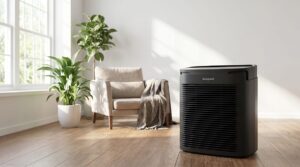
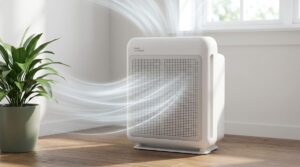
The design divides opinions aesthetically. The glossy black model “looks a lot like a large subwoofer,” which some find sleek and others find unusual for an air purifier. The white model is described as cleaner and more conventional. Both fingerprint easily—one user notes the “shiny piano black model does attract finger prints like a magnet.”
Unboxing is notably simple. One user compared it to opening an Apple product: “It slid out, I removed two pieces of protective styro caps, and unwrapped the shrink wrap. I took off the plastic wrap from the filters which were already in place so I didn’t have to read a book of instructions first to figure out where to put them. Then I simply plugged this sucker in, and it worked on auto right out of the box.”
The unit is compact enough to position easily throughout a home—16.8 x 18.3 x 9.7 inches and lightweight enough to move between rooms. It needs about a foot of clearance on the right side for proper airflow, and the circular front grill should remain unobstructed.
Filter System & Maintenance
The four-stage filtration system includes:
- Washable pre-filter mesh: Captures large particles like pet hair and dust. Users rave about this reusable component—”as often as needed, you just snap it out and clean it. It comes clean super quickly and can be reinstalled once dry.” One user cleans theirs by spraying from inside out with a garden hose.
- Activated carbon deodorization filter: Traps odors from food, pets, and smoke. Recommended replacement every 6 months.
- True HEPA filter: Captures 99.97% of particles down to 0.3 microns including mold, pollen, and allergens. Recommended replacement once per year.
- Vital Ionizer (optional): Further reduces ultra-fine particles. Can be toggled on/off; some users leave it off due to concerns about ozone production in occupied spaces.
Filter replacement costs are reasonable. OEM Coway filters run approximately $50 per year for the HEPA and carbon combination. Third-party aftermarket options are available at lower prices, though user experiences vary on quality. One user notes “I have seen many 3rd party companies that make the filters… most of them are much cheaper than the OEM Coway filters, and they have good reviews.”
Filter indicator lights notify you when replacement is due—reset by holding down the filter button for 3 seconds. Users with heavy pet hair or dusty environments may need to replace sooner than recommended intervals. One user in a home with German Shepherd noted filters needed changing earlier than the 6-month/12-month guidelines.
The washable pre-filter significantly extends main filter life by capturing large debris before it reaches the HEPA. One immunocompromised user specifically appreciates this design: “I just think about how many more of the other filters I would have to be purchasing if the company did not build in this pre-filter.”
Performance for Allergies & Respiratory Issues
Users with allergies, asthma, and respiratory conditions report significant relief.
One user who moved into an old home “had been sneezing and congested for months. After 1 day running this we woke up able to breathe freely and the air smells so fresh and clean.” Another with environmental allergies states: “My entire downstairs has much cleaner air. I have environmental allergies, lots of them. This has helped me so much.”
A particularly detailed review from an early adopter describes the transformation: “My bedroom is often very stuffy, especially in the winter when we have the heat set to 73 degrees… I do suffer from pollen allergies, as well as mild allergies to dust mites, grass, ragweed, mold spores, and pet dander. I didn’t know the difference between no allergy and mild allergy until sleeping one night with this purifier running. Man what a difference. My nose was not all dry and cracked up feeling on the inside. It also was not runny or scratchy.”
One user with severe sinus issues from dust reports: “All the air floating particles in my house are now 99% gone because of this air cleaning system… plus if someone smokes inside it removes the smoke from the air very quickly!”
Multiple users report improved sleep quality. One now sleeps “with mouth closed, which matters immensely to me for oral health and sleep quality.” Others describe waking up less congested and experiencing fewer allergy symptoms within days of use.
Eco Mode & Energy Efficiency
The eco mode is a standout feature for users running the unit continuously. When no pollution is detected for 30 minutes, the fan automatically stops to save energy. It restarts when air quality changes are detected.
Power consumption is modest: 77W maximum according to manufacturer specs, but significantly less on lower settings and eco mode. One user calculated their energy costs as negligible even with continuous 24/7 operation. Running on speed 2 uses only about 8 watts, according to one user’s research.
The auto mode handles most situations efficiently—ramping up when cooking, when someone enters the room, or when air quality drops, then returning to low power when conditions improve. Users consistently describe this as “set it and forget it” operation.
The timer function offers 1, 4, and 8-hour presets, useful for running the unit at high speed while away. Multiple users set it to run at full power for a few hours after work, then switch to auto overnight.
Where It Falls Short
No air purifier is perfect. Here’s what to consider before purchasing.
No smart features on base model: The standard AP-1512HH lacks WiFi, app control, and smart home integration. One user notes “this doesn’t interface with any AI, nor does it have a remote. I set it to automatic and let it do the job, which is fine with me.” If you want app connectivity, the AP-1512HHS model adds those features at a higher price point.
Loud at maximum speed: While users accept the noise at high speed as a necessary trade-off for rapid air cleaning, it’s noticeable. One user describes the max setting as generating “fearful” noise when it kicks into overdrive. This is temporary during high-pollution events, but worth knowing.
Indicator light can’t be fully disabled: The top LED can be dimmed but not completely turned off on some models. One user mentions they “just put a folded matching washcloth over the light” for bedroom use. This wouldn’t deter them from purchasing another unit, but it’s a minor annoyance for light-sensitive sleepers.
No longer the best value: According to HouseFresh’s analysis, after testing over 90 air purifiers, the AP-1512HH is “now a little dated” and “there are air purifiers on the market that will offer better value.” Competitors like the Levoit Vital 200S offer similar performance with app support at lower prices. However, none have the decade-long track record of reliability.
Ionizer concerns: Some users avoid using the ionizer feature due to potential ozone production. One user notes they keep it off because “the ozone produced by the ionizer irritates my throat while sleeping with the unit on all night.” The ionizer can be toggled off permanently.
Who Should Buy This
Reliability seekers: If you want an air purifier proven to work for years without failure, this is the benchmark. Users report 5-7+ years of continuous operation. The decade of Wirecutter recommendations isn’t marketing—it’s track record.
Allergy and respiratory sufferers: Users with allergies to dust, pollen, pet dander, and mold spores report genuine relief, often within 24 hours. If you’ve been suffering through symptoms, this unit has a strong history of providing improvement.
Pet owners: The washable pre-filter captures pet hair effectively, and the carbon filter handles litter box and pet odors. Multiple users with dogs and cats describe transformed air quality and reduced smells throughout their homes.
Those who prefer simple controls: No app required, no account creation, no WiFi setup. Press buttons, it works. For users who don’t want smart home complexity, this is a feature, not a limitation.
Wildfire smoke and pollution events: Multiple users specifically praise this unit’s ability to rapidly clear smoke during emergency air quality events. If you live in a region prone to wildfires or pollution spikes, the high-speed mode provides meaningful protection.
Who Should Skip This
Smart home enthusiasts: The base AP-1512HH lacks app control, scheduling, and voice assistant integration. If you want to monitor air quality from your phone or automate operation, look at the AP-1512HHS model or competitors with app integration.
Budget shoppers prioritizing features over track record: Competitors like the Levoit Vital 200S offer app control and similar HEPA filtration at lower prices. If maximizing features per dollar matters more than decade-long reliability data, explore alternatives.
Very large open spaces: The 361 square foot coverage means you’ll need multiple units for larger areas. Users with big homes typically buy several and place them strategically in bedrooms and main living areas.
Those needing absolute silence at high speed: If you’re extremely noise-sensitive and plan to run at maximum speed frequently, the 53.8 dB output may bother you. Most users find lower speeds sufficient for continuous operation.
FAQ
- How long does the Coway AP-1512HH actually last?
- Users consistently report 5-7+ years of reliable operation with continuous daily use. One user ran theirs nonstop for two years without any failures. The build quality and durability are frequently cited as key reasons for the unit’s long-term popularity.
- Is it quiet enough for a bedroom?
- Yes. On the lowest setting (24.4 dB), users describe it as completely silent—you can’t hear it even at night in a quiet room. Speed 2 produces pleasant white noise that many find helps with sleep. Only the highest setting gets notably loud, and most users rarely need it.
- How often do filters really need replacing?
- Coway recommends replacing the carbon filter every 6 months and the HEPA filter yearly. Real-world usage varies—homes with pets or heavy dust may need earlier replacement. The unit has indicator lights that notify you when change is due. Regular cleaning of the washable pre-filter extends main filter life.
- Does it actually remove odors?
- Yes. Users report elimination of cooking smells, litter box odors, pet smells, paint thinner, smoke, and general “old house” mustiness. The activated carbon filter specifically targets odor molecules. Multiple users describe their homes smelling noticeably fresher.
- What’s the difference between AP-1512HH and AP-1512HHS?
- The AP-1512HHS adds WiFi connectivity, smartphone app control via the IoCare app, and smart home integration. The filtration system and physical performance are identical. If you want remote monitoring and scheduling, get the HHS model. If you prefer simple manual controls, the standard model works great.
- Should I use the ionizer feature?
- It’s optional and can be toggled on or off. Some users leave it off due to concerns about ozone production irritating respiratory systems, especially during sleep. The purifier works effectively with the ionizer disabled. If you do use it, Coway suggests turning it off when occupying the room for extended periods.
- How does it handle wildfire smoke?
- Extremely well. Multiple users specifically purchased this unit during smoke events and report rapid clearing of hazardous air. During the 2023 NYC wildfire smoke incident, one user went from needing an N-95 mask indoors to breathing clean air within minutes of turning on the unit.
- Is this still worth buying in 2025?
- It depends on your priorities. For proven reliability and decade-long track record, yes. For maximum features at lowest price, newer competitors may offer better value. If you prioritize “will this still work in 5 years,” the Coway AP-1512HH has more real-world longevity data than any competitor.
What Real Users Are Saying
The pattern across years of reviews is remarkably consistent: this air purifier delivers exactly what it promises, and it keeps doing so for years.
“I bought a $90 tower purifier which took a long time to clear the air and which was noisier than a jet engine,” writes one user who upgraded. “This is more than double the cost, but the quality and performance are well worth the investment.” Another states simply: “They say you never regret buying the best. This is worth every penny and then some.”
The most telling indicator: users buying multiple units. “Absolute champ when it comes to air purifiers in this price range… Bought two, and is the only one I recommend to friends/family.” Another: “Between myself and family/friends, we have now purchased five or six. I hope they don’t stop making them.”
After over a decade on the market, the Coway Airmega AP-1512HH has earned its reputation through consistency rather than hype. It may not have the flashiest features or the lowest price, but when users describe an air purifier as something they’d buy again, recommend to family, and trust with their respiratory health—that’s the kind of endorsement that matters.