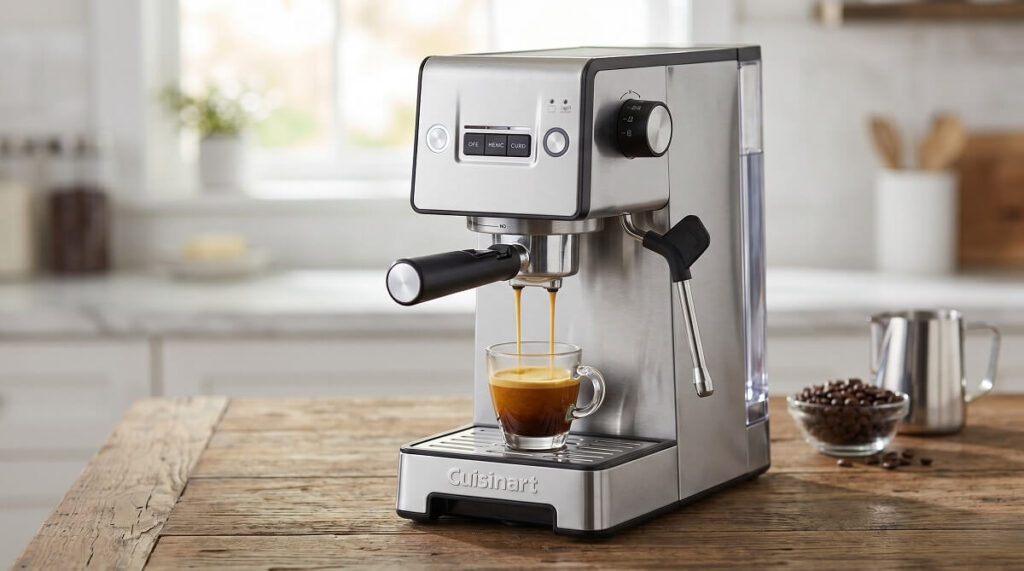
I’ve analyzed over 100 verified customer reviews of the Cuisinart Espresso Bar Slim and its variants. If choosing an espresso machine based on real owner feedback is your goal, the EM-160 Slim model is probably the one I’d recommend for most home users—especially those tight on counter space. But the EM-640 with its integrated grinder offers compelling value if you’re willing to sacrifice footprint for convenience.
According to Target’s verified reviews, the Cuisinart Espresso Bar Slim maintains a 4.2 out of 5 stars rating across 69 reviews, with the majority of complaints centered around a learning curve rather than fundamental design flaws. The larger EM-640 model, meanwhile, has earned consistent praise from former Breville owners who claim it delivers comparable results at half the price.
What Real Owners Say About Espresso Quality
The Cuisinart Espresso Bar produces consistently good espresso when used correctly. Multiple verified purchasers report that proper technique—specifically grind size and tamping pressure—makes the difference between watery disappointment and café-quality shots with thick crema.
Tyler Jefferson, a verified EM-320 owner, noted in his 5-star review that the machine “makes quality espresso, cappuccinos, and lattes” once you master the basics. The key issue he identified wasn’t quality but rather portafilter splash, which he solved by using a 6-inch tall glass that fits perfectly in the space between the base tray and portafilter.
Juan D., another verified purchaser, offered insight into why some users report poor results: “La máquina es excelente, muy buenos resultados… los que se quejan seguramente la usan de manera inadecuada, con las proporciones incorrectas, la molienda incorrecta, o no apisonan bien.” His point about improper proportions, incorrect grind size, and poor tamping explains the stark divide in reviews—those who dial in their technique love it, while those expecting push-button simplicity struggle.
One EM-640 owner who previously used a Breville machine stated: “For only half the price I was extremely impressed with how similar both of the machines are. They function just the same and honestly, the coffee taste just as good from either machine.” This comparison to the Breville Barista Express, which typically retails for $200-300 more, suggests the Cuisinart delivers legitimate semi-automatic performance at a mid-tier price point.
Space-Saving Design Worth the Investment
The EM-160 Slim model solves the counter space problem that plagues most home espresso setups. According to The Kitchn’s review, it occupies the same footprint as two coffee syrup bottles and weighs just under 13 pounds, making it genuinely compact without sacrificing functionality.
Lori, a verified EM-160 purchaser, emphasized this benefit: “I also enjoy that it doesn’t take up a ton of counter space.” Katie F. echoed this sentiment, specifically calling out the “adjustable mug shelf” that allows the machine to accommodate everything from demitasse cups to 16-ounce travel mugs without requiring additional clearance.
However, the EM-640 grind-and-brew model takes a different approach. Multiple reviewers noted its substantial footprint—one calling it “a beast” and another warning that it’s “definitely the largest espresso machine in the category.” EAM measured the unit at 35 pounds and recommended having two people unpack it. Laura Good in Canada warned that the EM-640 exceeds 16 inches in height (17 inches to the top of the hopper), requiring more than 18 inches of clearance if you want to remove the lid.
For apartment dwellers or those with limited counter real estate, the EM-160 Slim offers a rare combination of genuine espresso capability in a truly compact form. If counter space isn’t a constraint and you value the integrated grinder, the EM-640’s larger footprint becomes a reasonable trade-off.
Built-In Grinder Models: EM-640 vs. Manual Grinding
The EM-640 includes a conical burr grinder with 16 grind settings, dosing buttons for single and double shots, and even a built-in tamping lever. This integration eliminates the need for a separate $200-500 grinder setup, but it introduces complexity that divided reviewers.
EAM, a self-described “Keurig kind of guy,” found the EM-640’s workflow intuitive: “Just place the portafilter with either the single or double shot basket into the grinding cradle with the dosing guide on top. Press the single or double button and wait for the appropriate amount of coffee to drop in.” He appreciated that the machine handles grinding, dosing, and tamping in one integrated process, though he noted that overfilling the basket makes it nearly impossible to turn the portafilter into the brew head.
David P., who dove deep into espresso technique, had a different experience: “What do you mean you are not weighing your beans?” he joked, before admitting he created spreadsheets to track variables across six consecutive shots. His obsessive approach paid off—once he dialed in the perfect combination of grind size and pull duration, the programmable settings allowed him to replicate results consistently.
The grinder’s main limitation, according to outoftowners, is bean flow: “Grinder needs a little better design so the beans flow a little better. Sometimes you can hear the grinder running with no beans hitting it which makes the grind amount slightly off.” This suggests the hopper design works better when kept full rather than using the recommended 18-gram single-dose approach that specialty coffee enthusiasts prefer.
For users who already own a quality grinder or prefer the flexibility of weighing beans precisely, the EM-160 or EM-320 models make more sense. The EM-640’s integrated grinder offers convenience, but serious espresso enthusiasts may find it limiting compared to a standalone grinder that offers more granular control.
Cold Extraction Feature: Genuinely Useful or Marketing Gimmick
The Cuisinart Espresso Bar line includes a cold extraction setting that brews espresso at room temperature rather than hot. According to The Kitchn, this feature “prevents ice from melting and watering down drinks,” producing “bold, full-bodied shots of espresso on par with ones from my favorite coffee shops.”
One Yahoo reviewer went further, claiming their “morning iced coffee has never tasted better” and that it “rivals my favorite coffee shop.” The cold extraction takes just over four minutes to complete, which is slower than the 25-30 seconds required for a hot shot but faster than traditional cold brew methods that require 12-24 hours of steeping.
John Grime specifically called out this feature: “What I like most is… the cold extraction feature as I really like to enjoy iced coffees during the hotter months.” Sweet T mentioned using it for mochas, noting that drinks made with cold-extracted espresso taste “better than if I had gone to Seven Brew.”
However, J.M. admitted: “I did not test the ‘cold brew’ feature, so I can’t speak to that,” and G. noted that “making cold coffee from it does take a little time, but it does it well.” The feature seems most valuable for iced drink enthusiasts who previously struggled with dilution from melting ice or who want cold espresso without waiting overnight for cold brew.
For hot espresso drinkers, this feature adds no value. But if you regularly order iced lattes or cappuccinos, the cold extraction capability justifies the Cuisinart over competitors that only brew hot.
Common Issues and How Owners Solved Them
The most frequently reported problem is portafilter splash. Tyler Jefferson’s solution—using a 6-inch tall glass that fits the exact clearance between the drip tray and portafilter—earned 11 helpful votes from other owners facing the same issue. Todd J. Bragin offered an alternative: “If it splashes with a small cup either raise the shelf or use a larger cup. That way it doesn’t splash over the side.”
Tamara Smith identified the bottomless portafilter as a challenge for beginners: “Bottomless portafilters aren’t for newbies. If you are new to espresso and/or are the type of person who just wants a quick but quality cup of coffee without a lot of fuss or science, you should probably not get a bottomless portafilter.” She recommended Cuisinart offer an optional dual-spout portafilter as “training wheels” for users still developing their technique.
Several EM-640 owners mentioned the tamping lever causing problems when coffee is overfilled. EAM explained: “If it bottoms out on the basket when you’re tamping the coffee, it will turn in the brew head.” The solution is paying attention during dosing to ensure the grinder doesn’t overfill the basket.
G. pointed out a design quirk that frustrates espresso purists: “The thing that looks like a beautiful steam lever but isn’t.” Instead of controlling steam, the lever operates the tamping mechanism, while steam is controlled by a selector switch. This isn’t a functional problem but violates the intuitive design expectations of users accustomed to traditional espresso machine layouts.
Pete Chen noted that the default double-shot grind delivers about 20 grams of coffee—too much for standard dosing. His solution: “I just have to weigh 18g of coffee each time, and don’t use the hopper to store the beans.” This confirms that serious users will want a scale regardless of the integrated grinder’s convenience.
Amidst complaints, it’s worth noting that Cuisinart’s customer service received specific praise. One Amazon reviewer wrote: “The fact that Cuisinart has responded so quickly to those issues speaks to the customer service and value for money that you get by going with a responsive brand.”
Which Cuisinart Espresso Bar Model Should You Buy
Choose the EM-160 Slim if counter space is limited and you already own a burr grinder. At $195-250, it delivers genuine semi-automatic espresso capability in a footprint that actually fits in small kitchens. Multiple reviewers confirmed it produces quality espresso comparable to machines costing $100+ more from premium brands.
Choose the EM-320 if you want the mid-size option with slightly more features than the Slim but don’t need the integrated grinder. This model offers the best balance of footprint and functionality, according to reviewers who compared it directly to the EM-160 and EM-640.
Choose the EM-640 Grind & Brew if you’re upgrading from a basic setup and don’t own a grinder. The integrated conical burr grinder, tamping lever, and 16 grind settings justify the larger footprint and higher price ($400-500) compared to buying separate machines. Former Breville owners specifically called out the EM-640 as delivering comparable results at “half the price” of the Barista Express.
Skip all models if you want push-button simplicity. These are semi-automatic machines that require technique, practice, and patience. As Tamara Smith noted in her review: “Pass if you’re a newbie who isn’t interested in refining those skills and just wants to press a button or two for their espresso.” Fully automatic machines from brands like Jura or DeLonghi would better serve users who prioritize convenience over control.
The Cuisinart Espresso Bar line earns its positive reviews by delivering semi-automatic performance at prices typically associated with entry-level machines. The learning curve is real, but owners who invest the time to dial in their technique consistently report satisfaction levels comparable to machines costing twice as much.