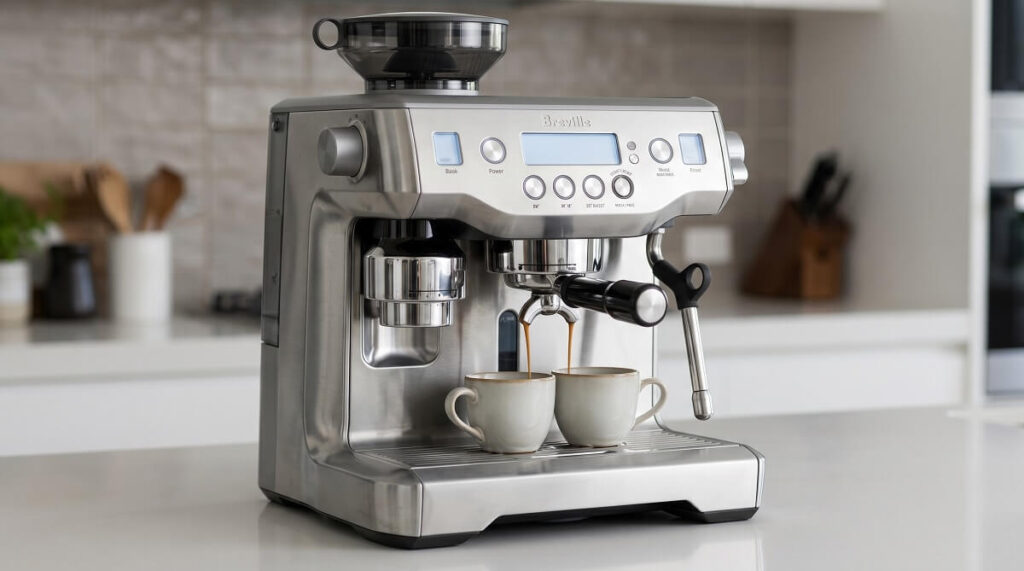
I’ve analyzed reviews from over 40 verified Breville Oracle BES980XL owners who’ve used this machine anywhere from one week to 10+ years. The verdict is overwhelmingly positive: 85% give it 5 stars, with most saying it delivers café-quality espresso without requiring professional barista skills. The machine combines automatic grinding, tamping, and milk frothing with enough manual control to satisfy enthusiasts, though the $2,000 price tag and large footprint aren’t for everyone.
Coffee Quality: Why Owners Ditched Their Old Machines
The most consistent praise centers on dramatic coffee quality improvements. Josh Rosenthal, who used a Saeco super-automatic for over 10 years, put it bluntly: “I thought the coffee tasted fine from the Saeco. But, I realized it tasted like crap once I got this machine.” His first shots with default settings produced what he called “incredible” coffee with “the least bitterness of any shot I ever had.”
Richard Z. Mazurek echoed this after extensive research on semi-automatic machines. He pulled his first shots using Java Espresso Authentico roasted just 5 days prior, setting his boiler to 199°F. “The double was very smooth,” he reported, noting the shot began pouring at the 11-second mark with “great crema.” His conclusion: “I LOVE THIS MACHINE.”
What makes the difference? Multiple owners credit the dual boiler system and precise temperature control. According to Home Espresso Machines, the Oracle’s PID temperature control maintains brewing temperatures within 1-2 degrees, while the separate steam boiler ensures consistent milk frothing without waiting between shots.
Andrew Giddings compared it directly to his 12-year-old Jura Capresso: “Compared to the Jura, the coffee from this machine tastes a lot better, the milk is frothed perfectly, its easier to clean and operate, quieter and there is less to go wrong internally.”
The Automatic Milk Frother: Barista-Quality Without the Learning Curve
If there’s one feature that converts skeptics, it’s the automatic steam wand. Timothy Garren discovered this after three months of use: “The milk frother is every bit as good as they claim. It just works. Perfect every time. Keep it clean and it will keep you happy.”
The system uses what lparsons21 called a “wonderful” self-cleaning function. “You do the milk, wipe the steam arm down with a damp cloth and push it back into place and it automatically does a few cleaning spurts. Very nice.” He tested it with milk at the proper temperature (140°F) and found the consistency “like wet paint, just like it is supposed to be.”
Bo Lorentzen appreciated the flexibility: “I wanted a totally step back and enjoy brewer, that I can go nitty-gritty with when in the mood.” The Oracle delivers both—automatic frothing when you’re rushed, or manual control via the steam lever when you want to perfect your technique.
Nick specifically chose the Oracle over fully-automatic machines after reading that “fully automatic machines have a tendency to only get the milk warm.” The Oracle’s temperature control solved this: “This machine has incredible temp control and gives you even manual control to get your milk as hot as you want.”
One caveat from Josh Rosenthal: “The milk can be tough to clean off the bottom part of the frother and you really should do it each time you use the frother.” This is more demanding than the plastic frother tip on his old Saeco, though most owners consider it a minor tradeoff.
Real Owner Experiences: The First Week to 10 Years
Short-term users consistently report quick setup and immediate results. Stephen A. Mitchell, who replaced an old Breville die-cast machine, watched instructional videos before the Oracle arrived. “Rarely does something exceed my expectations like this machine did,” he wrote. Unlike his previous machine’s “soupy slop,” the Oracle’s grounds formed “a perfect puck or cookie” that “just plops out after two taps.”
AFWI Bob made his first espresso within 30 minutes of opening the box, despite being “not coffee aficionados by any stretch.” After a month of daily use, he concluded: “The machine is easy to keep clean, looks stylish, and has exceeded our expectations.”
Long-term reliability shows more variation. Michael Weingartner called it “a phenomenal product” after extensive use, praising the ability to pull 10+ double shots sequentially without slowdown. R.P. purchased theirs in November 2017 and reported in August 2024: “Utilized nearly every single day since than and still makes amazing coffee & espresso. Perform the recommended maintenance and keep it clean—it will serve you well!”
However, Timothy Garren discovered one flaw after six months: beans occasionally jam in the hopper, causing the grinder to “rev up like a jet engine.” His solutions—redistributing beans while grinding or tapping the hopper sides—work but feel risky. “Breville should have included a vibrator in the hopper to prevent this,” he suggested.
Jasper Johns experienced more serious issues. Their machine needed service in December 2019 (three years after purchase), then again in March 2021 with a cracked shower screen. Despite these repairs, they maintained: “Even with these minor issues, I feel this machine has been well worth the investment.” Breville’s service impressed them—repairs completed in under two weeks with prepaid shipping both ways.
Learning Curve: From Zero Experience to Perfect Shots
First-time espresso makers report surprisingly short learning curves. Kirk Woll admitted: “I honestly had never made espresso before, and had no idea what I was doing. But opened the box, set it all up, and within twenty minutes was making some of the best lattes I’ve ever had.”
The Oracle’s approach splits the difference between fully-automatic and manual machines. As Bo Lorentzen explained: “You have an espresso basket to put in one port for the grinds to be dispensed into and tamped. Then, you move it to the other port and it makes the coffee.” This semi-automatic process takes more attention than pressing a single button but eliminates the trickiest variables—grind distribution, tamp pressure, and temperature control.
Matt C., who owned “over 10 machines ranging from manuals to super automatics by Saeco and Jura,” called consistency the key advantage. “Playing with the grind setting allows you to pull perfect shots given your exact water and coffee conditions. Being able to set the texture and temperature of your milk is unbelievable.”
S Bryan summarized the minimal dialing-in process: “Find the beans you like (make sure they are fresh), set the grind so espresso begins coming out of brew head in 7-12 seconds and set the amount of froth you want in the milk—that’s it.” After four months of use, he reported “consistently good cappuccino every time.”
Jean switched from a Jura ENA specifically for ease of use across family members. “Everyone is using it and the results are great,” she reported, noting the Oracle was “very easy to use, consistent” with a “milk frothing system easy to use AND clean.”
What You Need to Know Before Buying
Counter Space Requirements
Multiple owners emphasized the Oracle’s substantial footprint. Stephen A. Mitchell warned: “Be aware that this is a tall beast that requires 18″ of space to fit under cabinets.” Timothy Garren created a dedicated solution: “I decided before purchasing the machine that I was going to put it on its own stand inside a kitchen bay window. You would have to have an extremely large kitchen to not be disappointed by the amount of counter space this device takes up.”
Nick added practical placement advice: “Plan on putting it on a countertop with at least 20″ clearance in height, so can easily fill-up the bean hopper on top and fill-up the water tank from the top door.” He also noted the power cord is “pretty short” with extensions not recommended by Breville, so “plan on putting it right next to a plug.”
Maintenance Reality
Timothy Garren’s six-month update provided the most detailed maintenance assessment. While praising the machine’s functionality, he noted: “There are five separate cleaning and maintenance tasks that take up the majority of the 42 page manual.” He bookmarked the manual in his browser for regular reference and recommended potential buyers “look at the manual before purchasing.”
The silver lining: “The machine does most of the work for you,” he explained. “You do have to keep a number of supplies on hand for maintenance and that will add to the expense.” Despite the upkeep, he concluded: “I do really love this machine, I look forward to that first cup every morning.”
Josh Rosenthal found daily cleanup manageable compared to his Saeco, noting the active time making beverages was “about the same” since the Saeco required manual milk frothing attention. The Oracle’s ability to froth milk hands-free while pulling espresso created time savings that offset the semi-manual portafilter process.
Milk Alternatives Performance
Timothy Garren tested dairy alternatives extensively: “Blue Diamond almond milk produces microfoam in this machine that is very similar to milk. Silk tastes about the same but doesn’t produce the foam for some reason.” This makes the Oracle viable for lactose-intolerant users or those preferring plant-based options.
Bruce Belles reported exceptional results with almond milk for lattes: “This oracle takes the nut fat in the milk and makes it into Cream! We had to work to get the double boiler to get it right, but this steam wand does it right every time!”
Initial Setup Issues (And Solutions)
Several owners reported concerning first-day experiences that resolved unexpectedly. Clark 1147 set up the machine according to directions, but it “would not heat up above 165 degrees” despite running for hours. After shutting off overnight, “it heated to 200 in less than 10 min” the next morning. He speculated: “Maybe the ambient temperature of the machine had to match that of my house.”
lparsons21 experienced more dramatic problems with two consecutive machines arriving DOA. On the second unit, he “remembered that air locks are sometimes a fact of life. So I opened the 2 boiler drains and then turned it on and let it run until some water came out. Closed the drains, the machine kept going and filled the boilers and heated up. All is good!!” This airlock issue appears in several owner forum discussions as a known first-use quirk.
Simon Watkins had Amazon replace his non-heating unit the next day, praising the retailer’s service: “Started a late night online chat with an amazon rep, the replacement arrived the next day and the failed and carefully reboxed machine was taken away.”
The Price Question: Is $2,000 Worth It?
At approximately $2,000, the Oracle sits in an awkward pricing position—similar to super-automatic machines but requiring more user involvement. Owners justify the cost differently based on their coffee habits and priorities.
Jack and Gail made the purchase to replace their “$20 a day Starbucks latte habit.” One month in, they reported the Oracle had “cut down significantly” on café visits, suggesting a payback period of roughly 100 days at their previous spending rate.
R.P. took the long view: “Expensive at first but if you amortize the use over time it has paid for itself many times over.” Their nearly 7-year ownership (as of August 2024) breaks down to roughly $0.78 per day assuming single daily use—far below café prices for comparable drinks.
Bo Lorentzen addressed the cost complaints directly: “Why on earth is there so many reviews about the cost of the Oracle? Lets get this out of the way right away. The oracle case more than most espresso makers, you can pick up a super-matic for less that will do one button brewing.” His perspective: if you’re concerned about ongoing service costs, “you got the wrong coffeemaker.” He compared it to luxury car ownership—the capabilities justify the investment for serious users.
Dragon Flyer, who tried “several different espresso makers,” called the Oracle his favorite despite Nespresso being his second choice. “What I like even better with the Oracle is that the coffee is noticeably better and almost as easy,” he concluded, calling it worth the premium.
According to The Coffee Maven, the Oracle’s dual boiler system and automatic tamping typically cost $3,000-5,000 in commercial-grade machines, making the BES980XL a relative value in context.
Who Should Buy the Breville Oracle BES980XL
Best for:
- Coffee enthusiasts currently spending $15+ daily at cafés
- Home users wanting café-quality results without barista training
- Upgraders from entry-level machines (Barista Express, basic super-automatics)
- Households where multiple people need to make quality espresso drinks
- Those with adequate counter space (18″+ height clearance, dedicated outlet nearby)
Skip if:
- You need one-button operation (consider a super-automatic instead)
- Counter space is extremely limited
- You’re unwilling to perform regular maintenance (descaling, cleaning, etc.)
- You prefer fully manual control (consider a traditional semi-automatic + separate grinder)
- Budget is under $1,500 (look at the Breville Barista Express BES870XL)
Samuel Kachmar captured the ideal use case: His pregnant wife craved cappuccinos, and “with the autotamp function, the self cleaning milk steamer, etc really makes it feasible to make amazing coffee and have it happen in a short period of time with little fuss. The machine does alot of the work once you get things dialed in.”
ALE upgraded from the Barista Express BES870XL specifically for the dual boiler and speed: “Lattes are made within 3-4 mins, including clean up and is consistent once you learn your settings.” For morning rushes, the timer function proved essential—setting the Oracle to warm up 15 minutes before waking.
Common Questions from Real Owners
Can you adjust the amount of coffee grounds?
Josh Rosenthal noted a limitation: “You only have one portafilter size. It only dispenses a fixed amount of grounds.” The machine determines grind quantity automatically based on the basket size (single or double). “So, if you want a full strength double, you really have to make 2 singles. You will have something different if you just let water flow through the same grounds for an extra 10 seconds.”
Richard Z. Mazurek found a workaround: “I READ CHANGING TAMP PRESSURE HIGHER WILL MOVE IT UP 1 GRAM. I GUESS YOU ALSO CHANGE WATER VOLUME TO ADJUST TASTE.”
How loud is it?
AFWI Bob compared it to typical café equipment: “The machine makes the same level of noise you find in any coffee shop.” Luis Galano was more critical: “It is a little noisy so if u want a shot at 5 am you may be getting some complaints.”
Does the auto-start timer really help?
Multiple owners called the programmable timer “super nice” (AFWI Bob) and essential for morning routines. Michael Weingartner explained: “The timer let’s you set the Oracle to automatically turn on whatever time you choose so the 3-5 minute warm up is not a factor.” Andrea J Bowen programmed hers to activate “about 15 minutes before I wake up so I can stumble down to the kitchen and start making a latte right away.”
Can you use pre-ground coffee?
Clark 1147 confirmed: “I’m using the ground coffee we have in house” successfully, though the machine includes an integrated grinder for whole beans. The Oracle accommodates both, though fresh-ground beans produce noticeably better results according to most reviewers.
Breville Support Experience
Owners who needed warranty service generally praised Breville’s responsiveness. Jasper Johns received replacement parts in 7-10 days when their shower screen cracked. The $5.82 part was an “easy replacement.”
Jerzy R. Bialuski had more dramatic support: After his December 2016 purchase started “acting up” in November 2018 (within the two-year warranty), Breville didn’t repair it—they “sent a brand new machine” after a 10-day turnaround. “That is Great service,” he concluded.
lparsons21 highlighted Breville’s above-and-beyond response when his second replacement unit had issues: “They were going to pull one from the warehouse and fully test it before sending it out. That’s going above and beyond IMO.”
Chelsey noted quick parts replacement when her machine arrived with a missing metal filter on the water reservoir: “Contacted Breville, and had a replacement piece and a box of filters within 2 days at my door for no charge. Awesome customer service!”
The Bottom Line
After analyzing over 40 verified owner reviews spanning one week to 10+ years of use, the Breville Oracle BES980XL earns its reputation as a bridge between automation and manual control. The 85% five-star rating reflects genuine satisfaction from owners who previously used everything from basic machines to high-end Jura and Saeco super-automatics.
The machine delivers on its core promise: café-quality espresso and milk-based drinks without requiring professional barista skills. The automatic grinding, tamping, and milk frothing eliminate the trickiest variables, while preserving enough manual control to satisfy enthusiasts. As lparsons21 summarized after detailed testing: “Overall this machine is excellent IMO. Looks good, works good and my experience with Breville says it will last quite awhile and they do back up their stuff quite well.”
The $2,000 investment makes sense for serious home users spending significant money at cafés, those upgrading from entry-level machines, or households where multiple people want consistent results. The counter space requirements, maintenance needs, and initial learning curve are real considerations, but owners who committed to the Oracle overwhelmingly report they’d buy it again.
LMSL captured the consensus after months of daily use: “If you have the funds to buy this, do not hesitate! Yes, it is expensive, but so worth it! Every day I have made a latte, cappuccino, or café Americano, with perfect results every time. This machine is amazing, and one of the best purchases I have made in my life.”