When my blade grinder finally gave up after years of producing inconsistent grounds and coating my kitchen counter in coffee dust, one thing became very clear: I needed to upgrade to a burr grinder without spending $300+. After analyzing hundreds of verified owner reviews of the Bodum Bistro Premium Burr Grinder, I discovered something remarkable—this sub-$100 grinder has convinced thousands of coffee drinkers that professional-quality grinding doesn’t require a professional-sized budget. With owners reporting 4, 7, even 12 years of daily use producing espresso-quality grinds that transformed their home coffee from “acceptable” to “better than the coffee shop,” the Bodum Bistro has quietly become the go-to recommendation for anyone making the leap from blade to burr grinding.
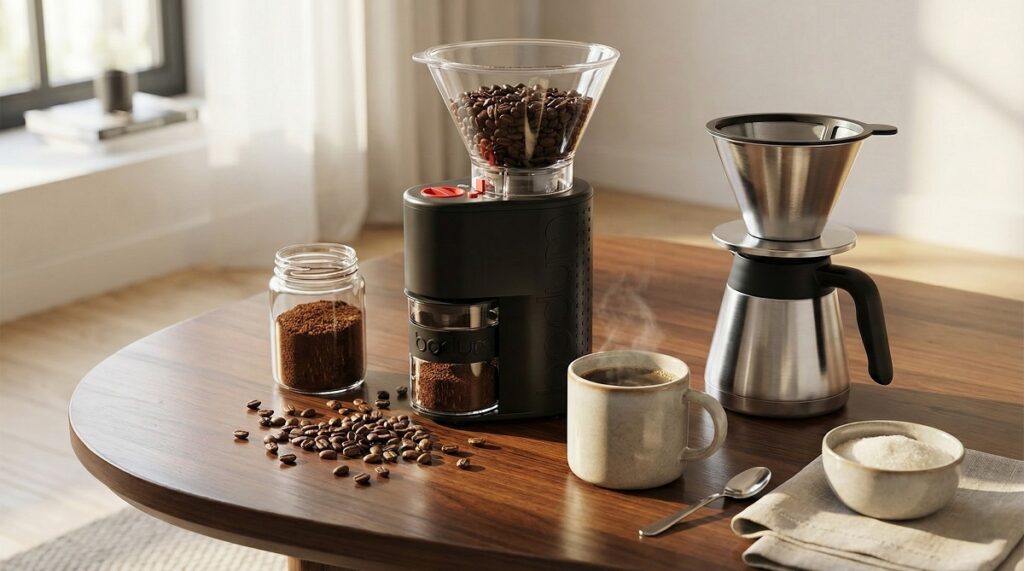
According to Amazon, where this model maintains strong ratings across thousands of reviews, the Bistro features a conical burr grinding mechanism, 12 grind settings from coarse French press to fine espresso, and a unique glass grounds container that eliminates the static electricity mess that plagues competing models. Real owners confirm these aren’t just marketing claims—the glass container and slow-grinding conical burrs deliver on the promise of mess-free operation and dramatically improved coffee flavor.
If you’ve been grinding with a blade grinder or buying pre-ground coffee and wondering if a burr grinder is worth the investment, here’s what hundreds of long-term Bodum Bistro owners have to say.
Key Specifications at a Glance
| Specification | Details |
|---|---|
| Model Name | Bodum Bistro Electric Burr Coffee Grinder |
| Grinder Type | Conical burr (hardened steel) |
| Grind Settings | 12 settings (twist hopper to adjust) |
| Grind Range | Coarse (French press) to Fine (espresso) |
| Bean Hopper Capacity | 7.75 oz / 220g |
| Grounds Container | Borosilicate glass with rubber lid |
| Timer | 0-20 seconds (mechanical dial) |
| Motor Limitation | 20 seconds maximum, 5-minute cool-down recommended |
| Dimensions | 7.9″ W x 6.3″ D x 12″ H |
| Weight | Approximately 4 lbs |
| Available Colors | Black, White, Red |
| Retail Price | $89-$119 (frequently on sale) |
| Warranty | 2-year limited |
What Real Owners Love About the Bodum Bistro
The overwhelming consensus from verified purchasers centers on three transformative qualities: grind consistency that dramatically improves coffee flavor, a glass container design that eliminates the static electricity mess of traditional grinders, and exceptional longevity that delivers years of daily use. According to reviews collected from Amazon and other retailers, these qualities consistently earn the Bistro recommendations from owners who’ve tried multiple grinders.
Grind Consistency That Transforms Your Coffee
The single most repeated claim across reviews is that switching from a blade grinder to the Bodum Bistro produces noticeably better-tasting coffee immediately. Gary R. McCue, whose review 48 people found helpful, described the difference after years of using blade grinders: “The grind seems exceptionally even. There is no comparison whatsoever with my last grinder. The quality of the coffee has improved greatly, I am again tasting flavors I remembered from the days of the old hand grinder.”
A. Cantu’s experience echoed this transformation: “Going from a $20 blade grinder to the Bodum burr grinder is like going from a Ford Festiva to a BMW. Coffee just tastes much noticeably better. There’s no real other way of saying it. I can even downgrade to cheaper beans now because they taste good too.”
Snoopy, a dedicated French press user, provided the most compelling evidence for grind consistency: “Bar none, every blade grinder has defeated the press, with varying degrees of literally sludge at the bottom of the cup. Well, no more. The Bodum beauty burrs out a nearly perfect consistency grind.” After switching to the Bistro, Snoopy reported only minor “silt” in the last few sips—”you may see a swirl of powdered grind at your last 4 sips, but you won’t taste or worse feel it.”
According to TechGearLab’s hands-on testing, the Bistro “performed well in grind consistency tests, despite costing less than most competitors,” making it an exceptional value in the burr grinder category.
The Glass Container: A Mess-Free Revelation
Perhaps the most universally praised feature is the borosilicate glass grounds container with its flexible rubber lid. This design eliminates the static electricity that causes coffee grounds to cling to plastic containers and spray across countertops—a problem that plagues nearly every competing grinder.
Jeremy, whose detailed review 19 people found helpful, called out this advantage specifically: “Bodum did an excellent job designing this grinder. No issues with static whatsoever. The flexible lid of the glass cup creates a seal with the grinder, ensuring grounds only go into the cup and not all over the place.”
Snoopy confirmed the cleanliness advantage: “The glass receiver and the soft rubber top keep it contained. I’ve gone through a lot of coffee getting my perfect cup down, and the counter top does not look like a disaster area.” He noted that unlike other grinders where “the counter top was covered in coffee dust,” the Bistro’s glass design means “just on cleanup alone, this thing is awesome.”
A. Cantu, who previously dealt with blade grinder chaos, expressed relief: “With the blade grinder, it was impossible to put beans in the container, grind, take off the lid, dump grinds into a container, then repeat 4 or 5 times, without spilling grinds everywhere. With the Bodum burr grinder, there is hardly any mess. I might notice some after a week of use, but it’s pretty small.”
glr, in a more recent review, reinforced this point: “Most aggravating is the static electricity caused by plastic grounds bins and the continued spewing of grounds when the bin was removed. The Bodum grinder, while not perfect, is very close, and at a price well below the before mentioned mess makers. One of the secrets of success here is the glass grounds receptacle and the center feed rubber cover. Almost no static mess and can be wiped clean with a paper towel.”
The Conical Burr Mechanism: Built to Last
The hardened steel conical burr is the component that separates this grinder from cheap blade models, and long-term owners consistently praise its durability and performance. FlyingDutchman, an engineer who disassembled the unit for analysis, provided detailed insight: “They put their money in the most important part: its beautifully made conical burr. The reduction gears are nylon. This is fine given the limited forces in play. The burr is driven through a neat safety clutch, a helpful feature in case of jams.”
Gary R. McCue provided the most compelling longevity evidence through multiple updates to his review: “After nearly 18 months the grinder is working as well as ever. I make coffee twice daily, no sign of slowing down, no strange noises.” His second update, posted two and a half years later, confirmed continued performance: “After four years of grinding, making coffee at least twice a day, this Bodum is still going strong. No problems whatsoever, no mess on the counter, still an even grind.”
Thorgils offered perhaps the ultimate testament to durability: “The motor (or, more likely, the on/off push switch) of my Bodum Bistro stopped working yesterday . . . 25 years and 33 days after entering service.” After a quarter-century of daily use, Thorgils had “no hesitation about rebuying the same model.”
Bostonian’s review, updated after 7 years, confirmed this pattern: “It finally died! It was an ‘honorable death’, after years of loyal duty in a household where fresh ground beans are ‘a must’. What did we buy this time? Same grinder!”
Simple Operation That Gets Results
Unlike complex grinders with digital displays and dozens of settings, the Bistro uses mechanical controls that owners find refreshingly straightforward. Josh described the functionality: “There’s not much to it—an on/off switch, a timer (to control grind ‘dosing’), a secondary ‘on’ button to initiate grinding, and the grind setting which adjusts by twisting the bean hopper.”
A. Cantu appreciated the simplicity after dialing in his preferred settings: “You’ve got 2 adjustments you can make: the grind size and the timer. Once you get a few pots brewed you’ll figure out pretty quickly what settings work for you. And the settings are mechanical (not electrical) so even if you unplug the machine, the settings will remain where they are so you dont have to change them. Ever. (unless you want to)”
Betty, writing after 9 months of daily use, confirmed the learning curve is minimal: “If you’re a serious coffee drinker (read: coffee snob), then this should not be much of a problem, because you’d be grinding beans fresh for every cup instead of brewing up a big pot (or grinding beans ahead of time for storage).”
Quieter Than Blade Grinders
While no grinder is silent, owners consistently note the Bodum Bistro operates more quietly than blade grinders. Snoopy described the noise profile: “This guy is reasonably quiet. It is grinding beans, so it will be noisy, but unlike all blade grinders I’ve used, this is a lower frequency noise and you can carry on a conversation with it running. Overall it is the quietest grinder I’ve used.”
Jeremy confirmed: “This grinder is more quiet than blade grinders. It is solidly built and probably muffles noise as much as possible.”
Common Complaints and Concerns
No grinder is perfect, and analyzing critical feedback reveals several recurring issues that prospective buyers should weigh carefully before purchasing.
The 20-Second Timer Limitation
The most frequently mentioned frustration involves the grinder’s 20-second maximum run time with a recommended 5-minute cool-down between grinds. This limitation exists to prevent motor overheating, but it creates inconvenience for those brewing large pots of coffee.
Edward Marcus, whose review 35 people found helpful, initially gave the grinder four stars but later downgraded to reflect his growing frustration: “I’m getting impatient waiting 5 minutes before running the grinder a second time. I now find this requirement an annoying restriction imposed by the manufacturer which should be corrected in subsequent models.”
Gary R. McCue addressed this pragmatically after years of use: “At the above setting, I can grind four coffee scoops of beans (one tablespoon each) in 20 seconds. But sometimes I grind five and I run to a stop with beans left. I have decided to wait maybe fifteen seconds and then hit the start button for another six to eight seconds and then stop it to grind the remaining beans.”
FlyingDutchman explained the engineering tradeoff: “This machine is not for you if you like to grind lots of coffee all at once. Why? It does not grind fast and on top of that the manual specifies letting the motor cool down five minutes between batches. This is a design compromise where manufacturing cost is traded against throughput.”
A. Cantu offered the most practical workaround for those who need more coffee: “If you can deal with the 5 minute wait in between grinds, then this grinder is for you. My favorite being ‘just brew a half pot at a time.’ It’s still not perfectly convenient, but if I need a full pot, that’s what I’ll do.”
Assembly Can Be Confusing
Several newer reviewers mentioned difficulty assembling the unit out of the box. Stephanie Deakin warned: “I had to search for a Youtube video to help me assemble the darn thing! It’s easy, you just have to press harder than you think you should on the hopper to get it locked into place.”
Mary Greene encountered a related issue with her bargain-priced unit: “Notice how many recent buyers of this bargain Bodum coffee grinder rate the grinder highly. My original workhorse Bodum grinder lasted 5 years until the motor conked out. BUT you may get one with a coffee bean holder cone that won’t swivel to your desired grind setting. Quick Fix if your new bargain Bodum coffee bean holder cone doesn’t swivel to your desired grind setting: LIGHTLY file the CLEAR plastic nub that’s a tiny bit too long until the coffee cone swivels.”
Grind Quality at Finest Settings
While the Bistro excels at drip and French press grinds, some espresso enthusiasts note limitations at the finest settings. According to Coffee Chronicler’s review, “at finer settings you will get some harshness in the cup and muddled flavors, making it difficult to discern particular flavor notes.”
Jeremy acknowledged this limitation: “I’ll admit, I was expecting the grind to be as consistent as commercially purchased pre-ground coffee. It is not. There are very small amounts of fine powder mixed in with the courser grinds, but overall it is not a problem for me. The grind is much more consistent compared to my old blade grinders!”
Hopper Tends to Rotate During Use
FlyingDutchman noted a mechanical quirk: “The hopper tends to rotate itself to a coarser setting owing to torque effects so check ever so often.” This means users need to occasionally verify their grind setting hasn’t shifted during operation.
Noise Level Higher Than Expected
While quieter than blade grinders, the Bistro isn’t silent. According to Coffeeness.de’s testing, “the grinder is one of the louder and more annoying models tested, and the reason is not so much its volume but its high pitch, which tends to rattle the eardrum more.”
Replacement Parts Difficult to Find
FlyingDutchman warned: “Bodum borosilicate glass replacement beakers are impossible to find, except the occasional used one on eBay, so do be careful.” This makes the glass container a potential point of failure if broken, though most owners report it holds up well to daily use.
Essential Tips From Long-Term Owners
Experienced Bodum Bistro users have developed techniques and maintenance practices that maximize the grinder’s performance and longevity. Here’s what they recommend.
Getting the Best Grind
- Tap the Sides Before Removing Container
- Jeremy advises: “Inevitably there will be grounds stuck up in the burrs when the machine shuts off, so if you don’t give the machine a little tap before pulling the grounds cup out, some grounds may fall out inadvertantly.” Multiple owners recommend tapping both sides simultaneously before removing the glass container to knock out remaining grounds.
- Fill the Hopper for Consistent Results
- Snoopy found the grinder “works best with a hopper full of beans. The timer and grind setting are most consistent then, as it feeds evenly.” This ensures steady bean flow through the burrs.
- Add Water Droplets to Reduce Static
- FlyingDutchman recommends: “Splash a few water droplets on your beans before grinding to reduce static buildup.” This simple trick minimizes the small amount of static that can occur with certain bean types.
Maintenance and Cleaning
- Regular Burr Cleaning
- FlyingDutchman emphasizes: “Remember to clean the burr area regularly because it can clog especially if your coffee is oily.” The grinder disassembles easily for access to the burr chamber.
- Rice Trick for Deep Cleaning
- Snoopy detailed this technique: “I took the old trick of running some white rice through the burrs (after a thorough brush cleaning) to get all the coffee out, then used it to convert coarsely ground flax seed to finely ground flax seed. Once done, the fine flax seed was very well and evenly ground.”
- Respect the Cool-Down Period
- Gary R. McCue’s advice after 4+ years of use: “If I exceed the 20 seconds when making a larger pot I always let the grinder rest for a minute or so to give the motor a break. Since I purchased this grinder I have had to replace both my automatic drip coffeemaker and my coffee roaster. As expenditures go in this throw-away society, this has been an excellent investment.”
How Does the Bodum Bistro Compare to Other Entry-Level Burr Grinders?
Dimon’s exhaustive research compared the Bodum Bistro to competing models in the same price range. According to HomeGrounds’ analysis, the Bistro occupies a “Goldilocks zone of being not too expensive yet well constructed enough to produce high-quality grinds,” making it one of the best values on the market.
| Feature | Bodum Bistro | Typical Blade Grinder | $200+ Burr Grinder |
|---|---|---|---|
| Grind Consistency | Excellent for price point | Poor, uneven particles | Superior, stepless adjustment |
| Static/Mess | Minimal (glass container) | Significant | Varies by model |
| Price | $89-$119 | $15-$40 | $200-$400+ |
| Grind Range | French press to espresso (12 settings) | Limited control | Precise, 40+ settings |
| Longevity | 4-12+ years reported | 1-3 years typical | 10+ years with maintenance |
| Grinding Speed | Slow (by design) | Fast | Moderate to fast |
| Capacity Limitation | 20-second cycles | None | None |
| Ease of Cleaning | Easy disassembly | Difficult | Varies by model |
Who Should Buy the Bodum Bistro Premium Burr Grinder
Based on patterns across hundreds of owner experiences, the Bodum Bistro is ideal for:
- Blade grinder users ready to upgrade — the immediate improvement in coffee flavor justifies the investment
- French press and drip coffee drinkers — the grinder excels at coarse to medium grinds
- Solo coffee drinkers or couples — the 20-second limitation works fine for 1-4 cups at a time
- Budget-conscious buyers — professional grind quality without the $300+ price tag
- Small kitchen dwellers — compact footprint that doesn’t dominate counter space
- Anyone frustrated with grinding mess — the glass container eliminates static electricity chaos
- First-time burr grinder buyers — simple mechanical controls without overwhelming features
- Espresso beginners with pressurized portafilters — adequate for entry-level espresso machines
Who Should Consider Other Options
This grinder may not suit everyone. Consider alternatives if you:
- Brew large pots daily: The 20-second timer with 5-minute cool-down creates frustration for 10+ cup brewing
- Are a serious espresso enthusiast: The finest settings produce adequate but not exceptional espresso grinds; dedicated espresso grinders offer better results
- Need commercial throughput: This is a home grinder designed for moderate daily use, not continuous operation
- Want stepless adjustment: The 12 grind settings are adequate but not infinitely adjustable like higher-end models
- Are extremely noise-sensitive: While quieter than blade grinders, the high-pitched motor may bother sensitive ears
- Already own a quality hand grinder: Manual burr grinders in this price range offer comparable grind quality with more control
Final Verdict
The Bodum Bistro Premium Burr Grinder has earned its reputation as the best entry point into burr grinding for good reason. Across hundreds of verified reviews spanning more than a decade, the pattern is unmistakable: owners who make the switch from blade grinders experience an immediate, dramatic improvement in coffee flavor that makes it impossible to go back.
As David C. Cobb summarized after 4 years of daily use before his first unit finally died: “Once I got the grind size and grind time dialed in, this machine delivered a consistent ground size and quantity that led to a cup of coffee I could rely on. No need to measure the proper tablespoon amount. I just had to empty the grounds chamber directly into the coffee filter. No fuss or mess. I was awarded with a consistent tasting cup of coffee daily with minimal effort. My only real criticism is that this machine is a little noisy, but the noise only lasts for a little over 5 seconds and for me the resulting improvement in convenience and taste is worth it. I know there are better machines out there but you really pay for those. This little Bodum does what I need it to do at a reasonable price. Highly recommended.” When his replacement was needed, he bought another Bistro without hesitation.
FlyingDutchman’s engineering assessment captures the value proposition perfectly: “Nothing will beat this elegant conical burr grinder on grind uniformity and range versus price. Bodum Bistro is aesthetically pleasing, engineered well, has a compact footprint, and punches above its weight. You will enjoy it for a long time if you stay within its design limits.”
At $89-$119 retail—frequently available on sale for $70-$90—the Bodum Bistro delivers an extraordinary combination of grind quality, durability, and mess-free operation. The 20-second limitation is real, but for individuals and couples brewing 1-6 cups at a time, it’s a minor inconvenience compared to the transformative improvement in coffee flavor. With owners reporting 4, 7, 12, and even 25 years of reliable daily service, this grinder represents exceptional value for anyone ready to experience what freshly-ground coffee should actually taste like.
Frequently Asked Questions
Is the Bodum Bistro good for espresso?
The Bistro produces adequate espresso grinds for entry-level machines with pressurized portafilters, but serious espresso enthusiasts may find the finest settings insufficient. Jeremy reported: “I don’t own an espresso machine, so I can’t comment on the espresso grinding ability of the grinder (I only grind for brewed coffee). From most reviews though, it seems to do espresso grind pretty good.” Josh confirmed it “might not be fine enough for a bottomless portafilter.” For beginner espresso setups, it works well; for advanced espresso brewing, consider a dedicated espresso grinder.
How long does the Bodum Bistro last?
With proper maintenance and respecting the 20-second cool-down guideline, owners report 4-12 years of daily use. Thorgils achieved 25 years before the switch failed. Gary R. McCue used his for 4+ years with twice-daily grinding. Bostonian’s unit lasted 7 years. The key is allowing adequate cool-down time between grinding cycles and regular cleaning of the burr chamber.
How much coffee can it grind in 20 seconds?
At medium grind settings (drip coffee), Gary R. McCue reports grinding “four coffee scoops of beans (one tablespoon each) in 20 seconds,” which is sufficient for about 4-6 cups of coffee. At finer espresso settings, 17 seconds produces enough for a double-shot. Jeremy confirmed: “At the drip filter setting 20 seconds grinds enough for 10 strongish cups of coffee (individual tastes will vary).” The amount varies significantly based on grind setting and desired coffee strength.
Is the glass container dishwasher safe?
While owners don’t specifically mention dishwasher use, the borosilicate glass container is durable and easy to clean. Multiple owners note it cleans easily with warm soapy water. MalinoisLover reported: “This glass is somehow different and cleaning is easy and simple. Mostly just with soapy water and a sponge unless especially dirty then the scrubber side of the sponge might be needed.” The minimal static means coffee grounds don’t cling to the glass, making cleanup quick.
Does it work with oily dark roast beans?
Yes, though oily beans require more frequent cleaning. FlyingDutchman advises: “Remember to clean the burr area regularly because it can clog especially if your coffee is oily.” Gary R. McCue specifically mentions using “very oily” French roast beans without gumming up the grinder. The key is periodic cleaning to prevent buildup in the burr chamber.
How loud is the Bodum Bistro?
The Bistro is quieter than blade grinders but not silent. Snoopy described it as “reasonably quiet” with “a lower frequency noise” compared to blade grinders, noting “you can carry on a conversation with it running.” However, some testing sites note the motor has a higher-pitched tone that may be more noticeable than the volume alone suggests. Most owners find the noise acceptable for the 5-20 seconds of operation.
Can I grind spices or other non-coffee items?
Snoopy successfully used the grinder for flax seeds after thoroughly cleaning out coffee residue with rice. However, this isn’t the grinder’s primary purpose, and switching between coffee and other items requires careful cleaning to avoid flavor contamination. Most owners recommend keeping it dedicated to coffee for best results and easiest maintenance.