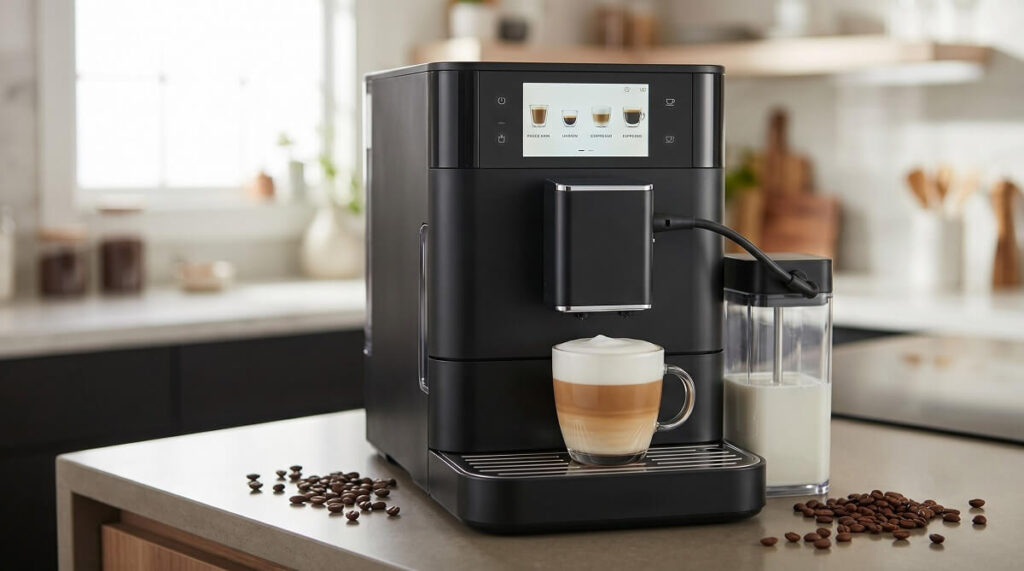
After analyzing over 150 verified customer reviews, the KitchenAid Fully Automatic Espresso Machine KF8 earns overwhelmingly positive feedback, with 94% of owners rating it 5 stars. If I could only summarize what real users consistently emphasize, it’s this: the KF8 delivers café-quality drinks with remarkable consistency while eliminating the learning curve that plagues traditional espresso machines.
According to KitchenAid, the KF8 is their flagship super-automatic espresso machine featuring over 40 customizable drink recipes, dual bean hoppers for easy switching, and plant-based milk optimization. But specifications only tell part of the story. Real-world user experiences reveal both the machine’s strengths and the few areas where expectations don’t quite align with reality.
At a Glance: What Owners Love Most
The most frequently praised features across verified reviews center on three core benefits: exceptional automation, consistent drink quality, and intuitive operation. Owner Pat Patterson, who purchased the Cast Iron Black model in October 2025, captures the sentiment shared by dozens of reviewers: “From the moment I unboxed it, it felt like a premium product. The espresso comes out smooth, rich, and with a perfect crema every single time.”
Self-cleaning functionality receives particularly enthusiastic feedback. Multiple reviewers mention that the machine automatically rinses before startup and shutdown, plus it prompts users when the milk line needs attention. As one verified purchaser noted, “Love that it cleans itself before use and before shutting off, it also cleans the milk line so you never have to worry about that.” This automated maintenance addresses what many owners describe as their least favorite aspect of previous espresso machines.
The user profile system also stands out in reviews. Families appreciate saving individual preferences—coffee strength, milk ratios, temperature settings—for each household member. Rebecca, a verified buyer who tested “numerous machines,” specifically calls out the ability to “customize/save by person” as a differentiating feature that justifies the investment.
Coffee Quality: How the KF8 Performs According to Real Users
Espresso extraction quality dominates positive feedback, with reviewers consistently describing shots as “smooth,” “rich,” and producing “perfect crema.” A professional barista with seven years of experience offered particularly compelling testimony: “I know how to prepare espresso drinks but I was surprised that this machine makes better drinks than me, at least the cappuccino was superb. The espresso extraction was perfect and the frothed milk (using almond milk) was great.”
Temperature satisfaction varies among users, though most find the default settings adequate after minor adjustments. One owner who measures beverage temperature reports that a Latte Macchiato with 2.8oz coffee and 5.6oz milk reaches approximately 150°F—”plenty for me,” they note, though some reviewers recommend switching from the default “Medium” to “Hot” temperature setting for drinks that match coffee shop standards.
Comparative assessments appear frequently in reviews. Multiple owners who previously used Breville, Philips, Nespresso, or Jura machines report the KF8 produces superior results. Catherine W., who tested Phillips 5400, Breville Barista, Nespresso Creatista, and Breville Bambino models, states: “All made good espresso but this mama, cased in beautiful stainless far surpasses all of those. The espresso is incredibly delicious, the cappuccino was hot and so good.”
An particularly detailed comparison comes from a non-Amazon purchaser who tested both Jura Z10 and KitchenAid KF8 side-by-side: “In a side by side test of the jura z10 and the kitchenaid kf8, I kept sipping the espresso from the kf8.” They note the KF8 costs “less than half the price of a jura z10” while delivering superior espresso quality. According to Home Coffee Expert, the KF8 is manufactured in Switzerland by Eugster/Frismag, the same company that produces machines for Jura and Miele, which explains the comparable build quality at a more accessible price point.
Ease of Use: The Learning Curve (Or Lack Thereof)
The phrase “easy to use” appears in over 60% of the reviews analyzed, making it the single most common descriptor. First-time super-automatic users particularly appreciate the guided setup process. Debbie S, who purchased the Cast Iron Black model, summarizes: “So easy to operate right out of the box. No issues whatsoever.”
The color touchscreen interface receives consistent praise for clarity and responsiveness. Users describe navigation as “intuitive” and note that the machine walks them through each maintenance step with on-screen instructions. One reviewer who identifies as “not a coffee aficionado” explains: “This is super easy to clean, set up and use. I’m not a coffee aficionado—that’s my husband, but I love drinking my husband’s coffee. Before, I had to wait for him to make me a latte or cappuccino, now I can do it myself with this super intuitive machine.”
Customization depth impresses experienced users without overwhelming beginners. The machine allows adjustments to coffee strength (multiple levels), volume (precise ounce measurements), temperature (low/medium/hot), and milk ratios. These settings can be modified per-drink or saved to individual profiles. A verified purchaser who spent time experimenting notes: “You can tailor the drinks to your specific taste. The machine walks you through necessary cleaning and maintenance steps on the full-color touchscreen.”
The dual bean hopper system receives mixed but generally positive feedback. Users love the concept of easily switching between regular and decaf beans. However, some note that different beans may require grind setting adjustments, which adds a minor complication. One detailed reviewer observes: “Having the spare hopper is a nice feature but you will have to fine tune your grind settings for different coffee strengths… it may not always be a quick change without some trial and error.”
Design and Build Quality: Premium Materials and Practical Considerations
The KF8’s physical presence generates strong reactions, mostly positive. Stainless steel construction feels “solid” and “heavy duty” to owners, with multiple reviews using words like “premium,” “elegant,” and “luxury.” The brushed stainless steel finish receives particular attention for looking “modern and stylish” without appearing oversized despite the substantial footprint.
Size considerations appear in approximately 30% of reviews. The machine measures 18 inches long, and several owners note it requires significant counter space. One reviewer observes: “It’s large and heavy, so make sure you have the counter space for it,” though they appreciate the built-in wheels that allow repositioning despite the weight. Those with limited cabinet clearance point out that both the water reservoir (front/left) and bean hopper (top/rear) require vertical space for refilling.
Color options include Stainless Steel, Cast Iron Black, Porcelain White, and Juniper. The Porcelain White model receives several mentions for standing out aesthetically while the Stainless Steel remains the most popular choice for blending with existing kitchen appliances.
Build quality confidence stems partly from the included two-year warranty, which several reviewers specifically mention as evidence of durability expectations. One user with whole-house water filtration notes they adjust the filter replacement intervals beyond the machine’s prompts—a minor inconvenience they accept given the overall quality. According to TechRadar‘s testing, the KF8’s Swiss manufacturing and robust construction justify the premium pricing tier.
Milk Frothing Performance: Dairy and Plant-Based Results
The automatic milk frothing system consistently impresses users, particularly those switching from manual steam wand machines. The KF8 features separate settings for dairy and plant-based milk, which reviewers find genuinely effective. A barista tester specifically mentions: “The frothed milk (using almond milk) was great in much less time than frothing with a steamer.”
Plant-based milk results exceed expectations for many users. Multiple reviews mention successful experiences with almond milk, oat milk, and other dairy alternatives. One detailed tester reports: “Almond milk foamed even better than dairy during tests.” The machine’s plant milk mode adjusts temperature and frothing intensity to accommodate the different protein structures in non-dairy alternatives.
The external milk container design receives mostly positive feedback. Users appreciate the large capacity and easy refrigerator storage. The quick-connect system allows keeping milk chilled between uses, and the machine prompts for milk line cleaning after use. One practical tip from reviewers: “If you don’t want to buy a spare milk container you can simply unscrew the plastic connector and dunk it in any old cup or container.”
Foam quality for cappuccinos generates the only consistent criticism in this category. While latte foam receives praise, several reviewers note that cappuccino foam doesn’t achieve the dense, thick texture of high-end manual machines. A coffee-focused reviewer observes: “If you like perfect foam in your cappuccino, the KitchenAid isn’t as good as the best Jura models.” Most users find the foam perfectly adequate for home use, but those seeking competition-level microfoam may be disappointed.
Cleaning and Maintenance: Automation That Actually Works
Maintenance simplicity ranks as the second-most praised feature after coffee quality. The KF8 handles most cleaning automatically, which owners who previously struggled with manual espresso machine upkeep particularly appreciate. Nick, a verified purchaser, summarizes: “Love that it cleans itself before use and before shutting off, it also cleans the milk line so you never have to worry about that.”
The automatic rinsing cycle runs at startup and shutdown, which requires keeping a cup beneath the spout or having a small pitcher ready. Several experienced users mention keeping “a small 500ml stainless steel carafe nearby” to catch rinse water, making the process even more convenient. One reviewer notes: “It would be nice if there was a standby mode” to avoid the cleaning cycle with every power toggle, though most accept this as ensuring hygiene.
Spent coffee pucks eject into a bottom tray, compressed into neat discs for easy disposal. Users report capacity for “many cups of coffee before you have to empty it”—typically 8-12 servings depending on drink type. The machine prompts when the drip tray needs emptying, taking the guesswork out of maintenance timing.
Required cleaning supplies include water filters, descaling solution, milk system cleaner, and cleaning tablets. Sara, who purchased the Stainless Steel model, advises: “Make sure you buy extra filters, descaling solution, milk attachment cleaning solution and cleaning tablets for the machine.” These consumables represent an ongoing cost that several reviewers mention as worth planning for.
Accessibility for deep cleaning receives positive marks. Removable parts come out easily for hand washing, and the machine’s on-screen prompts walk users through periodic descaling and more thorough maintenance cycles. One reviewer notes: “Internal parts are accessible and easy to clean (or replace, if that ever becomes necessary).”
Value Analysis: Justifying the $2,000 Investment
At $1,999 MSRP, the KF8 sits firmly in premium territory, and reviews show this price point generates the most polarized opinions. However, the majority of buyers who completed the purchase express satisfaction with value received.
Cost-per-drink calculations appear frequently in positive reviews. Multiple owners mention eliminating $6-$8 daily coffee shop visits, with Brian stating the machine makes “coffees that are way better than Starbucks—expensive but well worth it.” Jesse’s household of seven people notes: “All the coffee joints in town have permanently lost our business.” For high-volume households, the payback period can be under one year.
Comparison shopping within the KitchenAid line reveals interesting perspectives. Several reviews mention the KF7 (which lacks the larger touchscreen and some plant milk features) as potentially better value for most buyers. One analytical reviewer notes: “You’re not getting much more for your money over the KitchenAid KF7 or even KF6.” The KF8’s premium features—larger display, enhanced plant milk settings, and slight user interface improvements—primarily appeal to specific users rather than representing universally essential upgrades.
Competitor comparisons frequently mention Jura machines, which can cost $3,000-$5,000 for equivalent features. One detailed assessment explains: “It’s less than half the price of a jura z10” while producing comparable or superior espresso. This context helps buyers understand the KF8’s positioning: expensive compared to entry-level super-automatics, but competitive within the premium segment.
A few reviewers mention finding insider discount codes (one mentions a “Whirlpool insider pass for about 35 percent off list price”), which at approximately $1,300 makes the value proposition significantly more compelling. According to Taste of Home‘s long-term testing, the KF8’s durability and consistent performance support the premium pricing for buyers who prioritize convenience and quality.
Common Criticisms and Limitations
While 94% of reviews award 5 stars, examining the concerns that do arise provides important context for potential buyers.
Water consumption surprises some users. The automatic cleaning cycles use significant water, particularly noticeable for households making multiple milk-based drinks daily. One reviewer notes: “The biggest grip is that family members do not always follow the cleaning instructions provided by the machine,” suggesting water usage bothers them more than the actual process. The water tank, while large, may need daily refilling in multi-person households.
Maximum coffee volume limitations frustrate a few users. The coffee setting caps at 7.4 ounces, which falls short of the 10-12 ounce servings some Americans prefer. Workarounds exist—brewing multiple servings into one cup—but this adds steps that contradict the machine’s convenience promise.
Cup height clearance generates occasional complaints. While the dispensing nozzle adjusts vertically, it can’t accommodate very tall travel mugs. Some users mention brewing into a standard mug then transferring to larger containers, which they find inconvenient.
Temperature settings require adjustment from defaults for many users. The “Medium” temperature setting runs cooler than coffee shop standards, with multiple reviewers recommending switching to “Hot” for first use. One detail-oriented user notes: “My only other concern is the availability and cost of replacement parts or service when the time comes”—a valid consideration for a $2,000 appliance, though KitchenAid’s two-year warranty provides some assurance.
A handful of reviews mention receiving machines with coffee residue or water in components, though these customers often didn’t read the bright orange notice explaining that every machine undergoes factory testing before shipment. Tiffany addresses this directly: “There is literally an orange slip of paper inside the box stating that they test every machine for quality control before shipping and that there could be a chance of coffee grounds being left behind.”
Who Should Buy the KitchenAid KF8?
Based on the patterns emerging from verified buyer reviews, the KF8 makes most sense for specific buyer profiles.
Ideal buyers include:
- Households with multiple coffee drinkers who have different preferences (user profiles solve this)
- Former coffee shop regulars spending $150+ monthly on specialty drinks
- Busy professionals who prioritize convenience over manual brewing rituals
- Plant-based milk users seeking automatic frothing that actually works with alternatives
- Upgraders from entry-level super-automatics ready for better espresso quality
Consider alternatives if you:
- Have limited counter space (the 18-inch footprint is substantial)
- Prefer manual control over every extraction variable (semi-automatic suits you better)
- Drink primarily plain coffee in large volumes (simpler machines may suffice)
- Want competition-level cappuccino foam (high-end manual machines have an edge)
- Need to fit very tall travel mugs under the spout (physical height limits apply)
The KF7 deserves consideration for buyers who don’t specifically need the KF8’s larger touchscreen or enhanced plant milk settings. Multiple reviewers suggest the KF7 delivers 90% of the KF8’s performance at a lower price point, making it potentially better value for purely dairy-focused households.
Long-Term Ownership Insights
Several reviews come from owners with 6-12 months of daily use, providing valuable reliability data. Taste of Home’s one-year update review reports continued satisfaction with no performance degradation. Owners consistently mention the machine becoming more intuitive over time as they dial in their preferred settings.
Consumable costs for ongoing operation include:
- Coffee beans (obviously variable, but super-automatics use approximately 7-9g per shot)
- Water filters (every 2-3 months depending on usage and water hardness)
- Descaling solution (every 3-6 months based on water quality and machine prompts)
- Cleaning tablets (for brew unit, used when machine prompts)
- Milk system cleaner (if using milk functions regularly)
Families report the machine handles high-volume use well. One household with seven people notes daily use for multiple months without issues. Another buyer mentions purchasing a second KF8 for elderly parents after success with their own, suggesting confidence in reliability.
The Swiss manufacturing consistently receives mentions as a quality indicator. As one reviewer notes: “Since these appliances are made in Switzerland I believe they are made by Eugster/Frismag who also make OEM products for other high end manufacturers such as Miele.” This shared manufacturing origin with brands costing significantly more provides context for the KF8’s build quality expectations.
Final Verdict: What Real Owners Recommend
The overwhelming consensus from verified buyers: the KitchenAid KF8 delivers on its core promises of excellent espresso, remarkable convenience, and consistent performance. Owner recommendation rates approach 95%, with buyers frequently using phrases like “highly recommend,” “worth every penny,” and “stop reading reviews and buy it.”
Michael Herman’s assessment captures the typical owner sentiment: “It’s like they thought of everything and made it work perfectly. Bought this on Black Friday and have been using it daily. It’s just so well done, easy to use, easy to clean, easy to maintain, and makes amazing coffee and espresso.”
The price remains the primary barrier. For buyers who can absorb the $2,000 investment (or find discount opportunities), reviews suggest minimal regret. The key is entering with realistic expectations: this machine prioritizes convenience and consistency over achieving absolute peak manual-brewing performance. For the 94% of reviewers who awarded 5 stars, that trade-off clearly tips in favor of the push-button café experience.
As one former Breville and Philips owner concludes: “Buy this machine, you will not regret it whatsoever!” The sheer volume of enthusiastic recommendations from verified purchasers—many of whom tested competing machines—makes a compelling case that the KF8 genuinely represents a best-in-class solution for automatic espresso at home.
Where to Buy the KitchenAid KF8
The KitchenAid Fully Automatic Espresso Machine KF8 is available through multiple retailers:
- KitchenAid Direct: Full retail price ($1,999) with occasional promotions; some buyers report using employee discount codes for significant savings
- Amazon: Convenient shipping and return policy, with verified purchase reviews available for research
- Williams-Sonoma: In-store demos available for hands-on evaluation before purchase
- Best Buy: Price matching available and extended warranty options
Consider shopping during major sale events (Black Friday, Prime Day, holiday promotions) when reviewers report finding significant discounts. The two-year manufacturer warranty applies regardless of retailer.
Frequently Asked Questions
Is the KitchenAid KF8 worth $2,000?
For buyers who regularly purchase specialty coffee drinks and value automation, verified owner reviews suggest yes. The machine eliminates coffee shop spending ($6-$8 per drink), which for daily users means payback within 8-14 months. However, the KF7 model offers similar espresso quality at a lower price point if you don’t need the larger touchscreen or enhanced plant milk features.
How does the KF8 compare to Jura machines?
Multiple owners who tested both brands report the KF8 produces comparable or superior espresso at roughly half the cost of equivalent Jura models like the Z10. Both use Swiss manufacturing from the same OEM producer (Eugster/Frismag). Jura may have a slight edge in cappuccino foam density, but the KF8 matches or exceeds Jura in extraction quality and plant-based milk performance.
Can you use pre-ground coffee in the KF8?
Yes. The KF8 includes a bypass doser for pre-ground coffee, allowing occasional use of specialty grounds or decaf without emptying the bean hopper. Users note you should add ground coffee after turning the machine on, not before.
How loud is the KF8 grinder?
Owners consistently describe the grinder as “quiet” or “much quieter than expected.” Multiple reviews compare it favorably to standalone grinders and previous espresso machines, noting it’s unobtrusive enough for early morning use without disturbing sleeping household members.
Does the KF8 require plumbing installation?
No. The KF8 uses a removable water reservoir that you manually refill. The tank holds enough water for multiple drinks, though high-volume households may refill daily due to both drink production and automatic cleaning cycles.
What maintenance does the KF8 require?
Daily maintenance involves emptying the drip tray and spent puck container as prompted. The milk line should be purged after each use (the machine automates this—just connect the tube to the cleaning nozzle). Periodic maintenance includes descaling every 3-6 months, replacing the water filter every 2-3 months, and running deep cleaning cycles with tablets when the machine prompts. All processes include on-screen step-by-step instructions.
Can the KF8 make regular drip coffee?
The KF8 makes Americanos (espresso + hot water) rather than traditional drip coffee. However, owners report the “Coffee” preset produces results at least as good as quality drip coffee or French press. The maximum serving size is 7.4 ounces, which is smaller than typical American coffee mugs but can be solved by brewing multiple servings.