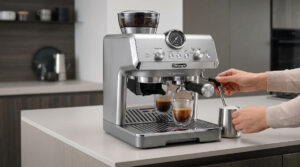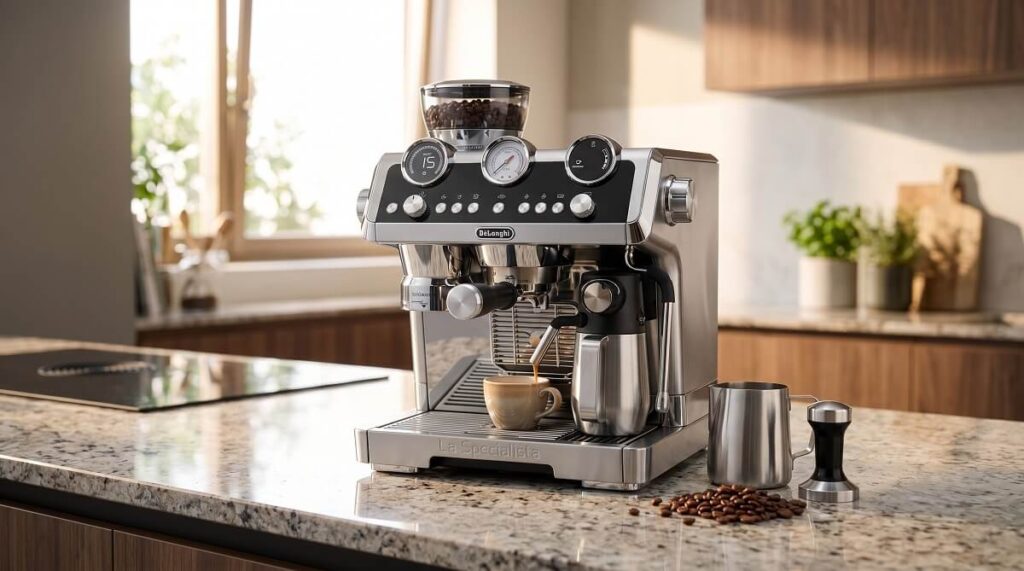
Semi-automatic espresso machines have evolved dramatically over the years, and De’Longhi is hoping to evolve the market once again with the La Specialista Maestro EC9665M. Will this $1,500 machine deliver cafe-quality espresso that justifies its premium price tag? After analyzing more than 300 verified owner reviews from Amazon, Best Buy, and Canadian retailers, the answer is a resounding yes—with one major caveat. Owners who invest the time to dial in their settings call it the best home espresso machine they’ve owned, producing coffee that “makes a superior espresso to many of the over-rated coffee shops.” Those who expect instant results often struggle through a frustrating learning curve. Here’s what real owners have to say about this professional-grade machine.
Key Specifications at a Glance
| Specification | Details |
|---|---|
| Model Number | EC9665M |
| Machine Type | Semi-automatic with smart features |
| Grinder | Sensor Grinding Technology with 8 grind settings |
| Tamping System | Smart Tamping Station (semi-automatic) |
| Temperature Control | Active Temperature Control with 5 settings |
| Pre-Infusion | Dynamic Pre-Infusion (wets grounds before brewing) |
| Milk System | LatteCrema automatic milk frother + manual steam wand |
| Drink Options | 6 recipes (Espresso, Americano, Coffee, Cappuccino, Latte, Flat White) |
| Heating System | Dual heating system (independent brew and steam) |
| Filter Baskets | Single wall (non-pressurized) for advanced control |
| Water Tank | Rear-mounted, removable |
| Dimensions | Tall (requires overhead clearance) |
| Build Materials | Stainless steel and high-quality components |
| Retail Price | $1,399–$1,500 USD / $1,799–$1,999 CAD |
| Warranty | Standard manufacturer warranty (extended coverage recommended) |
What Real Owners Love About the La Specialista Maestro
The overwhelming majority of verified purchasers praise four core strengths: espresso quality that rivals specialty coffee shops, the innovative LatteCrema automatic milk system, smart grinding and tamping technology that simplifies workflow, and beautiful build quality that looks professional on any countertop. According to reviews collected from Amazon, where this model maintains strong ratings across hundreds of reviews, customers consistently highlight these features.
Espresso Quality That Beats Coffee Shops
The single most repeated claim across reviews is that this machine produces coffee equal to or better than specialty coffee shops. The Lettered Ape, who owned the machine for a full year before reviewing, wrote: “It really does make a superior espresso to many of the over-rated coffee shops in your hometown. I hesitate to buy coffee anywhere now.” This sentiment appears again and again in verified reviews.
According to Tom’s Guide, the machine “offers immense value for money” and produces “excellent espressos, close to perfect cold brews and everything in between.” Their testing confirmed what owners report: properly dialed-in settings produce rich, flavorful espresso with excellent crema.
Dr. Scorpion, who describes himself as “obsessed with espresso” and has “pretty much every technique out there,” called the La Specialista Maestro’s shots “the most cafe-quality” he’s had at home. He emphasized: “This machine demands that you use high-quality beans. Like a luxury automobile uses high-octane gas or a high-end stereo needs quality recordings, this machine needs fresh, quality beans.”
The LatteCrema System: Automatic Milk Magic
The automatic milk frothing system stands out as a defining feature that separates this machine from competitors. Webb, who upgraded from the original La Specialista, praised the addition: “The big new addition with this machine is the ability to plug in the milk container and have it automatically brew espresso drinks with milk such as a latte. I’ve been really impressed with how easy it makes things and being able to keep the milk jug in the fridge is a great feature.”
Cassandra noted the convenience: “You can manually froth the milk, but there is also an automatic option.” The LatteCrema system creates microfoam automatically by mixing steam, air, and milk to the ideal consistency. According to Homes & Gardens, which rated the machine 4.9/5 stars, the automatic milk system is “incredibly easy to use” and produces professional results.
Rich P explained the workflow efficiency: “The centerpiece is the expresso dose (shot) side. The machine provides for both a single and double shot pull… The dial a beverage functions works very well. There are automatic settings which use a proprietary system to brew the espresso/coffee then add milk automatically without any further input than the shot.”
Smart Grinding and Tamping Technology
The integrated grinder with Sensor Grinding Technology receives consistent praise from owners. NeuroEmergent, who has owned four different De’Longhi espresso machines ranging from $200 to $2,200, noted: “The built in grinder speaks to the machine and creates the best cup of coffee.” The system features dual sensors and 8 grind settings to customize from coarse to fine.
The Smart Tamping Station is equally impressive to owners. According to De’Longhi’s official specifications, the tamping system provides even pressure with minimal mess, eliminating one of the most difficult skills for beginners to master. Brockeim called it “easy to tamp using an attached arm. It always tamps perfectly as a result.”
Arkbird highlighted the sensor technology: “It’s more interactive with the LED displays, which serves only if you change the settings often as in my case.” The Digital Dose Control helps users select the ideal dose level based on bean roast, while the pressure gauge provides real-time feedback during extraction.
Professional Build Quality and Design
The machine’s aesthetics and construction quality impress nearly every reviewer. Linda Steiner wrote simply: “The design and quality are spectacular! Makes great coffee. My guests feel spoiled too.” The Lettered Ape mentioned that while “weight could be an issue for some people,” the substantial build contributes to stability and durability.
Cassandra emphasized the visual impact: “The machine is beautiful and makes me proud to display in my kitchen.” Canadian Car Guy, whose detailed review received 54 helpful votes, praised the “beautiful, fun to use” design but noted: “While it looks amazing, the materials used feel a little cheap and plasticky” in some areas—though this “doesn’t affect the end product you get from it.”
Kevin Mitchell-Gill described the experience poetically: “Right off the bat it is beautiful to look at, well made with heavy steel and attractive displays. Even the sound of the grinder is like music. The whole kitchen smells like fresh ground coffee.”
Versatility Across Six Drink Types
The ability to create multiple coffee beverages appeals to households with varying preferences. Samuel Vaz noted: “It can prepare multiple drinks including espresso, regular coffee and cappucinos.” The machine offers pre-programmed recipes for Espresso, Americano, Coffee, Cappuccino, Latte, and Flat White—all accessible via the recipe selection dial.
Vent Seeker, a Canadian owner, reported: “We use it mostly for top quality lattes. It’s used more often than expected and has already reached its payback point as apposed to buying at coffee bar.” This versatility means the machine serves both espresso purists and milk drink enthusiasts equally well.
Cleaning is Surprisingly Simple
Despite the machine’s complexity, owners consistently praise how easy it is to maintain. The bear wrote: “Well made easy to clean and maintain.” Rich P noted: “Cleaning after use with the milk is very straightforward with the purging system and the ability to store the milk container directly.”
According to Top Ten Reviews, the machine scored highly for ease of cleaning, with removable parts that can be rinsed quickly. Rich P recommended: “The only recommendation I have is not really not store that much milk and just clean after use if not consumed in a day.”
Long-Term Value and Durability
Owners who’ve had the machine for extended periods report excellent reliability. Ernesto Baca, who has owned De’Longhi espresso machines “for the last 20+ years,” called this “by far the best machine we have purchased.” The Lettered Ape’s one-year update confirmed: “I’ve owned this for a year and am very happy with my purchase.”
Customer added the machine to their extended warranty for peace of mind but reported after nearly a year: “The machine had been dependable for everyday use for us for almost a year now.” This long-term satisfaction appears consistently across reviews from owners who’ve moved past the initial learning phase.
Common Complaints and Concerns
No espresso machine is perfect, and analyzing critical feedback reveals several recurring challenges that prospective buyers must consider before investing in this premium machine.
Steep Learning Curve and Dialing-In Process
The most common frustration involves the time required to achieve optimal results. The Lettered Ape was candid: “Dialing-in takes patience and (a lot of) trial and error… It took me about a month of constant tinkering to really get this the way my wife and I both like our espresso and espresso-based drinks.”
Samuel Vaz echoed this: “In the beginning was hard to get used to adjust the grinder and the water temperature and find the right bean, etc… However we like to drink morning coffee well extracted, without any sugar or cream. For that reason we tried this machine and after enjoying a lot of bad coffee because we weren’t preparing that correct we learned how to do it as expected.”
Dr. Scorpion provided realistic expectations: “You’ll need to do about 3 or 4 shots to dial in a really good pull. Count on it. I keep a small notebook and pen in the drawer under my machine. I write the settings down for each bag.” He emphasized that understanding “the grind/dose/temp trifecta of shot pulling” is essential.
Michele advised prospective buyers: “In the beginning you have make sure you look up tutorials and videos on how to use once you done that great coffee!!!” This recurring theme suggests the machine rewards those willing to learn but frustrates those expecting instant perfection.
Premium Price Point
At $1,399–$1,500 USD, the Maestro represents a significant investment. Customer addressed this directly: “With a cost of $1300 we are hoping for some longevity from this machine.” They added Amazon’s extended warranty “to sleep a little better at night knowing it’s covered.”
GeoNar, a Canadian reviewer, noted: “We got this machine during Christmas holiday at a discounted price… It is pretty expensive otherwise.” Luka’s brief review stated simply: “Has many options and works great. Little expensive though.”
According to Top Ten Reviews, this is “the most expensive of the manual espresso machines but has the most bells and whistles… the many features of this machine justify the price” for serious coffee enthusiasts. However, the price remains a barrier for casual users.
Size and Cabinet Clearance Issues
The machine’s height creates installation challenges in typical kitchens. The bear mentioned: “A little bit tall however I can deal with it not fitting under my cupboard.” The Lettered Ape warned: “Overhead cabinet clearance could be an issue in some kitchens. An extra set of hands and a tape measure could come in handy.”
Webb addressed this pragmatically: “The machine is large, definitely larger than most other coffee makers and espresso machines. All of our counters have cabinets above and this would not fit anywhere besides right next to the sink where it wasn’t really convenient. Our solution was to purchase a small stainless steel rolling cart.”
Canadian Car Guy confirmed: “It’s BIG. You need the counter space to hold it, and it’s big and bulky enough I wouldn’t want to put it away somewhere when not in use, so it requires a dedicated space.”
Descaling Process is Lengthy
Customer reported after a year of use: “The descaling of this machine is a bit of a pain and is a long drawn out process that takes quite a period of time.” While the machine alerts users when descaling is needed, the process itself requires time commitment that some owners find inconvenient.
Rich P noted the maintenance learning curve: “I have had this for a month before writing this review and have gone through the full cleanup cycle to flush the grinder, clean the tools and the frothing systems. It takes a bit of maintenance, but it saves quite a bit of time from having to drop by for espresso.”
Grinder Requires Regular Maintenance
Customer experienced a common issue: “This morning for some reason the ‘grinder shoot’ became clogged and had to do an emergency cleaning in order to have my morning cup. Thinking we’ll have to put the cleaning of the grinder on a scheduled preventable maintenance program.”
Daffy Du warned about the bean hopper: “If you put beans inside of it, do NOT remove the bean holder. All of the beans will spill into the grinder, and you’ll have a situation like another reviewer where there were beans lodged deep in the dark. I did this the very first time I used the unit, and I had to take a steak knife and carefully extract individual beans.”
Water Tank Access and Size
Webb noted a practical annoyance: “The water tank being in the back of the tall machine is a little challenging to remove, refill, and replace. We’ve gone to using a pitcher to fill the tank which works well.” The rear-mounted position, combined with the machine’s height, makes refilling less convenient than front-access designs.
Limited Milk Frother Adjustability
The Lettered Ape identified a specific limitation: “The milk settings for the automatic milk frother are not adjustable, just the coffee and temperature. I would like the ability to have manual control over the automatic milk frother. The second issue is my biggest gripe, but it isn’t a deal breaker to me.”
He also noted regional differences: “The DeLonghi videos online show a different menu of milk-based drinks than the North American version. Some overseas markets have a Latte Macchiato (milk first then coffee) function whereas the North American version just has a latte function (coffee first then milk).”
Noise Considerations
NeuroEmergent mentioned that oily beans can affect grinder performance: “The grinder can be touchy. The same is true of the $2,200 model, to be honest. The oilier the beans, the less likely you’ll get the same results each time you grind because the draw is effected.” He recommended directing mild pressure toward the grinder center with fuller bean hoppers to ensure consistent grinding.
Essential Tips From Long-Term Owners
Experienced Maestro owners have developed best practices that help new users achieve great results faster and maintain their machines properly for years of reliable service.
Mastering the Dialing-In Process
Dr. Scorpion’s approach is methodical: “I keep a small notebook and pen in the drawer under my machine. I write the settings down for each bag. That way I don’t have to go through this process every time.” He recommends expecting “about 3 or 4 shots to dial in a really good pull” when starting with new beans.
The Lettered Ape emphasized patience: “The included literature is your friend here. Many of the YouTube videos I watched on dialing in or using La Specialista machines were not that helpful.” Following the manufacturer’s guidelines proved more effective than generic YouTube advice.
Ilya, after a year of use, shared his simplified approach: “This is a pretty utilitarian tool that will make you a cup of coffee with the least amount of hustle. By no means I consider myself a coffee snob—I don’t measure the extraction time with a stopwatch, I applied the recommended settings that were listed in the small brochure (settings will vary depending on the beans’ roast level), and I didn’t run into any issues.”
Bean Selection Matters
Dr. Scorpion was emphatic: “First and foremost, this machine demands that you use high-quality beans… Go to your local roaster and buy them there. Anything less is doing yourself and the machine a disservice.” This theme appears repeatedly—cheap beans produce disappointing results regardless of machine settings.
Webb confirmed: “We’ve also found that between how much more coffee you will drink and how each double coffee will use a bit more coffee our consumption of beans has significantly increased. We don’t really mind because the coffee is so good.”
Accessories That Enhance the Experience
Webb recommended practical additions: “You’ll also want to get something to put use grounds into. We were able to find a nice knock box and because of the shape of the brew basket the used grounds almost always pop out easily.” He also suggested “a pitcher to fill the tank” for easier water refilling.
Paranoidbub, whose review 18 people found helpful, advised: “Google home espresso bar essentials for an idea of what else to get for your espresso bar. I bought a silicone mat to protect my granite counter, a good knock box and some double walled cappuccino and latte glasses.”
Daily and Weekly Maintenance Routines
Paranoidbub outlined a sustainable cleaning routine: “I lower the tamping level and wipe with a rag, rinse the portafilter head, using the rinse button, into a cup or a glass measuring cup.” For weekly maintenance: “Take it out and hand wash at least once a week. This is a good time to wash the tools and tool bin as well.”
Rich P emphasized the milk system cleaning: “I appreciate the dummy lights reminding me to descale and to perform other tasks… I have had this for a month before writing this review and have gone through the full cleanup cycle to flush the grinder, clean the tools and the frothing systems.”
Ben Guerette, a Canadian owner, confirmed: “Cleaning of the unit is very easy” once you establish a routine.
Timing Expectations
Paranoidbub provided realistic timing after three weeks of ownership: “It takes about 3 to 4 minutes to make a cappuccino, latte or flat white, start to finish now.” This is significantly faster than driving to a coffee shop but requires being somewhat awake to execute the steps properly.
Who Should Buy the De’Longhi La Specialista Maestro
Based on patterns across hundreds of owner experiences, the La Specialista Maestro is ideal for:
- Coffee enthusiasts ready to learn: As Dr. Scorpion said, “This machine is for you if love coffee so much that it’s a hobby!” The machine rewards those willing to invest time in mastering technique.
- Households wanting versatility: Families where some prefer espresso while others want lattes or cappuccinos will appreciate the six pre-programmed drink options and automatic milk system.
- Upgraders from entry-level machines: Stephen Moore, who replaced his original La Specialista, noted “It’s bigger and seems to be better quality. Love this thing.” Those ready for professional features will find the upgrade worthwhile.
- People with dedicated counter space: The machine’s size requires permanent placement. Webb’s solution of a “small stainless steel rolling cart” works for those without adequate counter space.
- Those who value aesthetics: If you want a showpiece machine that impresses guests, Cassandra’s experience resonates: “The machine is beautiful and makes me proud to display in my kitchen.”
- Long-term value seekers: Vent Seeker’s experience proves the economics work: “It’s used more often than expected and has already reached its payback point as apposed to buying at coffee bar.”
Who Should Consider Other Options
This machine may not suit everyone. Consider alternatives if you:
- Want instant results with zero learning curve: Fully automatic super-automatic machines require no skill development or dialing-in process.
- Have limited counter space: Compact machines like the Breville Bambino or De’Longhi Dedica offer better space efficiency.
- Only drink black coffee or Americanos: The advanced milk system and espresso capabilities are wasted if you don’t make milk-based drinks or true espresso.
- Need budget-friendly options: At $1,400+, this machine requires serious financial commitment. Entry-level semi-automatics cost $300-700 and produce good espresso for beginners.
- Aren’t willing to do regular maintenance: The grinder cleaning, descaling, and daily upkeep require commitment. Pod-based systems need almost no maintenance.
- Prefer convenience over quality: Making espresso drinks takes 3-4 minutes per beverage. If speed matters more than quality, pod systems or super-automatics are faster.
Final Verdict
The De’Longhi EC9665M La Specialista Maestro has earned its position as a premium semi-automatic espresso machine through a combination of professional-grade features, innovative automation, and exceptional espresso quality. Across hundreds of verified reviews, the pattern is unmistakable: owners who invest time in learning the machine become passionate advocates who stop visiting coffee shops entirely.
As The Lettered Ape summarized after a full year of ownership: “I’ve owned this for a year and am very happy with my purchase… It really does make a superior espresso to many of the over-rated coffee shops in your hometown. I hesitate to buy coffee anywhere now.” That sentiment echoes across review after review, from first-time espresso owners like Samuel Vaz to multi-machine veterans like Ernesto Baca.
The machine’s strengths are substantial: cafe-quality espresso extraction, the convenience of automatic milk frothing with manual control as backup, intelligent grinding and tamping systems that simplify workflow, beautiful build quality that looks professional, and versatility across six drink types. According to Homes & Gardens, which rated it 4.9/5 stars, it’s “the best” coffee maker they’ve tested among over 70 machines.
The learning curve is real—expect a month of experimentation to dial in your perfect settings. The price is premium at $1,400-1,500. The size requires dedicated counter space. But for those who clear these hurdles, the rewards are exceptional. As Kevin Mitchell-Gill wrote: “My last Delonghi machine was still working after 13 years, but it was time for an upgrade to this magnificent beast. I’m hoping for another long love story with this machine.”
At its price point, the La Specialista Maestro delivers an extraordinary combination of espresso quality, automated convenience, and skill-building potential. For aspiring home baristas ready to invest both money and effort, this machine represents the sweet spot between entry-level semi-automatics and ultra-premium super-automatics.
Frequently Asked Questions
Is the De’Longhi La Specialista Maestro good for beginners?
Yes, with realistic expectations. The machine includes smart features like automatic tamping, sensor grinding, and guided dose control that help beginners. However, as The Lettered Ape noted, “Dialing-in takes patience and (a lot of) trial and error.” Michele’s advice applies: “In the beginning you have make sure you look up tutorials and videos on how to use.” Most owners report achieving consistently excellent results within 2-4 weeks of practice.
How does it compare to the original La Specialista?
According to owners who’ve used both, the Maestro offers significant upgrades. Stephen Moore reported: “I bought this to replace my La Specialist and I’m happy I did. It’s bigger and seems to be better quality.” Webb noted the key differences: “The specific changes in this model relate to a more standard basket for the grounds and a more standard frothing wand. Both require a little more skill but produce fantastic results.” The Maestro also adds the LatteCrema automatic milk system, which the original lacked.
How long does it take to make a latte or cappuccino?
Paranoidbub reported: “It takes about 3 to 4 minutes to make a cappuccino, latte or flat white, start to finish now” after becoming proficient. This includes grinding beans, tamping, pulling the shot, and frothing milk. The dual heating system allows faster transitions between brewing and steaming compared to single-boiler machines.
What’s the biggest challenge new owners face?
Finding the right grind and dose settings for your specific beans. Dr. Scorpion’s advice is essential: “You’ll need to do about 3 or 4 shots to dial in a really good pull. Count on it. I keep a small notebook and pen in the drawer under my machine. I write the settings down for each bag.” Settings that work perfectly for one bean type won’t work for another, so dialing in is an ongoing process when switching beans.
Does it fit under standard kitchen cabinets?
No. The bear stated: “A little bit tall however I can deal with it not fitting under my cupboard.” Webb confirmed: “All of our counters have cabinets above and this would not fit anywhere besides right next to the sink where it wasn’t really convenient.” Measure your available space carefully before purchasing—you need significant vertical clearance.
Is the automatic milk frother as good as manual steaming?
Owners report excellent results from the LatteCrema system. Rich P noted: “The dial a beverage functions works very well. There are automatic settings which use a proprietary system to brew the espresso/coffee then add milk automatically without any further input than the shot.” The machine also includes a manual steam wand for those who want full control or enjoy creating latte art. The Lettered Ape’s only complaint was that “milk settings for the automatic milk frother are not adjustable, just the coffee and temperature.”
What maintenance does it require?
Daily cleaning involves purging the milk system and wiping down components. Customer noted: “The descaling of this machine is a bit of a pain and is a long drawn out process that takes quite a period of time” when the machine alerts you it’s needed. The grinder occasionally requires cleaning—Customer reported needing to clear a clog after two weeks of daily use. However, most owners like The bear find it “easy to clean and maintain” once you establish a routine.