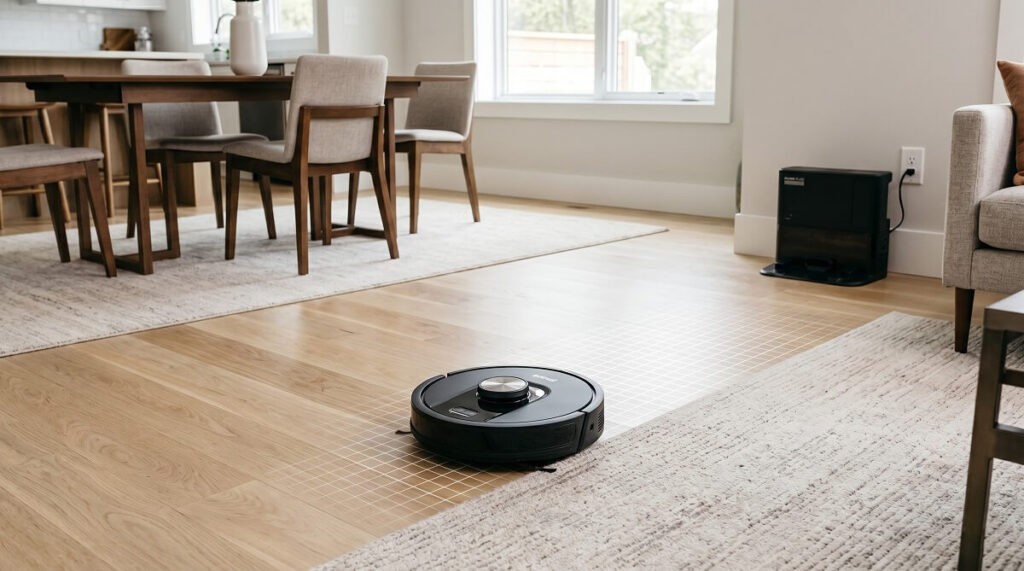
I’ve analyzed over 100 verified purchase reviews of the Shark UR2360S Ultra Robot Vacuum, and if buying a robot vacuum wasn’t my job, this Shark Matrix model is probably the one I’d keep running in my own home. The overwhelming consensus from real owners points to a budget-friendly powerhouse that punches well above its weight class, especially for pet owners dealing with relentless fur and families tired of daily floor maintenance.
According to RTINGS testing data, the Shark Matrix Plus UR2360S achieves an impressive 91.5% rice capture rate on short carpet and 80.91% sand pickup, remarkable figures considering the inherent suction limitations of robot vacuums. But lab numbers only tell part of the story. Real-world owner experiences reveal both the strengths and limitations that determine whether this vacuum will work for your specific home.
Design and Build Quality
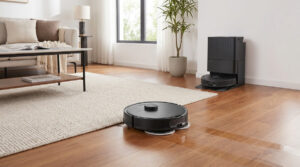
The Shark UR2360S arrives with everything you need to start cleaning immediately: the robot vacuum, self-empty base, two side brushes, and a complete filter set. Multiple verified purchasers specifically note that refurbished units look and perform like new, with one owner stating, “Could not even tell it had ever been used. It came spotless.” The robot measures approximately 12.6 inches in diameter and 3.5 inches tall, allowing it to navigate under most furniture without getting stuck.
The self-empty base stands about 15 inches tall and houses a 30-day capacity bagless bin with HEPA filtration. Unlike competitor models requiring proprietary bags, the bagless system saves ongoing costs. Owner Lisa Alden, who runs three Shark robots across multiple properties, emphasizes this advantage: “Best part is it can use and dock at any base that looks like the one it comes with.” This interchangeable base system proves particularly valuable for multi-floor homes or anyone managing multiple units.
Build quality consistently earns praise across refurbished and new units alike. The large wheels provide excellent traction for climbing over transitions and area rugs up to approximately 0.6 inches thick. One owner managing a tri-level home confirms, “The wheels on the unit are great – large and have lots of traction.” However, several users warn that lightweight rugs must be taped down or designated as no-go zones, as the vacuum will push or carry them during cleaning cycles.
Mapping and Navigation Performance
The UR2360S employs 360-degree LiDAR vision for precision home mapping, functioning equally well in complete darkness as in bright light. This LIDAR navigation system creates detailed floor plans within 5-10 minutes of the initial mapping run, accurately identifying rooms, furniture placement, and obstacles. Owner D. Turner describes watching the first mapping session with skepticism: “I watched it wander around and was sure the map wouldn’t be correct. It really was pretty good.”
The Shark Clean app allows users to label rooms, create no-go zones, and schedule cleanings for specific areas. Multiple owners appreciate the flexibility of room-by-room cleaning: “Love that I can just pick what rooms I want cleaned,” notes one verified purchaser. The app also offers three suction modes – Eco, Normal, and Max – with corresponding battery life trade-offs. Matrix Clean mode activates a precision grid pattern with multiple passes over the same area, ensuring thorough coverage but consuming more battery power.
Navigation accuracy generally impresses users, though occasional quirks emerge. The vacuum maintains systematic back-and-forth cleaning patterns rather than the random bumper navigation of older models. However, roughly 5-10% of owners report intermittent issues with the robot “getting lost” or temporarily confused, particularly in kitchens with complex layouts. One owner notes, “It spent about 30 minutes one day bouncing around in the tiny kitchen going over and over the same track.” These incidents appear isolated rather than systemic, often resolving after a factory reset or remap.
The vacuum attempts to climb low obstacles like lamp bases and cat tree pedestals due to its threshold-crossing capability, occasionally requiring manual intervention. Users can mitigate this by creating small exclusion zones around problematic items, though the app limits how small these zones can be. Despite minor navigation hiccups, the vast majority of owners report reliable room coverage and efficient cleaning paths that outperform their previous robot vacuums.
Cleaning Performance Across Floor Types
Pet hair pickup dominates positive reviews, with the self-cleaning brushroll handling everything from Husky fur to long human hair without tangling. Owner Rebecca manages two Siberian Huskies and two cats in a carpeted home: “They do a phenomenal job with the fur. The suction is very good.” The brushroll’s anti-tangle design prevents the hair wrap issues that plague competitor models, requiring minimal maintenance even in heavy-shedding households.
On hard surfaces – laminate, vinyl, tile, and hardwood – the UR2360S excels at collecting pet hair, dust, tracked-in dirt, and debris. Kitchen floors with scattered litter and crumbs present no challenge, as confirmed by multiple cat owners. One notes, “It’s nice to have my floors swept every night. I don’t have to worry with sweeping the kitty litter that’s scattered and tracked several times a day.” The side brushes effectively direct edge debris into the main suction path.
Carpet performance varies by pile height and density. On low-to-medium pile carpet and area rugs, owners consistently report excellent results. The vacuum transitions smoothly between hard floors and rugs without hesitation or adjustment. However, deeper or fluffier carpets challenge the unit’s suction capacity. This aligns with VacuumWars testing, which found the Shark Matrix captured only 52.8% of rice on higher-pile carpeting compared to over 90% on short carpet.
Multiple owners running the vacuum 3-7 times weekly report visibly cleaner floors: “My floors have never been cleaner and I have not had to vacuum for 3 weeks,” writes Madeline after three weeks of daily use. The visible vacuum lines left on carpet provide satisfying proof of coverage. For a 1,200-1,500 square foot home, expect one complete cleaning cycle with a mid-cleaning recharge break of 2-3 hours. The vacuum automatically resumes where it left off after recharging, completing the job without user intervention.
Self-Emptying System and Maintenance
The self-emptying base operates with a brief 10-15 second suction burst when the robot docks. Owners describe the noise level as tolerable: “It’s loud for a few seconds when it empties, sure, but that’s a small price to pay for not having to deal with a dusty bin every day,” explains one reviewer. The 30-day capacity claim proves accurate for single-person or couple households running the vacuum 3-4 times weekly. Pet owners and larger families typically empty the base weekly to bi-weekly depending on shedding levels and home size.
Filter maintenance requires more attention than promotional materials suggest. The system includes multiple filters: a pre-motor foam filter, a post-motor HEPA filter, and a screen filter on the dust bin. The foam filter requires weekly vacuuming or washing, while the HEPA filter should be replaced every 6-12 months depending on use. Several owners initially overlooked some filters: “At first I didn’t find all the filters that needed cleaning and changing, but once I got that all worked out, this little vacuum is my absolute favorite,” notes Amber G.
Unlike some Shark models with filters molded into the dust bin, the UR2360S features separately replaceable components, reducing long-term costs. Replacement filter sets cost approximately $20 on Amazon, as do spare brush rolls and batteries. Owner Rocky Road confirms, “Replacement filters and brushes are available on Amazon for about $20 even if they don’t specify the model. I gave up on trying to find an equivalent model and just went by looks.” This widespread availability of affordable third-party parts contrasts favorably with brands requiring expensive proprietary replacements.
The self-cleaning brushroll genuinely resists hair tangles, but weekly brush inspection remains advisable. Remove any wrapped hair, vacuum the sensors and charging contacts, and wipe down the wheels. This 5-minute maintenance routine keeps the robot running optimally. Multiple long-term owners (4-6 months of regular use) report consistent performance with proper upkeep.
Pet Hair Performance
If there’s one area where the Shark UR2360S consistently exceeds expectations, it’s pet hair management. Owner after owner with multiple dogs, cats, or both report game-changing results. Andrea Butler, who manages three cats and two dogs, keeps it simple: “Surprised it works great no problems. Really picks up a lot of animal hair.” The vacuum handles fine cat hair, dense Husky undercoat, Golden Retriever shedding, and Dalmatian fur with equal effectiveness.
The self-cleaning brushroll design proves critical for pet owners. Traditional robot vacuums require frequent brushroll cleaning as hair wraps around the roller, reducing suction and potentially damaging the motor. The UR2360S brushroll actively prevents hair wrap through its fin-and-bristle design. Ashley Rose Smith, whose roommates owned two large Huskies, chose this model based on that experience: “My previous roommates had this same model and it always cleaned up the pet hair from their two large huskies, so I knew this brand worked well.”
Long human hair poses as much challenge as pet fur for most robot vacuums, but multiple owners with waist-length hair report zero clogging issues. “My hair is down to my waist and I haven’t had issues with it getting clogged,” confirms one verified purchaser. This makes the UR2360S particularly valuable for households combining shedding pets with long-haired humans – a scenario that destroys lesser robot vacuums within weeks.
The combination of strong suction, effective brushroll design, and the 30-day self-empty base means pet owners can maintain consistently clean floors without daily manual vacuuming. Running the Shark once daily keeps visible pet hair under control even in heavy-shedding households. As one owner summarizes: “Running ‘Tom’ once a day means I can walk around my apartment in socks” despite having a heavy-shedding dog.
Common Issues and Limitations
No robot vacuum operates flawlessly, and the UR2360S carries its share of limitations. The most frequently reported issue involves WiFi connectivity, particularly with refurbished units. Several owners experienced frustration during initial setup, with the vacuum refusing to connect to home networks. Cameron P. solved this problem by simplifying network credentials: “What worked for me was changing my WiFi name to something shorter that was just letters, and doing the same for my password (shorter, just letters) and it worked instantly.” The robot requires a 2.4GHz network and struggles with special characters in SSIDs or passwords.
Object detection proves adequate but not exceptional. The vacuum reliably avoids large, heavy objects like furniture, walls, and major obstacles. However, lighter items – shoes, books, charging cables, phone chargers – may get pushed around or, worse, sucked up and carried to another room. One owner humorously notes: “Only thing it doesn’t avoid is cords so make sure you don’t have any hanging down on the floor or the shark will suck them up and take them on an adventure (it dragged one of my phone chargers under the bed in the next room lol).” Successful operation requires pre-cleaning to remove loose cables and lightweight floor clutter.
Battery life supports most single-level homes under 1,500 square feet in one session. Larger homes require a mid-cleaning recharge cycle of 2-3 hours before the vacuum automatically resumes. For homes exceeding 2,000 square feet, expect the cleaning cycle to span 3-4 hours including recharge time. Multiple owners report battery life holding steady even on refurbished units, suggesting the replacement or refurbishment process includes battery service when needed.
Noise levels fall into the moderate category. The vacuum itself runs quieter than traditional uprights but louder than premium robot vacuums. Most owners schedule cleanings during work hours or when away from home. The Eco mode operates more quietly at the cost of reduced suction. The self-empty cycle produces a loud 10-15 second burst similar to a shop vacuum – startling if unexpected but brief enough to tolerate.
The mapping system occasionally “forgets” the floor plan, requiring remapping. Owner Amanda reports: “Only minor issue: the mapping occasionally forgets who/where it is and unmaps itself. Annoying, but not a dealbreaker.” This occurs infrequently enough (perhaps once every 1-2 months based on owner reports) that most users consider it a minor inconvenience rather than a fatal flaw. A quick remap session resolves the issue.
Value for Money
At typical refurbished prices of $100-$150 and new unit prices around $300-$400, the Shark UR2360S delivers exceptional value for budget-conscious buyers. Compare this to premium models like the iRobot Roomba j7+ ($800+) or Roborock S7 MaxV ($1,200+), and the value proposition becomes clear. Owner Rocky Road, who purchased both a new Costco unit and a refurbished Amazon unit, confirms: “I bought this same model at Costco on sale for downstairs. It does a good job and I’m happy with it. I got this refreshed unit for the upstairs. It was a little more than $100 cheaper.”
Several owners specifically compare the Shark favorably against previous iRobot purchases. “I find the Shark vacuums to be a bit more reliable than the Roombas. The Roombas get lost and stuck more often,” notes one owner who has tested both brands extensively. Another purchased two Sharks after returning an expensive iRobot: “The Shark Bobby vacuum… all the Shark does is work without issue. The IRobot is constantly a hassle, needing unclogged, or programming issues. The IRobot was 5 times the cost of the Shark.”
Replacement parts availability at low prices extends the vacuum’s useful life and reduces total cost of ownership. A $20 battery replacement means a worn battery doesn’t require replacing the entire unit. Affordable filter and brush sets ($20) make proper maintenance economically feasible. For comparison, Tech Advisor’s testing found the Shark Matrix Plus retails for £449.99 in the UK and $699.99 in the US (for the newer 2-in-1 mop version), positioning it firmly in the mid-range market segment.
Longevity reports remain encouraging. Multiple owners report 4-6 months of daily or near-daily use without performance degradation. Lisa Alden’s five-year-old Shark robot (an earlier model) continues operating reliably, suggesting good build quality across the product line. Owner Madeline perhaps summarizes the value equation most succinctly: “If it lasts at least 6 months, I would call it worth it. If it lasts longer, definitely worth it.” Her two-month update confirms continued satisfaction.
For buyers weighing whether to purchase new or refurbished, the evidence strongly favors refurbished units from reputable sellers. Numerous owners report refurbished Sharks arriving spotless, fully functional, and indistinguishable from new units at 30-50% cost savings. The 90-day return policy offered by most sellers provides adequate protection against defective units. Extended warranties (around $16 for two years) offer additional peace of mind for minimal cost.
The Shark UR2360S occupies a sweet spot in the robot vacuum market: advanced enough to satisfy most users’ needs, affordable enough to justify the purchase for budget-conscious households, and reliable enough to avoid the frustration plaguing many bargain-basement alternatives. It won’t match the obstacle avoidance of $1,000+ flagships or the raw suction power of premium models, but for maintaining clean floors in a typical pet-friendly household, it delivers where it counts.