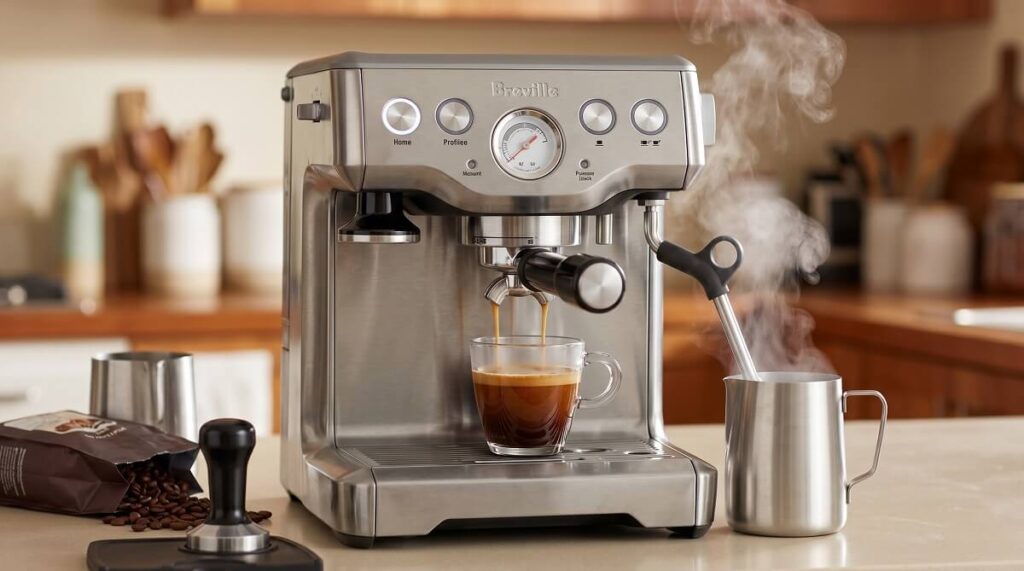
Semi-automatic espresso machines are nearly as ubiquitous in the home kitchen as drip coffee makers nowadays, and there is no shortage of options at every price point. If you have spent any time researching which machine to buy, there is a good chance that the Breville Infuser BES840XL keeps surfacing in conversations between people who take their espresso seriously. After analyzing the most detailed verified owner reviews of the Breville Infuser Espresso Machine BES840XL—reviews that collectively represent thousands of shots pulled over years of daily use—the consensus is striking: this machine produces espresso that owners consistently compare to commercial equipment costing ten to twenty times as much, provided you pair it with a quality burr grinder and invest time in learning the craft.
According to HomeGrounds, the Breville Infuser features a 1650-watt thermocoil heating system with PID temperature control, a 15-bar Italian pump with low-pressure pre-infusion, a 61 fl. oz. removable water tank, and a 54mm portafilter. It ships with both pressurized (dual-wall) and non-pressurized (single-wall) filter baskets for single and double shots, a stainless steel milk frothing jug, cleaning disc and tablets, and a built-in pressure gauge. The machine measures 10.25 x 12.5 x 13.25 inches in brushed stainless steel, and as CoffeeGeek noted, the Infuser may be the best machine in Breville’s entire lineup when price is factored in.
If you are weighing whether the Infuser justifies the investment over cheaper machines, or wondering how much effort it really takes to pull café-quality shots at home, here is what owners report after living with this machine for months and years.
Why Owners Call the Breville Infuser the “Sweet Spot” of Home Espresso
The phrase that appears most consistently across Infuser reviews is “sweet spot”—owners position this machine as the point where quality, features, and price converge in a way that more expensive machines cannot meaningfully improve upon for most home users. One owner who spent months calibrating the machine put it directly: “In my opinion, this is the ‘sweet spot’ of espresso making. You can make a really great cup of espresso with this machine at an affordable cost. Any more money and you are paying MUCH more to slightly increase the quality of the drink.”
Multiple owners with professional espresso backgrounds validate this positioning. A former Farmer Brothers coffee employee who previously used a commercial three-portafilter machine with precision grinders described the Infuser’s output: “This machine pulls a shot just as well as that $20,000+ commercial machine did and froths micro foam milk for my capps just as well too for literally a small fraction of the price.” Another owner who made over 2,500 shots on the Infuser concluded: “This machine is ABSOLUTELY the next best thing, just a tiny level below the $4,000+ machines.”
The Infuser’s dual filter basket system earns particular praise for growing with its owner. The pressurized (dual-wall) baskets let beginners pull decent shots with less precise grinds, while the non-pressurized (single-wall) baskets allow experienced users to pursue full extraction control. As one owner explained: “While I’m in lazy mode and just want a tasty espresso with good crema I’ll use the double walled portafilter for a perfect espresso with tons of crema. When I want to work on the barista skill I’ll use the standard portafilter.”
Espresso Quality: Pre-Infusion and PID Temperature Control in Action
The Infuser’s pre-infusion function is the feature owners credit most for separating it from cheaper machines. According to Black Ink Coffee, the low-pressure pre-infusion soaks and expands the coffee grounds before full extraction pressure engages, resulting in more even extraction and balanced flavor. Owners confirm this makes a tangible difference in the cup—one noted that switching to the Infuser from a previous machine with non-pressurized filters revealed “subtle taste characteristics from my coffee beans” that the prior machine never extracted.
The PID temperature control provides shot-to-shot consistency that owners describe as “amazingly repeatable and scientifically precise.” One reviewer observed that the pressure gauge responds to “even tiny changes in grain size or tamp pressure,” giving users real-time visual feedback on extraction quality. However, several experienced owners recommend a critical technique: always run an empty shot before making espresso. As one detailed reviewer explained: “The first shot runs about 20 degrees below the optimal 200 degrees and will result in an under-extracted espresso. It is also good to heat up your grouphead, portafilter and cup.”
The 9-bar extraction pressure earns praise from owners who have researched espresso science. One reviewer who tested extensively concluded that higher pressure is unnecessary: “9 bars of pressure is ideal. Even the big chains can’t train their people to follow directions, so all the coffee you get there is far inferior. Their coffee will taste horrid once you start making your own espressos with this machine.”
- Pre-Infusion
- Low-pressure water saturates and expands coffee grounds before full 9-bar extraction begins, reducing channeling and producing more balanced flavor. Owners consistently cite this as the Infuser’s most important feature advantage over cheaper machines.
- PID Temperature Control
- Electronic proportional-integral-derivative control maintains water temperature within 2°C of the target. The thermocoil heating system circulates water through a stainless steel coil for on-demand heating rather than storing hot water in a tank, reducing temperature fluctuation between shots.
- Pressure Gauge
- A front-mounted analog gauge shows real-time extraction pressure during each shot. Owners find it invaluable for learning—it visually confirms when grind size, dose, and tamp are dialed in correctly. One owner called it “immensely helpful,” though another noted it is “totally unnecessary” once you have mastered your routine.
The Grinder Question: What Every Infuser Owner Learns
If there is one universal lesson across Infuser reviews, it is this: the grinder matters at least as much as the espresso machine itself. Every single detailed reviewer either started with an inadequate grinder and upgraded, or bought a quality burr grinder from the outset and immediately benefited. The machine rewards proper grind quality and punishes poor grind consistency—and owners view this as a feature, not a flaw.
One owner documented their entire grinder journey over three months: they started with a Capresso Infinity burr grinder, which “did not have nearly the adjustability I would need to lock in the perfect grind setting for espresso.” They upgraded to the Breville Smart Grinder, which was better but still lacked fine-tuning ability. Finally, they invested in a Baratza Vario, and the results were transformative: “This was the ultimate step and proved to be most important towards producing amazing quality espresso.”
The Breville Smart Grinder Pro is the most frequently recommended companion by Infuser owners. One reviewer specifically advocated buying the Infuser and Smart Grinder Pro separately rather than the Breville Barista Express with its built-in grinder: “I think this is a better way to go rather than getting the Breville Barista Express with the built-in grinder. The Smart Pro has 60 settings so you can use it for coarse grinds for a French press. It is also much easier to clean and allows you to upgrade to a more advanced espresso machine without having to buy a new grinder.”
A critical insight that multiple owners share: grind settings change with every bean. One reviewer learned this through extensive testing: “Using Lavazza Super Crema, I could not go finer than a 17 on the grinder or else the machine would max out the pressure and I would get just a few drips of disgusting sour water. Using fresh coffee beans from a local roaster, I was able to go much finer.” Another confirmed the pattern: “Beans like Four Barrel and Blue Bottle always require much more fine grind settings, where beans like Stumptown and Barefoot require much coarser grinds.”
The Learning Curve: From First Failed Shot to Daily Perfection
The Breville Infuser is emphatically not a pod machine, and owners are upfront about the learning curve. One beginner who paired the Infuser with a Smart Grinder Pro reported it took “TEN shots before I made anything even remotely drinkable, and then I went through half a pound of coffee beans before I pulled my first GOOD shot.” Another who now makes 2,500+ consistently perfect shots admitted to “about the first 40 cups of failures” before achieving reliable results.
Several owners offer specific advice that accelerated their learning:
- Ditch the single-shot basket: The most upvoted piece of advice across all reviews. One owner explained: “I switched over to the single-walled double shot cup, and my first pull was ABSOLUTELY PERFECT. It poured like golden honey, ran a perfect 30 seconds, and had amazing crema.” Shots pull far more consistently in the double-shot basket regardless of whether you want one or two shots of espresso.
- Use a gram scale: Weighing coffee doses and liquid output dramatically improved shot consistency for multiple owners. One reviewer called this the second most impactful upgrade after the grinder.
- Time your shots: Owners consistently target 24-30 seconds for extraction, which helped them calibrate grind size and dose correctly.
- Use a puck screen: One owner who tried WDT tools and various techniques found a simple metal mesh screen placed on top of the tamped puck delivered “100% success rate. Zero failures. My ~$50 WDT tool is sitting here, useless and unneeded.”
- Run an empty shot first: Multiple owners independently discovered that the first shot after the machine warms up runs noticeably below optimal temperature.
The consensus is that the learning process itself is part of the appeal. As one owner reflected after months of practice: “This isn’t a Keurig. You will need to calibrate your grind for each new coffee you try, which can either be a huge pain or a lot of fun, depending on why you’re buying this machine. I found it fun.”
Steam Wand and Milk Frothing Performance
The Infuser’s steam wand receives broadly positive reviews from owners who use it for lattes, cappuccinos, and latte art. The 1650-watt heating system produces enough steam pressure for proper microfoam, and owners report results that rival their local coffee shops. One former professional noted: “It froths micro foam milk for my capps just as well as that $20,000+ commercial machine did.” Another long-term owner confirmed: “The steam wand is able to make foamed milk with the exact same quality as a professional machine.”
However, owners with extensive café experience note some limitations. One reviewer who frequents specialty coffee shops observed: “The milk steamer does a great job, but this steamer does the milk more on the creamy side. It seems hard to get the microfoam as velvety thin as Sightglass, Four Barrel, or Blue Bottle does, and because of this, my cappuccinos don’t have quite the intense coffee bite—but it’s getting pretty close.” For latte art specifically, owners recommend practice and the right milk. One reviewer discovered that organic grassfed whole milk made a significant difference: “I bought organic grassfed whole milk, and wow, it is the way to go. It tastes great and easy to get an excellent microfoam.”
The auto-purge function after steaming receives appreciation from owners who understand its purpose. After you finish steaming milk, the machine automatically cycles hot water through the system to bring the temperature back down to the correct range for espresso extraction. This prevents the next shot from being over-extracted due to residual heat from steaming—a common problem on cheaper single-boiler machines.
One practical tip multiple owners share: steam your milk first, then pull your espresso shot. As one reviewer advised: “If you are making cappuccinos or lattes, please do steam your milk first so that as soon as you extract the espresso you can use it right away.”
Build Quality and Long-Term Durability
The Infuser’s long-term reliability is well-documented across owner reviews spanning years of daily use. One owner who held off reviewing until durability could be properly assessed reported: “I’ve had zero problems with durability. I use the machine almost every day, and it just works with no problems.” That reviewer continued using the machine for years without changing the water filter or running a cleaning cycle—though they used reverse osmosis filtered water, which prevents mineral buildup.
According to CoffeeGeek, one long-term owner reported their Infuser lasted 11 faithful years before finally failing, noting they “can’t exactly complain that it lasted over a decade with daily use.” Multiple other reviewers report 2-3 years of trouble-free daily operation with proper maintenance.
The brushed stainless steel exterior holds up well over time, and owners describe the overall construction as solid for the price point. One reviewer who evaluated the machine purely on durability after years of ownership concluded: “The machine is well-made. It isn’t going to break down on you after just a year or 2 of use even if you aren’t faithful with cleaning and maintenance.”
When issues do arise, Breville’s customer service earns praise. One owner whose steam wand developed a leak received a full replacement: “They responded quickly to my initial support request and had arranged to replace the machine free of charge within 48 hours. Not only that but they offered to ship the new one in advance of the return of the faulty one.” The machine carries a 1-year limited product warranty, though owner experiences suggest the hardware often outlasts the warranty period by many years.
Cleaning and Maintenance: What Actually Works
One of the most detailed owner contributions involves the cleaning process—specifically, correcting errors in Breville’s own documentation. According to one meticulous owner who researched the issue extensively, the cleaning instructions in the Breville manual and on their website have been incorrect for several years. The manual instructs users to place a cleaning disc with a small hole into the basket, but current machines ship with a disc that has no hole. The cleaning solution is backflushed through the group head and expelled into the drip tray—not out through the portafilter as the manual describes.
The correct cleaning procedure, as documented by owners who have figured it out:
- Ensure the water tank is full and the drip tray is empty before starting
- Place the solid cleaning disc (no hole) in the single-cup basket with a cleaning tablet on top
- Hold down both cup buttons and press the power button to initiate the cleaning cycle
- The cycle runs five pressure stages over approximately five minutes, backflushing detergent through the group head
- After the cycle completes, remove the portafilter and wash all components thoroughly
- Run four to five flush cycles through the group head using the 2-cup button to clear remaining detergent—using blue-dyed tablets and a white cup makes it easy to confirm when the water runs clear
For daily maintenance, owners recommend emptying the drip tray after each use. The auto-purge function expels hot water into the drip tray after steaming, which fills it faster than expected. As one owner noted: “Just do what I do—empty the tray each time you use it. It is very simple and only takes a few seconds.”
Water quality matters significantly for long-term machine health. Most owners recommend filtered water at minimum, with reverse osmosis water being ideal for preventing scale buildup. One owner who uses filtered water simply ignores the descale indicator light and has experienced no issues, while another credits reverse osmosis water for years of zero maintenance beyond basic cleaning.
What Owners Wish Was Different
Despite overwhelmingly positive reviews, owners identify several consistent shortcomings that potential buyers should consider.
1. No Built-In Grinder Means Additional Investment
The Infuser does not include a grinder, and every owner emphasizes that a quality burr grinder is non-negotiable for good results. According to HomeGrounds, the lack of a built-in grinder is the primary differentiator between the Infuser and the Barista Express. Budget an additional $150-300 for a grinder capable of producing consistent espresso-fine grounds—owners most frequently recommend the Breville Smart Grinder Pro or Baratza Vario.
2. Single Boiler Limits Workflow Speed
The Infuser uses a single thermocoil, meaning you cannot brew espresso and steam milk simultaneously. You must wait for the machine to transition between brewing and steaming temperatures. While the auto-purge function manages this transition automatically, it adds time to the process—a limitation that owners who make multiple milk-based drinks in sequence find noticeable.
3. The 54mm Portafilter Divides Opinion
The Infuser uses a 54mm portafilter rather than the commercial-standard 58mm. Some owners view this as a limitation for aftermarket accessories and dosing flexibility, while others argue the smaller diameter actually improves extraction for single doses by keeping the coffee bed deeper and more concentrated. As one experienced owner noted: “I feel a large portafilter is a disadvantage in extraction as you spread the grind of a single espresso shot in a larger portafilter.”
4. Accessories Feel Incomplete
Multiple owners note that the included accessories, while functional, leave gaps. The machine ships without a knock box, an appropriately sized coffee scoop for beans, a frothing thermometer, or an espresso cup. One frustrated reviewer called these omissions “branding opportunities lost” and suggested Breville could do more to set up new owners for success out of the box.
5. Amazon-Only Availability
According to CoffeeGeek, Breville has removed the Infuser from their main USA website and transitioned the machine to an Amazon-only SKU. This limits purchasing options and may raise concerns about long-term production commitment, though the machine continues to receive strong sales and reviews.
Who Should Buy the Breville Infuser
Based on verified owner reviews and professional analysis from HomeGrounds, Black Ink Coffee, and CoffeeGeek, the Breville Infuser fits these buyers particularly well:
- Best for: Aspiring home baristas who already own a quality burr grinder or are willing to invest in one—the Infuser rewards good grind quality with professional-caliber espresso
- Best for: Beginners who want a machine that grows with their skills—the dual filter basket system (pressurized and non-pressurized) lets you start simple and progress to full manual control
- Best for: Owners who enjoy the process of learning espresso craft—the pressure gauge, pre-infusion, and PID control provide feedback and consistency that make learning rewarding rather than frustrating
- Best for: Daily espresso drinkers who want long-term value—owners report years of reliable daily use, and many calculate the machine pays for itself within weeks compared to coffee shop spending
- Best for: Milk drink enthusiasts who want capable steaming without a dual-boiler price tag—the steam wand produces quality microfoam for lattes and cappuccinos, though latte art requires practice
- Consider alternatives if: You want a fully integrated setup with built-in grinder—the Breville Barista Express bundles the grinder at the cost of some grinder flexibility
- Consider alternatives if: You primarily want convenience over craft—super-automatic machines or pod systems will produce consistent results with less effort, though at lower quality
- Consider alternatives if: You need to brew and steam simultaneously for high-volume entertaining—the single-boiler design adds transition time between functions
As one owner who spent three months mastering the Infuser summarized: “I am now consistently making absolutely fantastic espresso drinks. I would HIGHLY recommend this machine to anyone looking for a semi-automatic machine in this price range.” Another captured the machine’s core appeal after years of daily use: “The cost of these machines is intimidating, but this one is capable of making 100% professional quality espresso and steamed milk. It seems like an excellent value—much, much cheaper than daily trips to Starbucks.”
Frequently Asked Questions
- Do I need a separate grinder for the Breville Infuser?
- Yes. The Infuser does not include a built-in grinder, and every owner emphasizes that a quality burr grinder is essential for good results. The most frequently recommended companion is the Breville Smart Grinder Pro, which offers 60 grind settings and grinds directly into the portafilter. Budget $150-300 for a grinder that can produce consistent espresso-fine grounds.
- How long does the Breville Infuser last with daily use?
- Owner reports range from 2-3 years of trouble-free operation up to 11 years of daily use before failure. Longevity depends heavily on water quality and maintenance habits. Owners who use filtered or reverse osmosis water consistently report the longest lifespans with the fewest issues.
- Is the Breville Infuser good for beginners?
- Yes, with a caveat. The pressurized filter baskets let beginners pull acceptable shots while learning, and the pressure gauge provides visual feedback during extraction. However, owners report a genuine learning curve—expect 10-40 failed shots before consistently pulling good espresso. Most owners consider this learning process enjoyable rather than discouraging.
- Can the Breville Infuser make good lattes and cappuccinos?
- Yes. Multiple owners, including former professional baristas, confirm the steam wand produces microfoam quality comparable to commercial machines. Owners recommend using grassfed whole milk for the best results and steaming the milk before pulling the espresso shot. Latte art is achievable with practice, though the single-boiler design means you cannot steam and brew simultaneously.
- What is the difference between the pressurized and non-pressurized filter baskets?
- The pressurized (dual-wall) baskets have a single small hole at the bottom that creates artificial crema and forgives inconsistent grinds—ideal for beginners or pre-ground coffee. The non-pressurized (single-wall) baskets have many holes and rely entirely on your grind quality for proper extraction and crema. Owners overwhelmingly recommend transitioning to non-pressurized baskets with a quality grinder for the best espresso.
- Why does my drip tray fill up so fast on the Breville Infuser?
- The auto-purge function expels hot water through the back of the machine into the drip tray after steaming to bring the temperature back to the correct brewing range. This is by design and protects your next espresso shot from being over-extracted. Owners recommend simply emptying the drip tray after each use session.