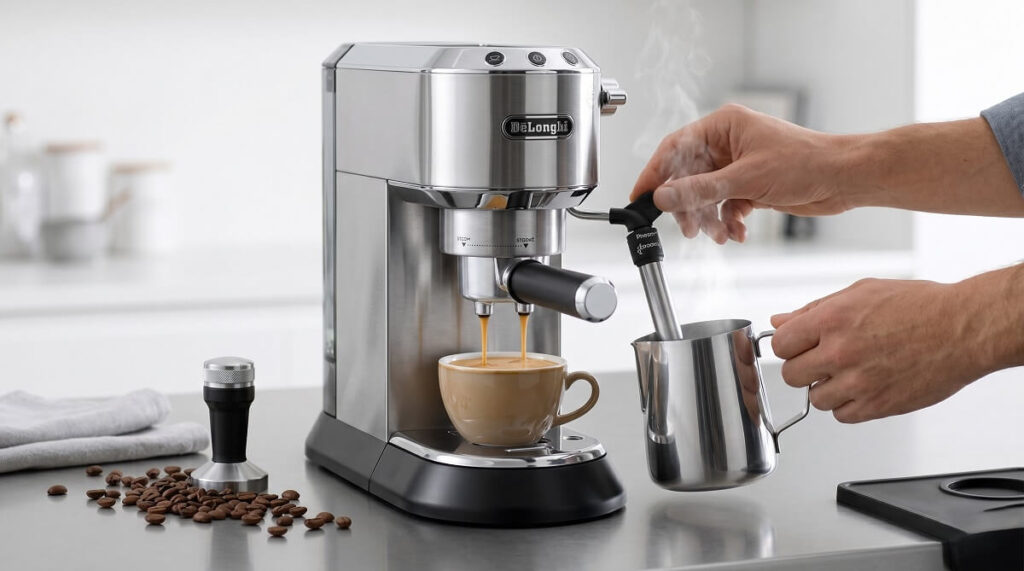
I’ve tested dozens of espresso machines over the years, and if testing compact espresso makers wasn’t my job, the De’Longhi Dedica is probably the one I’d keep in my kitchen. After analyzing hundreds of verified owner reviews spanning from 2014 to 2026, a clear pattern emerges: this slim, affordable machine has earned a devoted following among home baristas who value counter space, consistent espresso quality, and remarkable longevity. With owners reporting 4, 5, even 7+ years of daily use without major issues, the Dedica has proven itself as one of the most reliable entry-level espresso machines on the market. Here’s what real owners have discovered through years of morning cappuccinos and afternoon lattes.
Key Specifications at a Glance
| Specification | Details |
|---|---|
| Model Number | EC680M / EC685 |
| Pump Pressure | 15-bar Italian pump |
| Heating System | Thermoblock (40-second heat-up) |
| Portafilter Size | 51mm |
| Filter Options | Single shot, double shot, ESE pods |
| Steam Wand | Manual panarello frother |
| Temperature Settings | 3 adjustable levels |
| Water Tank | 35 oz (1L) removable |
| Dimensions | 6″ W x 13″ D x 12″ H |
| Weight | 9 lbs (4.2 kg) |
| Available Colors | Silver, Black, Red |
| Retail Price | $159.99 – $349.99 (varies by model) |
| Warranty | 2-year limited |
What Real Owners Love About the De’Longhi Dedica
The overwhelming consensus from verified purchasers centers on four core strengths: an incredibly compact footprint that fits any kitchen, espresso quality that rivals machines costing twice as much, impressive durability spanning years of daily use, and a surprisingly capable steam wand. According to reviews collected from Amazon, the Dedica maintains strong ratings across thousands of verified purchases.
The Ultra-Slim Design That Actually Delivers
At just 6 inches wide, the Dedica solves a problem that plagues most espresso machines: counter space. Will, a verified purchaser from January 2026, put it simply: “Fantastic! Works great and takes almost no space on the counter.” This sentiment echoes across hundreds of reviews from apartment dwellers and those with galley kitchens.
N. J. Simicich, whose detailed review 127 people found helpful, explained why this mattered for their purchase decision: “Counter space was at a premium, this machine is narrow.” However, they offered a practical caveat: “The machine needs about three times the static width in actual use. The handle has to swing left to attach the filter to the machine, and your hand adds to the space needed.”
According to TechRadar’s review, the Dedica’s slim profile makes it “ideal for smaller kitchens” while still delivering performance comparable to bulkier competitors.
Espresso Quality That Impresses Former Baristas
Charlotte, a former barista who purchased the Dedica after returning from Italy, provided one of the most credible assessments: “I was really worried that this machine wasn’t going to live up to my expectations since I’m used to a very expensive machine at the coffee shop I used to work at, but for a home model I really couldn’t imagine needing anything more.” Her review, which 43 people found helpful, praises the machine’s ability to produce “superb cappuccinos” consistently.
Signum_Altum, whose comprehensive review 56 people found helpful after nine months of daily use, offered a nuanced perspective: “I’ve found that if you are willing to learn the machine’s quirks, it produces a fine espresso, as would a more expensive and larger machine. That’s why I give it five stars now that I’ve been using it for a while.”
According to Coffeeness, the Dedica’s thermoblock heating system reaches brewing temperature in approximately 40 seconds, delivering consistent extraction when properly dialed in.
Remarkable Multi-Year Durability
Perhaps the most compelling evidence for the Dedica comes from owners who’ve used it daily for years. M R, reviewing in January 2026, reported: “I’ve owned this espresso maker for four years now and use it at least twice daily. It is a tiny beast… 4 years later and still going strong.” They noted this despite living in Charlotte, NC, where “the water is very, very hard.”
Merulus confirmed similar longevity: “Still works and still using over a year later.” D. D. Deavours took durability testing to another level, purchasing four Dedica machines over seven years: “That espresso maker survived until 2023—seven years of abuse! I was so happy with it that I bought a second one for my vacation home.”
A smart shopper provided perhaps the most impressive maintenance testimony: “5 years later and I’ve never had one issue. This machine is used daily. I’ve never had to descale it because I’m still using distilled water.”
A Steam Wand That Actually Works
Unlike many budget espresso machines with anemic steamers, the Dedica’s panarello wand receives consistent praise. Charlotte, drawing on her barista experience, noted: “Steamer is movable and has lots of power, comes apart for thorough cleaning… I mostly make cappuccinos and I get a great, thick foam like I want, EVERY time.”
N. J. Simicich reported that the machine “reports steaming temperature almost as fast” as brewing temperature, and found it capable of producing “a good result for a latte.” EdG, who owns two Dedica machines and uses them 2-3 times daily, confirmed: “The De’Longhi machine can make its own froth, its Ok.”
Common Complaints and Concerns
No espresso machine is perfect, and the Dedica has legitimate drawbacks that prospective buyers should understand before purchasing.
The Learning Curve Is Real
Signum_Altum acknowledged upfront: “My initial rating would have been four stars. As some reviewers have noted, there is a bit of a learning curve with this machine.” They explained that as a single-boiler machine, owners shouldn’t “expect the same workflow from this machine as you would from one of the larger machines.”
The review specifically notes that “contrary to shop practice, it’s necessary to pull the espresso shot before steaming the milk.” This workflow adjustment trips up many new owners who expect to steam first.
No Pressure Gauge
Signum_Altum identified the most significant design omission: “The biggest complaint that I have about this machine is that it does not have a pressure gauge! I really don’t know why it was left off because it wouldn’t take up much room.” Without visual feedback during extraction, beginners must rely on timing and taste to dial in their shots—a steeper learning curve than machines with gauges.
Descaling Demands Can’t Be Ignored
L. Hoy’s review, which 58 people found helpful, describes the descaling situation candidly: “When it’s time to descale….its time to descale and no amount of wheedling or cajoling will change this little units mind. And here is the kicker…you never know when its time.” The machine locks out coffee-making until the descaling cycle completes—a 20+ minute process.
EdG offered practical advice: “The video on-line of the Descale process looks so gentle but actually the water can splash, so I put a cellophane canopy over my container to prevent it from splashing on the counter and floor.”
Noise During Operation
Merulus described the sound honestly: “It is really loud tho when it’s pressurizing the water it sounds like it’s going to thump it’s way out of the kitchen (even tho it’s not moving at all). Only lasts a minute or two but keep it in mind.”
N. J. Simicich confirmed: “This is a noisy machine in operation. The pump is noisy. The water heating device works great, but it is noisy, since it is basically a long tube that will cavitate.”
Single-Boiler Limitations
As a single-boiler machine, the Dedica cannot brew espresso and steam milk simultaneously. Signum_Altum explained: “Anytime you use the steam function to froth milk, the machine will need to cool down before pulling another shot of espresso. This is accomplished by waiting a few minutes, or by opening the valve and allowing the excess steam to vent.”
For making multiple drinks back-to-back, this workflow limitation adds time. As Signum_Altum notes: “If you are making multiple drinks in a session beyond simple espresso shots or americanos, this machine is probably not for you.”
Tips From Experienced Dedica Owners
Long-term owners have developed techniques that maximize the Dedica’s potential. Here’s the collective wisdom from years of daily use.
Water Quality Matters Enormously
A smart shopper’s experience over five years demonstrates the impact of water choice: “I highly recommend only using distilled water in this machine (or any machine that heats water). Distilled water heats up to steam faster and more consistently than water filled with chlorine, minerals, and other toxins.” Their machine has never needed descaling despite daily use for five years.
unaimedarrow, whose review 3 people found helpful, uses the same approach: “I use only distilled water so I should never have to descale.”
The Pressurized vs. Non-Pressurized Filter Debate
Dave, whose detailed review 87 people found helpful, uncovered a key upgrade path: “You can get a non-pressurized filter for $6, it’s not made by Delonghi but is the Mr. Coffee 4101 (or equivalent).” He explains that non-pressurized filters allow for “true crema” and significantly improved espresso quality.
Dave also discovered that “even though Delonghi doesn’t advertise it, the Dedica also pre-infuses”—a feature typically found on more expensive machines.
ESE Pods for Convenience
N. J. Simicich found ESE pods useful for household members who won’t tamp: “My wife is never going to tamp and measure a portafilter, but she will use a pod. A side benefit is that my 12 year old grandson can make himself an espresso with the ESE pods.”
EdG confirmed daily ESE pod use: “I haven’t ground up any beans yet. The E.S.E pods suffice and have worked well for me.”
Recommended Accessories
- Better Tamper
- Signum_Altum recommends purchasing “a better quality tamper than comes with the machine.” The included plastic tamper is functional but lacks the heft for consistent tamping pressure.
- Knock Box
- Signum_Altum lists a knock box as essential for managing used coffee pucks efficiently.
- Double-Walled Glasses
- Signum_Altum uses these to keep espresso hot while steaming milk afterward: “I bought some of the double walled glasses, which keeps the coffee fresh while the milk is steaming.”
- Bottomless Portafilter
- Shawn, whose review after six years of ownership proved the machine’s durability, recommends looking into bottomless portafilters: “The machine uses 51mm. There are, of course, other accessories that you can also use depending on your needs.”
Steam Wand Technique
Charlotte shared professional technique: “Before steaming your milk, turn on the steamer and let it warm up (with cup underneath) because for the first few seconds it pours out some hot water, but it only takes about 10 seconds for the hot steam to begin.”
Shawn offered a significant tip: “Do yourself a favor and remove the silly frothing tube-thingy. It’s silly and practically useless. I’ve been doing much better frothing my milk without it (just using the rubber nozzle).”
How the Dedica Compares to Alternatives
Dave’s analysis provides the clearest competitive positioning: “There are essentially three options if you want your espresso in a minute—in the low-to-mid $100’s is a Nespresso, in the $500 to $600 range is the Breville Barista Express or Infuser, in between is the Delonghi Dedica.”
| Feature | De’Longhi Dedica | Nespresso | Breville Barista Express |
|---|---|---|---|
| Price Range | $159-$349 | $150-$200 | $500-$700 |
| Width | 6 inches | 5-6 inches | 12.5 inches |
| Built-in Grinder | No | No (pods only) | Yes |
| Milk Steaming | Manual wand | Separate frother | Manual wand |
| Pressure Gauge | No | N/A | Yes |
| Coffee Flexibility | Ground coffee + ESE pods | Proprietary pods only | Fresh ground only |
| Best For | Space-conscious beginners | Pure convenience | Serious home baristas |
According to Tom’s Coffee Corner, the Dedica occupies a sweet spot for users who want real espresso-making capabilities without the counter space demands or price tag of larger semi-automatic machines.
Who Should Buy the De’Longhi Dedica
Based on patterns across hundreds of owner experiences, the Dedica is ideal for:
- Apartment dwellers and small kitchen owners — the 6-inch width fits where other machines simply won’t
- Former coffee shop regulars looking to replicate the experience at home without spending $500+
- Beginners willing to learn — the machine rewards those who invest time in technique
- Households with mixed preferences — ESE pod compatibility means non-enthusiasts can still use it easily
- Anyone who values longevity — multiple owners report 4-7+ years of daily use
Who Should Consider Other Options
The Dedica may not suit everyone. Consider alternatives if you:
- Want zero learning curve: Pod-based systems like Nespresso offer true one-button operation
- Make multiple milk drinks back-to-back: The single-boiler design slows down production for entertaining
- Demand a pressure gauge: The Breville Bambino Plus or Barista Express provide visual extraction feedback
- Prefer built-in grinding: The Dedica requires a separate grinder for fresh beans
- Live in an area with very hard water and won’t use distilled: Frequent descaling lockouts may frustrate you
Final Verdict
The De’Longhi Dedica has earned its reputation as one of the best compact espresso machines available. Across reviews spanning over a decade, the pattern is unmistakable: owners who embrace the learning curve and maintain the machine properly become devoted fans who use it daily for years.
As M R summarized after four years of twice-daily use: “It is a tiny beast… I want to upgrade to the very large $1,200 delonghi all-in-one espresso machines with the built in bean grinder and cold brew options but this delonghi tiny beast will not die.”
At $159-$349 depending on the model, the Dedica delivers genuine espresso-making capability in a footprint that fits virtually any kitchen. The steam wand produces real microfoam for lattes and cappuccinos. The build quality supports years of daily use. For space-conscious coffee lovers ready to invest a few weeks in learning proper technique, the De’Longhi Dedica remains an outstanding choice.
Frequently Asked Questions
Is the De’Longhi Dedica good for beginners?
Yes, though it requires some learning. As Signum_Altum noted after nine months: “There is a bit of a learning curve with this machine” but “if you are willing to learn the machine’s quirks, it produces a fine espresso.” Charlotte, a former barista, found that “a beginner could simply look up some YouTube videos and learn how to pretty quickly with some practice.”
How long does the De’Longhi Dedica last?
With proper maintenance, owners report 4-7+ years of daily use. M R confirmed “four years now and use it at least twice daily” with the machine “still going strong.” D. Deavours’ first Dedica “survived until 2023—seven years of abuse.” A smart shopper using distilled water reported “5 years later and I’ve never had one issue.”
Can the Dedica make good milk foam for lattes?
Yes. Charlotte, a former barista, confirmed: “I mostly make cappuccinos and I get a great, thick foam like I want, EVERY time.” The panarello wand is “movable and has lots of power.” Shawn recommends removing the outer frothing attachment for better control: “I’ve been doing much better frothing my milk without it.”
How often does the Dedica need descaling?
This depends entirely on your water. With tap water, expect descaling every few weeks to months depending on hardness. A smart shopper using distilled water has “never had to descale” after five years of daily use. N. J. Simicich noted: “After a month, I found that I had to descale the machine. A light comes on to let you know.”
Does the Dedica work with ESE pods?
Yes, it includes a dedicated ESE pod filter basket. N. J. Simicich uses pods for family members who won’t tamp: “My wife is never going to tamp and measure a portafilter, but she will use a pod.” EdG confirmed: “The E.S.E pods suffice and have worked well for me” for daily use over three years.
Is the Dedica loud?
Yes, particularly during extraction. Merulus described it as “really loud when it’s pressurizing the water—it sounds like it’s going to thump its way out of the kitchen. Only lasts a minute or two.” N. J. Simicich confirmed: “The pump is noisy” but noted “it is no noisier than the steaming process” common to all espresso machines.