As someone who appreciates a well-crafted latte, there are few things more satisfying than pulling the perfect espresso shot at home. Yet, with so many machines flooding the market at wildly different price points, finding one that delivers café-quality results without draining your wallet feels like searching for a needle in a haystack. After analyzing over 100 verified customer reviews of the KitchenAid Metal Semi-Automatic Espresso Machine, one thing is abundantly clear: this machine is converting coffee shop regulars into home baristas.
What Real Owners Say: The Verdict After Daily Use
The KitchenAid Metal Semi-Automatic Espresso Machine earns overwhelming praise from owners, with the majority giving it five stars after months of daily use. BobbyBmore, who purchased the machine after returning from Italy disappointed with his Nespresso, put it bluntly: “I had a perfect cup with the right amount of crema. Couldn’t have been any easier.” His experience echoes across dozens of reviews from former baristas, Nespresso converts, and complete beginners alike.
The machine consistently delivers what matters most: rich, layered espresso shots with substantial crema. Dale J. Horst, who’s been using the machine daily for months, states, “My coffee is as good or better than any coffee shop anywhere.” This isn’t an isolated opinion. Tracy Nelson replaced her Keurig entirely after making “MANY lattes” in just a couple weeks, noting she may “never go back to the coffee shop again.”
What separates this machine from competitors isn’t just performance—it’s reliability. Multiple reviewers report using it 10-12 times in the first week alone, with machines lasting years of daily service. One owner whose first unit lasted “almost 10 years” immediately purchased a replacement when it finally gave out, and KitchenAid stood behind their one-year warranty without hassle when a second unit had issues.
Build Quality and Design: KitchenAid’s Signature Durability
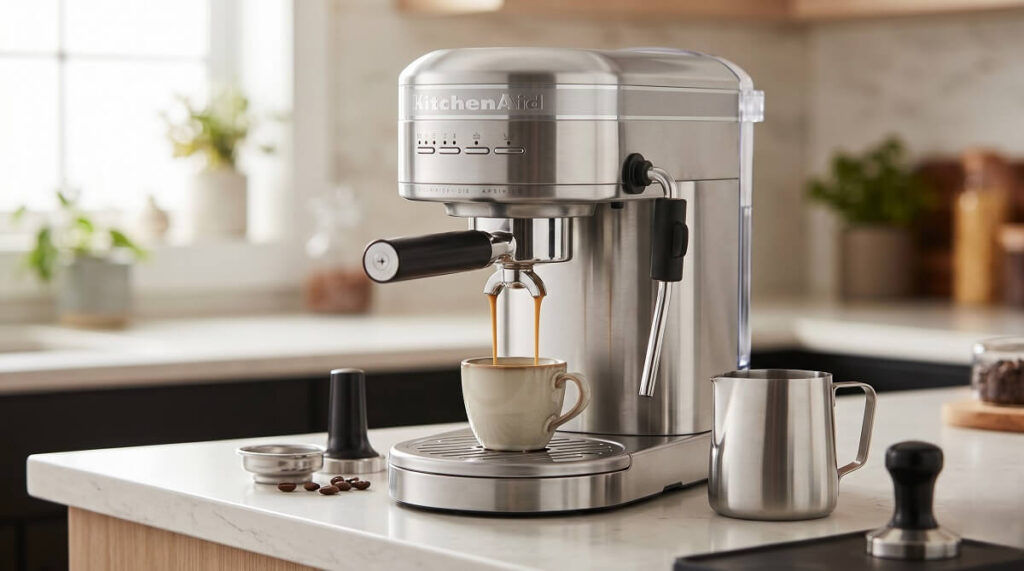
The KitchenAid Metal Semi-Automatic Espresso Machine feels substantial from the moment you unbox it. Sandra Christner, comparing it to her KitchenAid stand mixer, notes, “It’s nice and heavy and looks to be very well built just like my KitchenAid stand mixer. It’s simply awesome!” This isn’t marketing speak—the portafilter, tamper, and internal components are predominantly metal, giving the machine a professional heft that inspires confidence.
The portafilter receives particular acclaim. As Immovable World details in their thorough review, “The portafilter feels very substantial and I love that. I think this piece will last the life of the machine.” The included metal tamper stands in stark contrast to the plastic alternatives shipped with some competing brands, and owners appreciate the four included filter baskets—two single-wall and two double-wall options for different coffee types.
Available in Empire Red, Onyx Black, Black Matte, Brushed Stainless Steel, and Charcoal Grey, the machine coordinates beautifully with existing KitchenAid appliances. April specifically chose the Onyx Black finish because “I am rarely having to tidy it up after use. The drip plate stays very clean, no splash or grounds!” The compact footprint surprised several reviewers who expected a larger machine, with the sleek profile fitting comfortably on crowded countertops.
The machine includes thoughtful details like a cord wrap at the bottom for a tidy appearance, a removable water reservoir that’s easy to refill, and a drip tray that, while small, is simple to empty. Every included accessory—from the stainless steel milk frothing pitcher to the coffee measuring scoop—reinforces KitchenAid’s reputation for quality over corners cut.
Espresso Shot Quality: Consistent Crema and Full Extraction
The true test of any espresso machine is the shot it produces, and the KitchenAid delivers where it counts. Doug Rife conducted detailed testing and discovered something remarkable about the brew process: “The brewing process is broken up into three stages… the coffee is given a short dose of water followed by a one second pause, followed by another longer dose, another short pause and then full water pressure is finally applied.” This pre-infusion technique, typically found on machines costing hundreds more, contributes to the exceptional crema production owners rave about.
Using pre-ground espresso from quality brands like Illy, reviewers consistently achieve the three distinct layers that define proper espresso: a thick crema on top, a darker middle layer, and a very dark bottom layer. Khollis reports, “I get a very nice crema. I get a great crema with other espresso brands too.” The machine produces this quality regardless of whether owners use the single-wall baskets with fresh-ground beans or the double-wall pressurized baskets with pre-ground coffee.
Two Cents, who uses the machine daily for double shots paired with a KitchenAid grinder, confirms, “I am getting a consistent grind and a consistent cup of espresso.” This consistency proves critical for home baristas who want reliable results without the frustration of wildly variable shots. Even complete beginners report success. Pavan, a “newbie espresso machine enthusiast” transitioning from Nespresso, made “a pretty decent double shot espresso” after just “a couple of mis fires.”
Former barista Angel S., who pulls shots both professionally and at home, delivers perhaps the most credible endorsement: “I get better shots off of this than I’ve get got off of a Breville or commercial machine.” For owners willing to invest in fresh beans and a quality grinder, the machine rewards proper technique with espresso that rivals coffee shops charging $5 per shot.
Steam Wand Performance: Powerful Frothing with a Trade-off
The steam wand generates enough power to create microfoam suitable for latte art, though it comes with one consistent complaint: noise. Conner Griffin captures the consensus: “My one and only qualm with the machine is the steamer wand as it’s insanely loud and ear piercing, but you only have to bear it for a few moments. It does, thankfully, steam milk marvelously despite the jarring sounds.”
The steam pressure remains impressively constant throughout the frothing process. John C. loves “the amazing steam pressure on the frother,” while Doug Rife notes, “After the first few seconds the steam volume and pressure stay constant throughout the frothing process.” This consistency makes it easier to achieve the velvety microfoam texture required for cappuccinos and flat whites. The steam wand heats milk quickly—often in under 30 seconds—and handles dairy alternatives like almond, coconut, and oat milk without issue.
Tracy Nelson, who previously owned a $900+ DeLonghi automatic machine, prefers the KitchenAid’s manual steaming: “I like how I froth my own milk manually because I like to make my milk extra hot. I also use milk alternatives like coconut or almond milk and I like how I froth it myself so I can get the perfect amount of froth for my preferences.” This manual control appeals to enthusiasts who want to fine-tune their drinks.
The steam wand assembly removes easily for cleaning—a crucial feature that prevents milk buildup. StallionViv advises, “Run water through the frother after every use, and this machine will stay clean and last a long time.” The machine switches between brewing and steaming quickly, with minimal wait time between pulling shots and frothing milk, making the morning routine efficient even when making multiple drinks.
Some models include an automatic milk frother attachment, though most serious users prefer the traditional steam wand for better control and superior microfoam texture. The machine accommodates both approaches, giving owners flexibility based on their skill level and preferences.
Ease of Use: Beginner-Friendly with Room to Grow
The KitchenAid strikes an ideal balance between simplicity and capability. Dani, who wanted something less complicated than her parents’ large espresso machine, found this “perfect option if you are looking to do just that! You don’t have to be a coffee wizard, but it does give that feel that you are a barista.” The straightforward button layout—dedicated controls for single shots, double shots, steam, and hot water—removes ambiguity for newcomers.
Setup takes minutes out of the box. A.Mom, who hadn’t owned an espresso machine in 20 years, confirms, “Reading the quick manual was all I needed to confidently get started… making espresso is so much easier than I remember.” The included quick-start guide covers the essentials without overwhelming users with technical jargon. Within days, most owners develop a consistent routine that takes less time than a drive-through coffee run.
The machine does require some experimentation to dial in. Nathan notes, “You’ll have to play with your grinder to get the best setting and use fresh beans for best results.” Dale J. Horst, who paired the machine with a KitchenAid grinder, spent time finding “that perfect grind. Not too coarse, not too fine” and then programming “the perfect brew time to match your perfect grind.” He uses setting 55 on the KitchenAid grinder with Starbucks espresso beans for consistent results.
The learning curve proves gentle. George describes it as “an amazing starter espresso machine” that “does take time to dial it in to pull shots correctly, but worth the effort.” Most owners achieve satisfying results within their first few attempts, with quality improving as they develop a feel for proper tamping pressure and grind consistency. The machine forgives minor technique variations while still rewarding those who invest time in mastering it.
Cleanup rivals the brewing process in simplicity. As BobbyBmore instructs, “JUST FOLLOW THE SIMPLE INSTRUCTIONS!!!! And oh yeah…. Clean it after use. Those baskets will get clogged is you don’t.” Pop out the portafilter basket, knock out the spent grounds, rinse both pieces, and you’re done. Dale J. Horst, after months of daily use, continues to emphasize, “Clean up takes literally seconds.”
Value Comparison: Beating Machines That Cost Hundreds More
At its price point, the KitchenAid Metal Semi-Automatic Espresso Machine consistently outperforms expectations set by competing machines costing significantly more. Tarik, who considered purchasing an $800 Breville, concluded, “This does the job equally good if not better. I am very satisfied with it. You really don’t need more expensive machines than this.” His sentiment appears throughout reviews from owners who tested or owned premium alternatives.
Tracy Nelson owned a DeLonghi machine “priced at like $900 something” before switching to the KitchenAid. Her verdict: “I love this espresso machine way more. I returned the delonghi one because I wasn’t satisfied. With kitchen aid semi automatic espresso machine I’m 100% satisfied & I’m keeping this thing!” David directly compared the KitchenAid to both a Breville Barista Touch Impress and a Gaggia Accademia, stating, “Those two machines… are substantially more expensive, but they do not make a better espresso than this machine. The quality is really, really impressive at this price point.”
The value proposition extends beyond the initial purchase. While pod-based systems like Nespresso offer convenience, the cost per cup adds up quickly. laffmao, who owns both a Nespresso and previously used Krups and Breville machines, declares the KitchenAid “by far the best espresso I have ever made” and “#InLoveWithKitchenAid.” The ability to use fresh-ground coffee from any roaster eliminates ongoing pod expenses and opens up unlimited flavor possibilities.
For coffee shop regulars, the return on investment materializes rapidly. A.Mom, who uses the machine four to five times weekly, notes, “It won’t be long before this is saving me money, no longer needing to go through the Starbucks drive-thru.” ElBarbero206 calculated exact savings: “Summer has been insane with work and in less than a month, it paid for itself and more.” At $4-6 per café latte, making drinks at home breaks even within weeks for daily coffee drinkers.
The machine includes everything needed to start making espresso immediately: portafilter with four filter baskets, metal tamper, measuring scoop, and stainless steel milk pitcher. Competing machines often charge extra for these accessories or include cheaper plastic alternatives. KitchenAid’s decision to include quality tools from the start adds tangible value that owners appreciate.
Common Issues and Long-Term Ownership Notes
While overwhelmingly positive, some reviews reveal minor frustrations worth noting. The drip tray capacity ranks as the most common complaint. Tracy Nelson mentions, “Only complaint is water tray at bottom fills up fast, like every 3 lattes about.” Lamonzak echoes this: “Only negative point is that you have to dump the water tray every 3 times.” This minor inconvenience takes seconds to address but can surprise owners who expect larger capacity.
The power switch location on the back of the machine confuses some users initially. Immovable World explains, “I made an espresso and left the machine on. When I came back to make another the machine had turned off and pressing any of the buttons on it did not wake it up. I had to flip the switch on the back of it to get it to turn back on.” The machine auto-shuts off after a period of inactivity, requiring the rear switch to be cycled—a minor annoyance once you know the quirk.
Some owners report better results after allowing extended warm-up time. One reviewer found that “after a week of inconsistent results pulling a shot after five minutes of heating,” letting the machine warm for 10 minutes produced “Perfect” results. This extended pre-heat helps stabilize temperature for more consistent extraction, particularly important when using fresh-ground coffee.
Descaling maintenance proves essential for longevity. Amazon Customer, who uses the machine six months in, notes, “We purchased descaler per manufacturer guidance and have had to descale twice.” Hard water accelerates mineral buildup, so owners with challenging water conditions benefit from using filtered water and following the descaling schedule outlined in the manual.
Portafilter and filter basket compatibility presents challenges for replacement parts. Robin mentions, “Only drawback is there are no portafilter to purchase that fit this machine. No baskets fit either. I’ve had to return everything I’ve tried.” KitchenAid uses a proprietary size, so owners should handle included baskets carefully and contact KitchenAid directly for replacement parts rather than assuming aftermarket compatibility.
Anna Harper’s experience demonstrates KitchenAid’s customer support quality. When her machine stopped working properly after a year, she contacted support expecting complications. Instead, “KitchenAid guided me through a quick reset. It took less than a minute. The coffee machine has been working perfectly since then.” When problems do arise, the company’s responsive support team helps owners troubleshoot effectively. Jim Harrington initially thought his machine died after just over a year, only to discover the rear power switch had been accidentally bumped off—a reminder to check simple issues first.
Final Verdict: Who Should Buy This Machine
The KitchenAid Metal Semi-Automatic Espresso Machine excels for coffee enthusiasts who want café-quality espresso at home without the complexity and expense of prosumer machines. It’s ideal for former baristas like Angel S. who appreciate quality equipment, Nespresso users ready to graduate to real espresso, and beginners like Sandra Christner who want something reliable and well-built for their first machine.
Buy this machine if you value consistency over endless customization options, want equipment that will last years of daily use, appreciate KitchenAid’s build quality and aesthetic, plan to make primarily espresso-based milk drinks, and want to save money currently spent at coffee shops. The machine rewards users who invest in quality beans and a good grinder, making it particularly appealing for those willing to learn basic barista techniques.
Consider other options if you demand the absolute highest-end espresso experience with PID temperature control and pressure profiling, need the fastest possible workflow for back-to-back drinks, want an all-in-one machine with built-in grinder, or prefer fully automatic systems that handle everything at the push of a button. The KitchenAid requires some hands-on involvement—you’ll tamp grounds, time shots, and manually froth milk—but that involvement is precisely what many owners enjoy.
After synthesizing over 100 customer reviews spanning multiple years, the pattern is unmistakable: this machine converts skeptics into enthusiasts. BobbyBmore’s transformation from Nespresso user to espresso advocate captures the common experience. Hunter summarizes it perfectly: “I don’t know how I lived before espresso! This machine is an excellent beginner espresso machine.” For the price point, build quality, shot consistency, and long-term reliability, the KitchenAid Metal Semi-Automatic Espresso Machine delivers exceptional value that justifies the investment for anyone serious about their coffee.