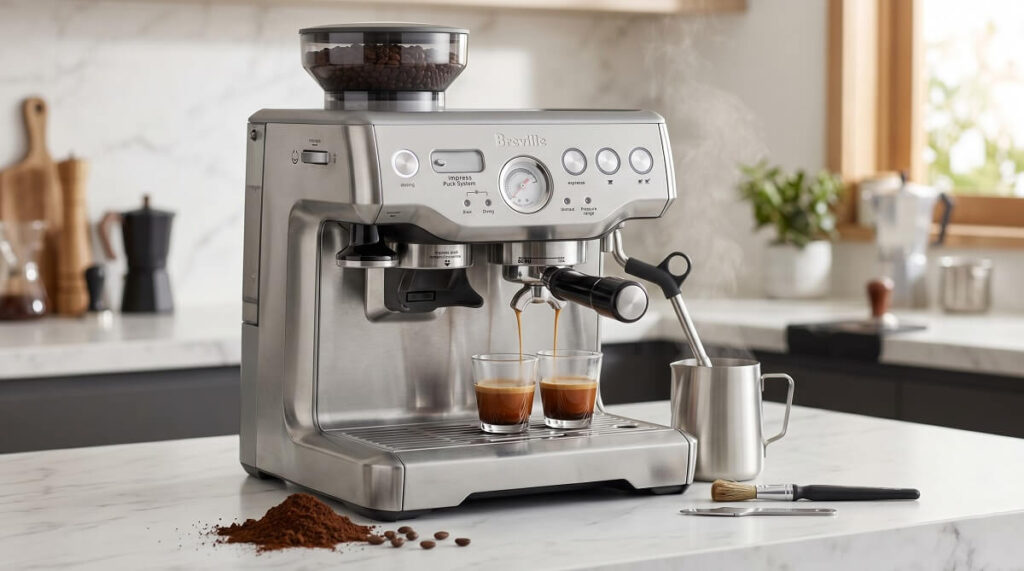
Coffee enthusiasts have been raving about semi-automatic espresso machines for years, and Breville has been at the center of that conversation since the original Barista Express debuted in 2009. But does the upgraded Barista Express Impress BES876BSS—with its assisted tamping, intelligent dosing, and 25 grind settings—actually deliver on the promise of café-quality espresso at home? After analyzing over 50 verified owner reviews, the answer from real buyers is a resounding yes, though with a few caveats worth knowing before you invest.
Priced at $799.95, the Barista Express Impress occupies a competitive middle ground between entry-level manual machines and fully automatic units costing thousands. According to Breville, the machine features the Impress Puck System with intelligent dosing, a 54mm stainless steel portafilter, PID-controlled thermocoil heating delivering water at exactly 200°F, and a 15 bar Italian pump with low-pressure pre-infusion. But specifications only tell half the story. Here’s what owners actually experience after weeks, months, and years of daily use.
The Impress Puck System: A Game-Changer for Consistency
The assisted tamping and intelligent dosing system is the single most praised feature across Barista Express Impress reviews, and it’s the primary reason most buyers chose this model over the original Barista Express. The system delivers a constant 22 pounds of impression pressure with a 7-degree barista twist, eliminating one of the biggest variables in home espresso preparation. Owner after owner describes the difference this makes in their daily routine.
One detailed reviewer, John B., who compared this machine against a DeLonghi ECP and considered the Specialista Opera, wrote: “The unit is well designed, especially the automatic tamping (quick, consistent, and no mess).” He added that the dose level indicator has “passable accuracy” and the system remembers settings between uses. Another owner, Ethan A., who purchased the Impress specifically for its tamping assistance after inconsistent results with manual tamping, confirmed: “The Impress system is fantastic. I prefer single shots while my partner prefers doubles, and it remembers settings for both, so you do not have to change the settings between users.”
First-time espresso machine owners find the system particularly valuable. Janalge, who called this their “first espresso machine,” reported after two months of ownership: “The automatic feature for grinding beans and the automatic tamper which is easy and clean I think are two great features. It makes an excellent espresso without all the fuss that others go through—it’s perfect for first-time users.” Sam Jenkins, who had previously struggled with an earlier Breville model, was even more direct: “The automatic tamper is fantastic. I was doubtful of the green light telling you it is the perfect amount, but I LOVE it.”
Espresso Quality That Eliminates Coffee Shop Visits
The espresso quality from the Barista Express Impress receives near-universal praise from owners, many of whom report completely eliminating their daily coffee shop habit. The combination of the integrated conical burr grinder with 25 settings, PID temperature control, and low-pressure pre-infusion followed by 9-bar extraction produces results that owners consistently compare favorably to professional café drinks.
Norman, a longtime Breville brand fan replacing a Nespresso machine he’d used daily for over six years, documented his experience in granular detail: “With the Lavazza coffee and my new Breville, I’ve cut that back to 4 packets of Stevia and it’s perfect. I noticed a lot of nuance in the taste of my espresso shot. The latte tasted very, very fresh, light with just a hint of bitterness.” He rated his Nespresso 4 out of 10 and the Barista Express Impress 8.5 out of 10.
Paula M. captured the enthusiasm shared by many owners: “OHHHH the Crema is absolutely AMAZING. By far the BEST, so so much better than the coffee shops. One of my best investments.” She even calculated the payback period: “Making on average 2.5 cups a day, it will still only take less than 90 days for it to be paid off instead of going to a coffee shop.” Michael Kelvin, who has owned his machine since November 2022, offered a more measured but equally positive assessment: “You can get an 8 or 9 out of 10 espresso every time, and do it in a fraction of the time. Honestly, I’ll make an espresso before I go out since I know the quality I’m going to drink vs buying some crap espresso somewhere else.”
Built-In Grinder Performance and Flexibility
The integrated conical burr grinder with 25 settings earns strong marks from owners, though several note that finding the right grind for specific beans requires initial experimentation. According to Breville’s specifications, the grinder features an intelligent dosing system that auto-corrects based on previous dose and tamp outcomes, learning from each use to deliver more consistent results over time.
John B. provided one of the most technically detailed grinder assessments: “The grinder is good, has a wide range and decent granularity (1 notch might correspond to 3 seconds extraction time), is easy to clean and service, and I had no problem getting the extra-fine grind needed for decaf beans.” He also noted that for single-dose use with an aftermarket hopper, grinding by weight works well alongside the dose level indicator.
Norman discovered that dialing in the grind is a straightforward process with measurable results: “Something I learned from the Breville videos is that start to finish, the extraction should take about 30 seconds or you need to adjust the grind. First day was about 20 seconds, but the espresso still tasted way better than my Nespresso shots, so I adjusted the grind by a couple of clicks. Next day, the extraction took 25 seconds, so I adjusted the grind again. Extraction took 30 seconds and had a great crema.” SheilaA1955 confirmed that bean-specific adjustment is important but manageable: “Coffee is excellent after finding the correct grind settings for my favorite beans, Ruta Maya Dark. That grind setting is 8.”
Darren A Buehrer found the auto-dosing system impressively quick to learn: “The auto dose learned the bean in 3 uses and has been right on ever since.” However, R. Jackson noted an occasional quirk: “On several occasions, the beans stuck in the grinder, so I had to manually grind to get the correct level. I have learned to ‘bump’ the bean hopper to free the beans before there are problems.”
The Steam Wand: Capable but Demands Technique
Unlike the Barista Touch BES880BSS with its automatic milk frothing, the Barista Express Impress features a traditional manual steam wand. This means results depend entirely on the user’s technique, and owner experiences vary more widely in this area than in any other aspect of the machine.
Derek, who uses his machine for daily lattes, praised the overall system: “The steam wand froths milk beautifully for creamy lattes or cappuccinos—it’s powerful and easy to clean.” Jonathan Lewis, after a year of ownership, offered a more honest assessment: “My only issue has been with the milk frother. I haven’t quite mastered the technique to get that perfect foam, but it still works well enough for lattes and cappuccinos.” Luis Lozoya echoed this sentiment: “I’m still practicing my milk frothing for latte art, but overall this machine is durable, reliable, and a great value.”
John B. provided a nuanced technical perspective: “This is a real steam wand so you need proper technique. Being somewhat low-volume is actually an advantage as it affords more time to work when learning.” He also flagged a maintenance concern: “Milk tends to get sucked up and congeal within the wand tube, and steam purges don’t expel it.” His used purchase had a wand tube blocked by 1.5 inches of congealed milk, though he noted it was easily fixed. Several owners, including Norman, bypass the steam wand entirely by heating milk in the microwave and using a separate frother wand for simplicity.
What Owners Wish Was Better
While the overwhelming majority of reviews are enthusiastic, several consistent criticisms emerge across the owner feedback. Understanding these limitations helps set realistic expectations before purchasing.
The most frequently cited frustration is the lack of a low-water indicator. When the reservoir runs dry, the machine simply stops working mid-extraction without warning. As R. Jackson explained: “When out of water, the machine will just not extract or steam (even stopping mid-extraction), and for a moment you’ll think it’s broken. Since a dry pump will fail very quickly, this is a major oversight.” John B. confirmed: “This happens exactly at the marked ‘min’ level of the reservoir, which is a fairly large volume of water that can’t be used.” PCM, a longtime owner, also listed this as a concern: “No low water indicator. Sometimes you’re caught off guard dry in the middle of a brew.”
Portafilter clearance limits the size of cups that fit beneath the spout. Ethan A. noted: “Anything besides a low-profile mug simply won’t fit under the portafilter without removing the drip tray.” PCM confirmed this: “You can only comfortably fit in regular sized mugs.” Some owners work around this by purchasing a bottomless portafilter for additional clearance.
The painted color models attract specific criticism. Steven, who owns the Black Truffle version, reported after a year of use: “The black paint has started to wear off and I would probably only purchase the full stainless.” John B. reinforced this: “The painted models use a matte, thin layer of paint that easily scratches. Any scratches will especially be noticeable on the darker colors since it’s stainless steel underneath. If I chose again, I’d pick stainless steel or white.” Buyers choosing colored models should weigh aesthetic preference against long-term durability.
Ethan A. also wished for an adjustable descale reminder frequency: “I live in the Southwest with very hard water. Having used the machine for about 6 weeks now, I have found it already necessary to descale the machine despite the light not turning on.” R. Jackson emphasized the importance of regular descaling: “The machine needs to be descaled regularly, especially if you live in a hard water area.”
Build Quality and Long-Term Reliability
Owners consistently praise the Barista Express Impress for its substantial build quality and thoughtful design. The machine’s heft and stainless steel construction inspire confidence from the moment it arrives. Cesar Rivera noted: “It’s heavy so I love that too! Seems durable. Definitely getting value for the money.” Luis Lozoya agreed: “The build quality is impressive and you can tell it’s made to last.”
Scott Brown provided one of the most valuable long-term assessments after a full year of ownership: “Over the past year, it has continued to work flawlessly with no mechanical issues, which speaks to its build quality. Most importantly, it consistently makes excellent espresso and great coffee, rivaling what we’d get at a café.” Steven, who had owned a previous Breville model for five years before upgrading, confirmed: “I consider 5 years a success since I pull a minimum of 5 shots per day.” His current Impress model shows no signs of issues.
Masha Radzinsky offered perhaps the strongest endorsement of durability: “I’ve bought this exact machine 3 times in the past ten years, I literally cannot live without it! My husband and I each make about 4-6 espresso drinks a day, not to mention lattes for company.” PCM reported that when his grinder did break, warranty repair was straightforward: “Wrote an email, got a special padded box in the mail, sent it off and got a fixed machine in about a week.”
The practical design details also earn praise. The tool tray that attaches to the rear of the drip tray, the easy-remove bean hopper, and the ability to refill water from the top without removing the reservoir are all mentioned by multiple owners as thoughtful touches. Transplanted1, a 71-year-old owner, appreciated the ergonomics: “The machine is heavy enough I can insert the portafilter and only lightly brace the machine with my left arm crossed over the top.”
Who Should Buy the Breville Barista Express Impress
Based on verified owner feedback, the Barista Express Impress is ideal for anyone who wants hands-on espresso crafting without the intimidation and mess of fully manual dosing and tamping. It particularly suits owners upgrading from pod-based machines like Nespresso or Keurig who want dramatically better espresso quality, households looking to eliminate expensive daily coffee shop visits, and first-time espresso machine buyers who want guidance without sacrificing control.
The machine also appeals to existing Breville owners upgrading from the original Barista Express or the Infuser. Transplanted1 explained: “I got tired of tamping and finding the proper amount of grounds to use and this machine is PERFECT for me.” Katie, who upgraded from a Mr. Coffee Cafe Barista, was unequivocal: “If you are considering this machine, hesitating or wavering because of the price tag like I was, STOP WAITING AND GET IT NOW! I am honestly shocked at how much better my coffees are now.”
As Brianne L Noyes summarized after her purchase: “The Breville Barista Express Impress has completely transformed my morning routine. The Impress system takes the guesswork out of grinding and tamping, so even if you’re new to espresso, it feels effortless and professional.” And from Jackie Golding, who finally pulled the trigger after years of daily Starbucks visits: “This espresso machine has truly elevated my morning routine, and I’ve already saved so much money by making coffee at home.”
Frequently Asked Questions
Is the Breville Barista Express Impress good for beginners?
Yes. The Impress Puck System automates dosing and tamping—two of the most challenging aspects of espresso preparation for newcomers. Multiple first-time espresso machine owners report making excellent drinks within their first few days. The intelligent dosing system learns from each use and auto-corrects, while the LED dose indicator provides clear visual feedback on puck quality.
How does the Barista Express Impress compare to the original Barista Express?
The Impress adds the automated tamping system, intelligent dosing with auto-correction, and increases grind settings from 18 to 25. According to Breville, the assisted tamper delivers a constant 22 pounds of pressure with a 7-degree barista twist. Owners who upgraded report significantly less mess, more consistent shots, and a faster morning routine. The Impress costs approximately $150-200 more than the standard Express.
Does the Breville Barista Express Impress have automatic milk frothing?
No. The Barista Express Impress features a manual steam wand, unlike the Barista Touch BES880BSS which includes automatic milk texturing. Owners report the steam wand is capable of producing quality microfoam for latte art, but it requires learning proper technique. Several owners recommend watching tutorial videos to master milk steaming.
What colors are available for the BES876?
The Barista Express Impress is available in Brushed Stainless Steel, Black Truffle, Black Stainless Steel, Damson Blue, and Olive Tapenade. Multiple owners caution that the painted color models (Black Truffle, Damson Blue, Olive Tapenade) use a thin matte paint layer that scratches easily, revealing stainless steel underneath. Owners who prioritize long-term appearance recommend choosing Brushed Stainless Steel.
How often does the Breville Barista Express Impress need descaling?
Descaling frequency depends on water hardness. The machine has a descale indicator light, but owners in hard water areas report needing to descale before the indicator activates. R. Jackson recommends regular descaling and notes that generic citric acid and cleaning tablets work as well as Breville’s branded products at a lower cost. Using filtered or soft water extends the interval between descaling cycles.