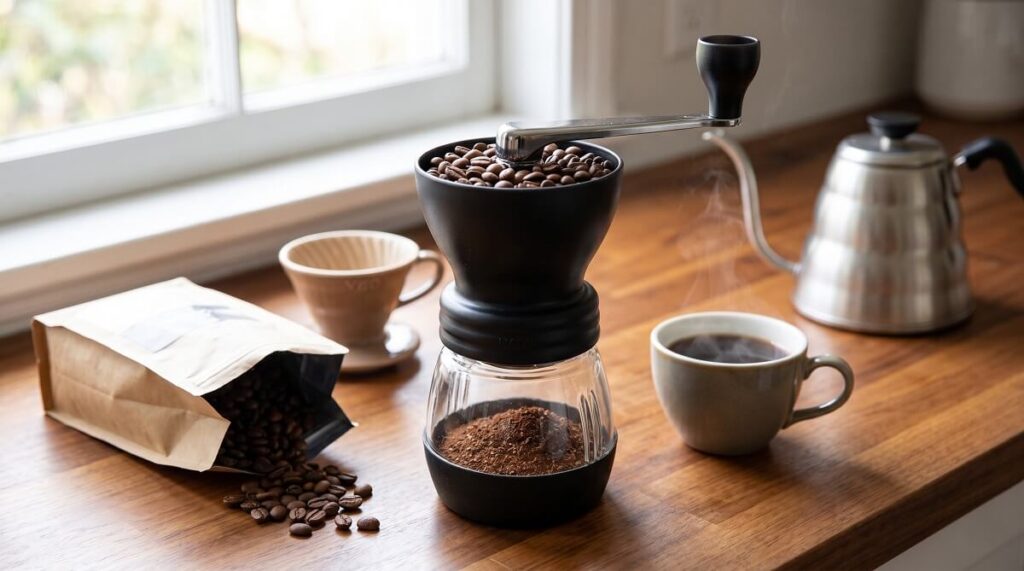
Freshly ground coffee shouldn’t require a three-figure electric grinder, yet many popular burr grinders run well over $100. Enter the Hario Skerton Pro Ceramic Coffee Mill—a manual grinder that delivers consistent ceramic burr grinding for a fraction of the cost. After analyzing more than 1,500 verified owner reviews, one thing becomes very clear: this hand-crank grinder has converted countless skeptics who never thought manual grinding could produce coffee this good. With a 4.6-star average across major retailers and owners reporting 2-5 years of daily use without issues, the Skerton Pro has earned its reputation as the go-to budget burr grinder. Here’s what real owners have to say.
Key Specifications at a Glance
| Specification | Details |
|---|---|
| Model Name | Hario Skerton Pro |
| Burr Type | Ceramic conical burr |
| Capacity | 100g whole beans (hopper), 120g ground coffee (jar) |
| Grind Settings | Stepless adjustment with audible clicks |
| Materials | Glass jar (made in Japan), ceramic burrs, plastic hopper |
| Jar Thread | Standard Mason jar compatible |
| Included Accessories | Silicone grip base, plastic storage lid |
| Grinding Speed | ~60-70 rotations for single cup (15-18g) |
| Best For | Pour-over, French press, drip coffee, Aeropress |
| Not Recommended For | Espresso (inconsistent at fine settings) |
| Retail Price | $45-$55 |
| Warranty | Standard manufacturer warranty |
What Real Owners Love About the Hario Skerton Pro
The overwhelming consensus from verified purchasers centers on four core strengths: consistent ceramic burr grinding that dramatically improves coffee quality, solid build quality with thick glass and durable components, easy disassembly for cleaning, and exceptional value compared to electric grinders. According to reviews collected from Amazon, where this model maintains a 4.6-star rating, customers consistently praise these qualities.
Consistent Grind Quality That Transforms Your Coffee
The single most repeated claim across reviews is that the Skerton Pro’s ceramic burr grinder produces remarkably even grounds compared to blade grinders. Gregory S Aubin, whose review 4 people found helpful, noticed the difference immediately: “The Hario mates up to the press pot and all the grounds slide in neatly. Most important: after your first grind you’ll wonder why coffee never smelled so good. I can grind very coarse and very fine, but the grinds are consistent.” He noted a dramatic reduction in sediment: “I use to have a fine sludge at the bottom of my cup. A lot. Turkish coffee lot. Now? Much reduced.”
Nathan confirmed the consistency advantage over blade grinders: “I had a blade grinder before this and my coffee beans would always end up in all different sizes. The Hario Skerton does an amazing job at giving you an even and equal grind.” According to HomeGrounds, the Pro version includes improved burr stabilization compared to earlier Skerton models, addressing the side-to-side wobble that plagued the original design.
Beverly, who tested at least 5 other grinders, wrote enthusiastically: “I have been looking for a burr type coffee grinder and have tried at least 5 others — all of which were much more expensive and electric and none of them were all that great. The Groundwork coffee company where I order my coffee beans recommended this Hario and I am so delighted they did. It is perfect! My search for the perfect coffee grinder is finally over.” Her review earned 5 helpful votes from other buyers.
Solid Build Quality That Inspires Confidence
The Skerton Pro’s construction quality stands out in its price range. AK Music Lover, whose review one person found helpful, praised the materials: “The grinder has a nice sturdy feel to it. The base is fairly thick clear glass with no bubbles or defects. and the rubber base thing keeps the unit firmly in place on the counter while grinding.” Mandy echoed this assessment after choosing the Pro over cheaper imitations: “I was motivated by the idea of a stronger glass bowl and ceramic grinding implements that would withstand the stresses of regular use.”
According to Coffee Chronicler, the Skerton Pro represents a significant upgrade over the original model with “improved burr stabilization, a redesigned handle with better leverage, and a larger grinding capacity.”
Nathan highlighted the thoughtful details: “All the parts are incredibly solid and come apart easy for cleaning and storage. Every part of this grinder is made with quality and I see it lasting a very long time. It even gives you little extras, like the rubber boot for grinding on a hard surface, or a plastic cap to keep your grounds stored.”
Easy to Disassemble and Clean
The Skerton Pro’s tool-free disassembly earns consistent praise from owners who value easy maintenance. Paul Gush, whose review 5 people found helpful, appreciated the engineering: “It can be completely disassembled without any tools – no cheesy and irreversible snap fits. So, it’s easy to clean and replace parts, should the need ever arise. The threads of the jar are big enough that some coffee grounds won’t foul them.”
Cat Sunshine found cleaning straightforward: “It is very easy to remove the moving parts for cleaning and just as easy to put them back in order.” Stephen J confirmed: “It’s very easy to take apart and clean.” This matters for coffee quality, as oils and residue from previous grinds can affect flavor over time.
The standard Mason jar threading provides unexpected flexibility. According to multiple reviews, if you break or lose the included glass jar, any standard-mouth Ball or Mason jar screws right on. Amazon Customer confirmed: “The grinder part fits a standard size mason jar perfectly, so if the glass receptacle is too small just grab a jar and screw it on.”
Great Value for Pour-Over and French Press
For medium to coarse grinds, owners consistently report the Skerton Pro punches well above its price point. BillyWilliams, whose review 16 people found helpful, did extensive research before purchasing: “After reading comments and watching video reviews, I chose to go with the hario skerton pro. I mainly use a french press and it grinds the beans very well. The consistency of the grinds is perfect. Was looking to remove as much of the fine sediment as possible. With my electric grinder I feel made the grinds too fine even when set to coarse. The hario has significantly reduced the sediment.”
Mike M summarized the value proposition after a year of use: “Hario makes a decent product for a great price – cheap doesn’t mean bad here. The conical burrs work great, often times people even upgrade them but I haven’t seen any reason over the past year to do that. The large hopper allows you grind about 50 grams of beans, which, to me, was the most important aspect, because normally I brew a Chemex and my recipe calls for that much coffee.” His review earned one helpful vote.
According to TechGearLab, the Skerton Pro delivers “powerful air cleaning at a fraction of the cost of many units we tested,” making it an ideal entry point for those upgrading from blade grinders or pre-ground coffee.
Grind Adjustment with Audible Clicks
The Pro version’s improved adjustment system addresses a major complaint from the original Skerton. Mike In San Diego, whose review 2 people found helpful, appreciated the functionality: “Grinder is easy to use, I needed one that I could adjust the grind without having to use an electric one. The grind comes out perfect for my percolator. If I needed a finder grind, just a few adjustments and its ready to go. I like that they include a lid to cap off the bottom jar so I can grind in advance.”
Cat Sunshine explained the mechanism: “Adjusting for grind size is simple – you can hear the clicks as you turn the knob.” pulpfictionfan, whose review 2 people found helpful, clarified a common misconception: “It is NOT true that you have to keep it in the same position if you want to keep the grind the same consistently, all you have to do is count how many times you turn the nut underneath and then you can change the grind settings manually that way. If you can count, you can change the grind settings, that easy. It actually clicks into a setting so that is all you have to count.”
Perfect for Travel and Off-Grid Coffee
The manual operation makes the Skerton Pro ideal for camping, travel, and power outages. pulpfictionfan loved the portability: “I took this on a camping trip and I was so happy to be able to ‘rough it’ and still have good coffee!” Gregory S Aubin highlighted another advantage: “If I go camping, I can bring it – I wouldn’t bring a plug in appliance camping – especially the noise.”
Brad M. Watkins summed up the travel appeal: “Now I have fresh ground coffee everywhere. This is a sturdy beast that I can throw in my backpack and literally have everywhere. I store the beans in the glass portion in a Ziploc bag so it’s very compact and easy to take with me everywhere. I don’t leave home without it.”
Common Complaints and Concerns
No manual grinder is perfect, and analyzing negative feedback reveals several recurring issues that prospective buyers should weigh before purchasing.
Manual Grinding Takes Time and Effort
The most common complaint involves the physical effort required, especially for larger quantities. dcl, whose review 8 people found helpful, bought the grinder with enthusiasm but struggled with daily use: “The amount of handle turning necessary has turned out to be a strong deterrent to using it. I got most of the way through a bag of beans, then started buying ground coffee again. At first, with a coarse grind for french press, it was okay. Doing a slightly finer than regular grind for the italian coffee maker was simply that, a morning grind.”
Nathan acknowledged the effort: “The only downside is it does take a little muscle to grind. You do a lot of spinning to get a few tablespoons of grounds and a bean can catch it just right and add some extra resistance. For the money you can’t really do better – but know that the hand grinding option will take more effort than pushing a button.”
According to Sip Coffee House, grinding 20 grams of beans takes approximately 60-70 seconds at medium settings. For reference, amiko confirmed: “A standard measure of beans takes about 60-70 rotations (depending on how fine it’s set) to completely grind.”
Chad Fillingim offered a creative solution for cold brew grinding: “If you’re looking to create Cold Brew, it requires a lot of coarse grind. At which point I hook my power drill up where the handle goes and get after it for about 10 mins.” Harold P. Fultz, Jr., whose review 2 people found helpful, provided drill guidance: “At home, I attach a battery operated hand drill. Works great, but run slowly to avoid generating heat. MAKE SURE YOUR DRILL IS SET TO ROTATE IN THE CORRECT DIRECTION as per the included instructions. If it is not, you may end up destroying your grinder.”
Not Ideal for Espresso
While the Skerton Pro can grind fine enough for espresso, consistency suffers at the finest settings. According to Bean Ground, the grinder “lacks consistency when grinding on a coarse setting” and isn’t recommended for espresso despite being capable of fine grinds.
A, who uses the Skerton Pro with an Aeropress, v60, and moka pot, noted the limitation: “Not unexpectedly, it does output enough fine particles that espresso grinding was not an option, it’d either choke the machine or be too coarse (I have a Gaggia Classic, my usual grinder with it is a Gaggia MDF). So I use it almost daily as a secondary grinder for pour over.”
Mike M, who tested espresso grinding with a Flair Pro 2, was “actually surprised at how fine this can grind” but noted the grind “getting a little wonky the coarser you get.”
Silicone Base Doesn’t Stay Attached
Multiple owners mention the rubber base sleeve slipping off during use. Cat Sunshine noted: “The silicone grip on the bottom of the glass cup does come off easily, but I do like it as a little more protection as you grind on a table or counter top.” Paul Gush was more blunt: “The rubber grip on the bottom easily falls off, but it isn’t needed anyway.”
C. Barcome’s recent review echoed this: “Works very well but the silicone bottom falls off easily.” amiko’s wife found it created a usability issue: “My wife has small hands and claims it’s difficult to hold in one hand and grind with the other…a problem easily rectified by sitting the jar on a flat surface while grinding.”
Grind Adjustment Has No Visual Markers
While the Pro version includes audible clicks, it lacks visual grind size indicators. Dana noted: “The only thing is the grind size adjustment doesn’t have any type of marking so if you want 2 different sizes of grind for different types of coffee making (say, pour-over and french press) you need to make sure you remember which one you used last and how many clicks you adjust it from there. Not a big deal though.”
AK Music Lover explained the adjustment process: “Adjustment of the grind size requires the base to be removed and the bottom nut advanced or retarded to close or open the gap between the grinding faces, and there is no grind size guide other than your best guess based on that gap.”
Occasional Bean Bridging Requires Shaking
Some owners report beans occasionally get stuck in the hopper instead of feeding into the burrs. Becca noted: “Yes I do have to stop frequently to shuffle or push the little beans down to the cone, but it is awesome, and works GREAT!” Nuthatch had a different experience: “Instructions say it will need a shake now and then, but I only needed to do so once, and that was the first time I used it. Never since.”
Who Should Buy the Hario Skerton Pro?
This grinder delivers exceptional value for specific use cases while falling short for others. Here’s who benefits most:
Buy It If You:
- Make 1-2 cups of pour-over, French press, or drip coffee daily
- The Skerton Pro excels at medium to coarse grinds for these brew methods. Cat Sunshine praised it for French press: “The best and #1 reason why I bought this grinder is that it can hold more beans than a normal manual grinder – I can grind all the beans I need for my french press in one go.”
- Want to upgrade from a blade grinder on a budget
- Beverly’s experience says it all: “I have been looking for a burr type coffee grinder and have tried at least 5 others — all of which were much more expensive and electric and none of them were all that great. My search for the perfect coffee grinder is finally over.”
- Travel, camp, or need a grinder for power outages
- Brad M. Watkins uses his everywhere: “This is a sturdy beast that I can throw in my backpack and literally have everywhere.”
- Enjoy the ritual of manual coffee preparation
- Ryan & Val captured the meditative appeal: “Only takes a few minutes and adjusts easily. I am at one with my coffee process from first grind to first sip!” Gregory S Aubin agreed: “The clean crunch and smooth operation makes it a bit meditative.”
Don’t Buy It If You:
- Make espresso regularly
- According to Coffee Chronicler, the Skerton Pro “still lacks consistency when grinding on a coarse setting” and isn’t suitable for espresso despite being able to grind fine enough.
- Grind for multiple people or large batches
- dcl’s experience illustrates the limitation: “To use-up the bag of beans I left the grinder on the counter all day, giving it sessions of a few minutes at a time such that, by the next morning, I had enough to make that essential cup of java.”
- Have hand strength or endurance issues
- T. Stanley warned: “It takes me 2-4 minutes to grind the coffee for the above portions and if you do not have good hand endurance you will get tired and may get a cramp in one of your hands.”
- Want the fastest possible grinding
- Stephen J noted: “It is a bit of a workout to use. My hands hurt a bit when I was done grinding, but I imagine it will get easier with time.” For those prioritizing speed and convenience, an electric grinder makes more sense.
Final Verdict
The Hario Skerton Pro Ceramic Coffee Mill delivers on its core promise: consistent burr grinding at an accessible price point. For pour-over enthusiasts, French press devotees, and anyone making 1-2 cups daily, this grinder provides a massive upgrade from blade grinders or pre-ground coffee without the $100+ investment of electric burr grinders. The ceramic burrs produce even grinds, the tool-free disassembly simplifies cleaning, and the thick glass construction inspires confidence in long-term durability.
The manual operation is both the Skerton Pro’s defining feature and its primary limitation. Those who embrace the ritual find it meditative and satisfying—a few minutes of intentional preparation before enjoying exceptional coffee. Those grinding for multiple people or larger batches will find the effort quickly becomes tedious. The grinder works best within its sweet spot: 15-30 grams of beans ground at medium settings for single-serve brewing methods.
At its typical $45-55 price point, the Skerton Pro represents exceptional value for the right user. Beverly tried five other grinders—all more expensive—before finding satisfaction with the Hario. Gregory S Aubin ditched his noisy electric burr grinder and hasn’t looked back. If you’re ready to slow down, grind fresh for every cup, and discover what your coffee beans actually taste like when ground consistently, the Hario Skerton Pro is ready to convert you too.